Teething Amber Beads: A Safety-First Guide for Parents

The short answer: teething amber beads have no proven therapeutic benefit, and both the American Academy of Pediatrics and the FDA have issued clear warnings about the strangulation and choking hazards they present. If your child is wearing one right now, here is what to do immediately:
- Remove the necklace before any nap or overnight sleep. No exceptions.
- Never leave your child unsupervised while wearing any amber jewelry.
- Consider switching to a bracelet or anklet worn on the wrist or ankle instead of the neck, which reduces strangulation risk.
- Inspect the cord and clasp today. Frayed cord, loose beads, or a clasp that does not snap open easily are grounds to retire the piece.
If you have weighed the evidence and still intend to purchase, Baltic Secret offers certified Baltic amber pieces with child-size options and documented safety features. The buying checklist further in this guide will tell you exactly what to look for.
Pro Tip: Before putting any amber piece on a child, pull the cord firmly from both ends. If it does not break or the clasp does not release under moderate tension, it does not meet the basic safety standard for children’s jewelry.
Table of Contents
- What do sellers claim amber beads do for teething?
- What does the clinical evidence actually say?
- What are the real safety risks of amber teething jewelry?
- What are the safer ways to soothe a teething baby?
- If you still choose amber, follow this checklist
- How do you buy authentic Baltic amber and what features matter?
- How long do amber beads last, and how do you care for them?
- Key Takeaways
- The honest position on amber teething jewelry
- Certified Baltic amber for children, shipped to the U.S.
- Useful sources and further reading
What do sellers claim amber beads do for teething?
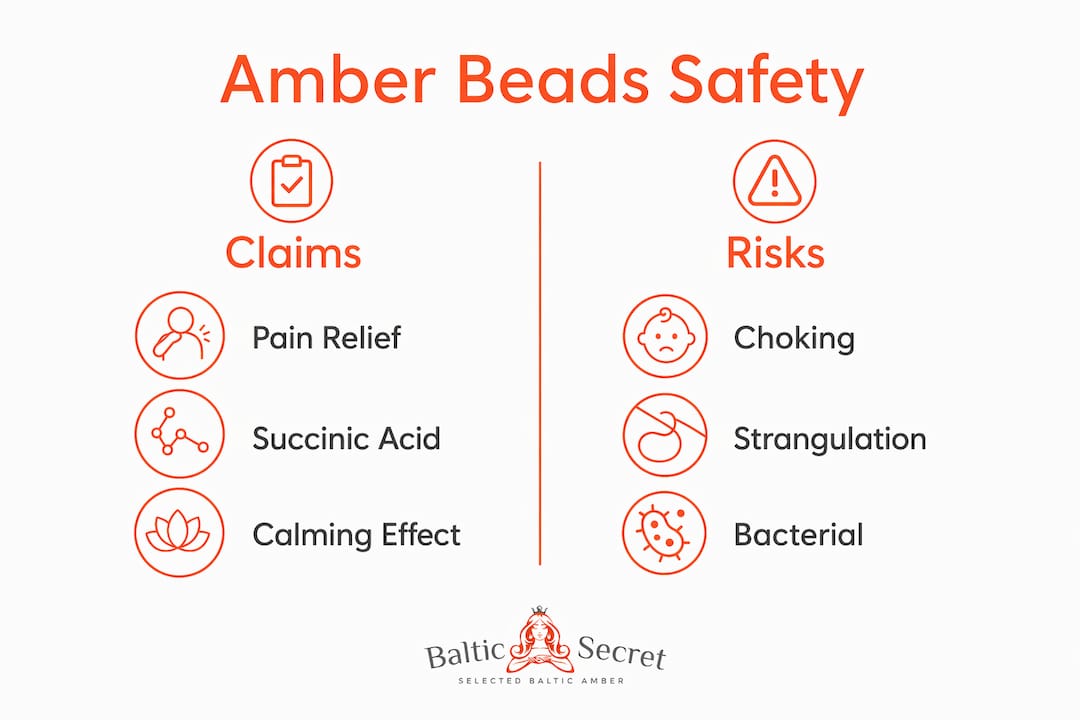
The marketing around amber teething necklaces centers on one main idea: that Baltic amber contains succinic acid, and that body heat releases this compound through the skin, producing anti-inflammatory and analgesic effects. Sellers typically present a cluster of related claims:
- Succinic acid is absorbed transdermally when the warm skin contacts the bead.
- The absorbed compound reduces inflammation and dulls teething pain.
- Amber stimulates the thyroid gland, which sellers claim reduces drooling and redness.
- Continuous wear is necessary for the effect to build up over time.
- Some vendors also cite a sensory-stimulation angle: that the texture and weight of the beads provide calming proprioceptive feedback.
These claims are presented as though they follow naturally from the fact that succinic acid exists in Baltic amber. The leap from “amber contains this compound” to “wearing amber delivers a therapeutic dose” is where the evidence falls apart, as the next section explains.
The appeal is real. Parents dealing with a miserable, drooling infant at 2 AM are not looking for a clinical trial. They want something that feels natural, safe, and backed by generations of use. That emotional logic is exactly why these products sell, and why the gap between the marketing and the science deserves a clear look.
What does the clinical evidence actually say?
No published clinical study has demonstrated that wearing an amber teething necklace reduces infant teething pain. That is not a hedged position. It is the conclusion of integrative literature reviews that examined the full body of available research and found insufficient evidence of therapeutic benefit alongside consistent documentation of safety risks.
The succinic acid mechanism is the most testable claim, and it has been tested. A BMC Complementary Medicine and Therapies study measured succinic acid content in Baltic amber beads at roughly 1.44% by weight per bead, then tested whether intact beads released any of it under skin-relevant conditions: a pH 5.5 buffer solution and an organic solvent at 37°C (body temperature). Intact beads released no measurable succinic acid. Only beads that physically fragmented released trace amounts. The mechanism sellers describe does not occur with whole, intact beads at body temperature.
Regulatory bodies have taken notice. Authorities including the FDA have warned parents about teething jewelry and have pushed back against unsupported therapeutic claims. The AAP position is direct: infants should not wear jewelry, and amber necklaces provide no proven teething benefit.
One nuance worth naming: some parents genuinely report that their baby seems calmer while wearing amber. Healthcare providers point out that this is likely a caregiver effect. When a parent feels they are doing something helpful, their own stress decreases, and a calmer caregiver creates a calmer infant. That is a real and meaningful dynamic. It is just not a pharmacological action from the amber itself.
What are the real safety risks of amber teething jewelry?
The risks are not theoretical. The FDA has received reports of infant deaths and serious injuries linked to teething jewelry, including amber necklaces. Here is what the hazard profile looks like:
- Strangulation. A necklace can catch on a crib rail, toy, or piece of furniture and tighten around an infant’s neck within seconds. This is the highest-severity risk.
- Choking. If a bead breaks free, it is exactly the size and shape to lodge in an infant’s airway.
- Clasp failure. Many amber necklaces are marketed with “breakaway” clasps, but consumer testing under ASTM standards found that a significant number of necklaces did not open at standard tension thresholds. The breakaway protection may not work when it matters.
- Tourniquet risk. Bracelets and anklets can restrict circulation if they tighten, especially during sleep or active movement.
- Bacterial colonization. Studies have found multiple bacterial species on amber necklaces worn by children. Most are non-pathogenic in healthy infants, but the risk is higher for immunocompromised babies or those with skin breaks near the necklace.
“Teething necklaces and bracelets pose a strangulation risk and a choking hazard. The FDA has received reports of deaths and injuries to infants and children caused by teething jewelry.” — Nationwide Children’s Hospital
The strangulation and choking hazards are immediate and serious. Bacterial colonization is a lower-probability risk but becomes more relevant if the necklace is shared between children or rarely cleaned.
Pro Tip: Hold the clasp between two fingers and pull the cord away from it with moderate force. If the clasp does not release, or if any bead moves along the cord, the piece does not meet basic child-safety construction standards. Retire it.
What are the safer ways to soothe a teething baby?
Pediatricians have a short list of approaches that are both effective and safe. None of them involve jewelry.
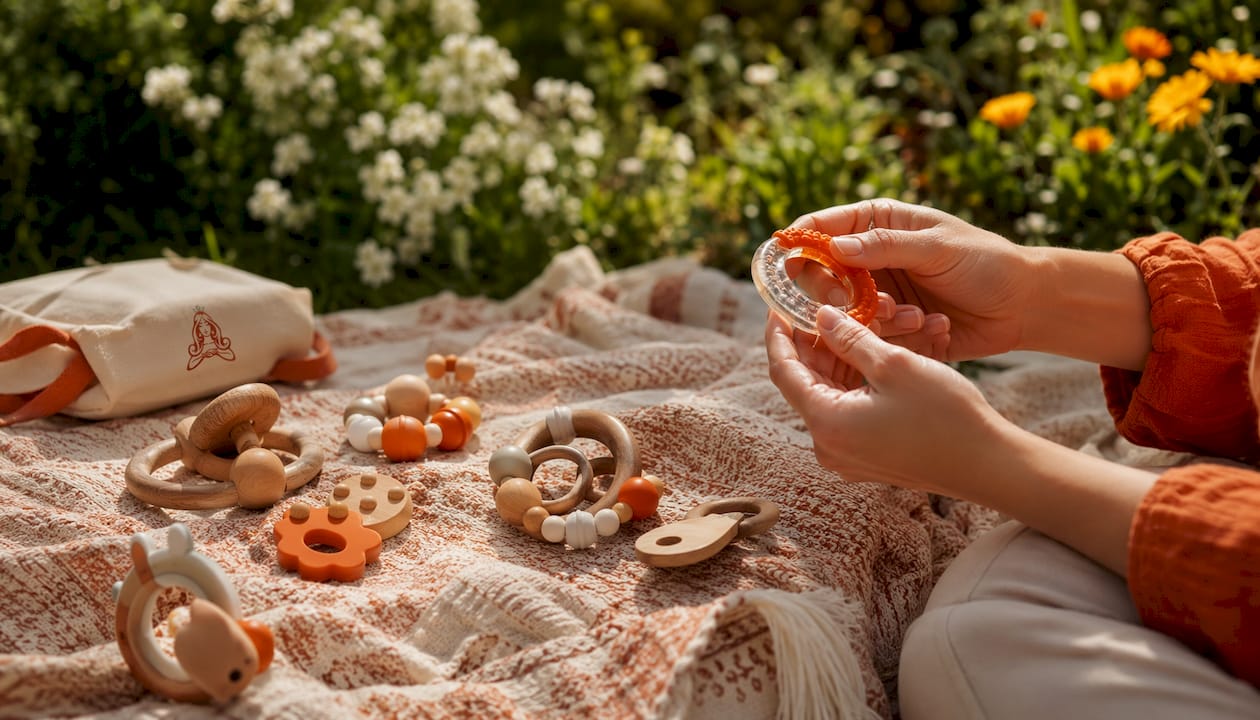
- Chilled teether (not frozen). A refrigerated silicone teether gives counter-pressure on the gum and a mild numbing effect from the cold. Frozen teethers are too hard and can bruise gum tissue.
- Cold, damp washcloth. Chill a clean washcloth in the refrigerator, then let your baby chew on it under supervision. Simple, free, and effective.
- Gum massage. A clean finger pressed firmly against the gum provides counter-pressure that many infants find immediately calming.
- Age-appropriate analgesics. For infants over 6 months, acetaminophen (Tylenol) or ibuprofen (Motrin, Advil) at the correct weight-based dose is the most evidence-backed option for pain relief. Always confirm the dose with your pediatrician.
- Distraction. A new toy, a change of scenery, or skin-to-skin contact can interrupt the pain cycle more effectively than parents expect.
A few things to avoid: topical benzocaine gels (sold as teething gels) are not recommended for infants under 2 years. The FDA has warned that benzocaine can cause methemoglobinemia, a condition that reduces the blood’s ability to carry oxygen. Homeopathic teething tablets have also drawn FDA warnings for inconsistent belladonna content. Stick to the physical approaches above and, when pain is clearly significant, a weight-appropriate dose of acetaminophen.
Call your pediatrician if teething symptoms seem unusually severe, if your baby has a fever above 100.4°F, or if you notice swelling, redness, or signs of infection around the gums.
If you still choose amber, follow this checklist
The safest choice is not to use amber teething jewelry at all. If you have considered the evidence and still decide to proceed, these rules reduce risk as much as possible.
Wear rules:
- Never worn during sleep, including naps. Remove it every time.
- Never worn without a supervising adult in the same room, eyes on the child.
- Use a bracelet or anklet worn on the wrist or ankle, not a necklace around the neck.
- Remove during any activity where the cord could catch: playtime in a crib, high chair use, car seat.
- Inspect before every single use. If anything looks wrong, do not put it on.
Construction checklist before purchase:
- Screw clasp or a tested breakaway clasp that releases under low tension.
- Individual knots between every bead so a broken cord does not scatter all beads at once.
- Beads small enough that they cannot block an infant’s airway if swallowed.
- Smooth, polished beads with no sharp edges.
- Certificate of origin confirming the amber is genuine Baltic succinite from the Baltic region.
“When parents still choose to use amber jewelry, major pediatric advisories are consistent: remove the item during sleep, never leave the child unattended while wearing it, and consider wrist or ankle placement rather than the neck.” — Integrative review consensus, PMC
Age guidance: No amber jewelry is recommended for infants under 3 months. For older infants, the AAP’s general position is that infants should not wear any jewelry. If you proceed, the supervision and removal rules above are non-negotiable, not suggestions.
How do you buy authentic Baltic amber and what features matter?
If you are buying, construction and safety features matter far more than the seller’s therapeutic claims. Here is what to verify before purchasing any amber teething jewelry.
Authenticity checks:
- Ask for a certificate of origin confirming the amber is Baltic succinite (not resin, copal, or plastic).
- Genuine Baltic amber is warm to the touch, lightweight, and slightly translucent. Resin fakes often feel heavier or have a uniform, too-perfect appearance.
- Raw amber has a matte, irregular surface. Polished amber has a smooth sheen. Both are genuine; dyed beads with unnaturally uniform color (including some marketed as green Baltic amber) should come with documentation of natural color origin.
- Request a lab report or certificate if you have any doubt. Reputable sellers can provide documentation.
Construction features to require:
- Individual knots between every bead.
- Screw clasp or a breakaway clasp with documented tension testing.
- Child-appropriate bead size (small enough to pass a choke-tube test if you have one available).
- Recommended necklace length for children is typically around 33 cm (13 inches), short enough to not loop or catch easily.
Baltic Secret sources its amber directly from Lithuania and provides certified Baltic amber with child-size options. Their handcrafted children’s necklaces and bracelets include knotted construction and size guidance on the product pages. When evaluating any purchase, use those product pages as a reference for what documented safety features should look like.
Pro Tip: Ask the seller to show you a photo of the raw bead surface before polishing. Genuine Baltic amber has a characteristic rough, irregular outer crust (called cortex). Resin fakes are cast in molds and lack this natural surface variation.
How long do amber beads last, and how do you care for them?
With careful handling, a well-made amber piece can last for years. What shortens the lifespan faster than anything else is chemical exposure: perfume, sunscreen, chlorine, and alcohol-based products all degrade amber’s surface and can weaken the cord over time.
Cleaning:
- Wipe beads with a soft, dry cloth after each wear.
- For a deeper clean, use lukewarm water and a very mild soap, then dry immediately with a soft cloth.
- Never soak amber in water, and never use alcohol, acetone, or commercial jewelry cleaners.
Storage:
- Keep amber in a soft pouch or a lined compartment, away from other jewelry that could scratch the surface.
- Avoid direct sunlight and heat sources, which can cause discoloration and surface cracking over time.
Inspection and replacement:
- Check the cord for fraying, stretching, or discoloration before every use.
- Check each knot between beads. A knot that has loosened or shifted means the cord has been stressed.
- Check the clasp for smooth operation. Any stiffness or resistance in a screw clasp, or a breakaway clasp that no longer snaps cleanly, is a replacement signal.
- Replace the piece immediately if any bead is chipped, cracked, or has a sharp edge.
There is no fixed replacement schedule, but a piece worn daily by an active toddler will show wear faster than one used occasionally. When in doubt, replace it.
Key Takeaways
Amber teething beads have no clinically proven benefit, and the strangulation and choking risks are documented and serious. If you still choose to use them, strict supervision and removal during sleep are non-negotiable.
| Point | Details |
|---|---|
| No proven benefit | Lab studies show intact amber beads release no measurable succinic acid at body temperature. |
| Documented safety risks | The FDA has received reports of infant deaths and injuries linked to teething jewelry, including strangulation and choking. |
| Safer alternatives exist | Chilled teethers, cold washcloths, gum massage, and age-appropriate acetaminophen are all evidence-backed options. |
| Strict rules if you proceed | Remove during every sleep, never leave unsupervised, use bracelet or anklet instead of necklace, inspect before each wear. |
| Baltic Secret as a source | If purchasing, Baltic Secret offers certified Lithuanian amber with knotted construction and child-size options. |
The honest position on amber teething jewelry
There is a tension at the center of this topic that most articles gloss over. Baltic Secret sells amber teething jewelry. The clinical evidence says it has no proven therapeutic benefit and carries real physical risks. Both of those things are true, and pretending otherwise would not serve you.
What the evidence actually shows is that the harm-reduction framework matters more than the yes/no purchase decision. Parents who use amber jewelry with strict supervision, proper construction, and a removal-during-sleep rule are in a meaningfully different risk category than parents who leave a necklace on a sleeping infant. The product is not the whole story. How it is used is.
Baltic Secret’s position is that parents deserve the full picture: the evidence on succinic acid release, the AAP and FDA guidance, the construction features that reduce risk, and the alternatives that carry no jewelry-related hazard at all. The brand sources directly from Lithuania, provides certificates of origin, and builds child-size pieces with knotted cords and safety clasps.
The brand lists these products because parents will seek them out regardless, and a well-constructed, certified piece from a transparent source is a better outcome than an uncertified one from a marketplace with no safety documentation. That is not a rationalization. It is the honest reason.
Certified Baltic amber for children, shipped to the U.S.
Parents who have read this guide and decided to purchase deserve a source that does not hide behind vague claims. Baltic Secret’s children’s amber necklaces and bracelets are handcrafted from certified Lithuanian Baltic amber, with individual knots between every bead, child-appropriate sizing, and screw clasp options. Every piece comes with documentation of amber origin.
The U.S. store at balticsecret.com carries both polished and raw amber options in child sizes, with full product descriptions covering construction, bead size, and care. Before you order, review the safety checklist in this guide, confirm the clasp type on the product page, and remember the one rule that matters most: remove it before your child sleeps.
Useful sources and further reading
These are the primary sources behind the guidance in this article. For any medical decision, consult your pediatrician directly.
- FDA Safety Warning on Teething Jewelry — The FDA’s official press announcement warning parents about deaths and injuries linked to teething necklaces and bracelets.
- AAP / HealthyChildren.org on Amber Teething Necklaces — The American Academy of Pediatrics’ parent-facing guidance on why infants should not wear jewelry.
- PMC Integrative Review: Risks vs. Benefits — A peer-reviewed literature review covering therapeutic evidence, safety incident data, and ASTM testing of amber necklace clasps.
- BMC Complementary Medicine and Therapies: Succinic Acid Leaching Study — The laboratory study measuring succinic acid content and release from intact Baltic amber beads under skin-relevant conditions.
- Nationwide Children’s Hospital: Dangers of Amber Teething Necklaces — Clinical patient-education page summarizing choking and strangulation hazards with practical parent guidance.
- CPSC SaferProducts.gov — The U.S. Consumer Product Safety Commission’s incident reporting database, where you can search for reported injuries from children’s jewelry and file a report if your child is injured.
This article provides general information for educational purposes. It is not a substitute for advice from your child’s pediatrician or a qualified medical professional. Always confirm current guidance with your child’s doctor before making decisions about teething pain management.
Recommended
- Amber Bracelet vs Necklace for Toddlers: Safety Guide – Baltic Secret
- Teething Necklace Size Guide for Babies: Stay Safe – Baltic Secret
- Best Amber Teething Necklace for Babies — What Parents Need to Know | Balticsecret – Baltic Secret
- Premium Amber Teething Necklace & Bracelet for Babies / Polished / Mul – Baltic Secret