Choosing Amber Bracelet Toddler Size: A Parent's Guide
Choosing an amber bracelet toddler size means finding a fit that is snug enough to stay secure but loose enough to avoid restricting circulation or causing discomfort. The right fit is the single most important factor in making amber jewelry safe for daily wear on a toddler’s wrist. Resources like the In Season Jewelry sizing chart and products from Binnie Beads confirm that most toddler wrists fall in the 12 to 15 cm range, and that one-finger clearance between the bracelet and skin is the gold standard. Get the size wrong in either direction, and you trade comfort for risk.
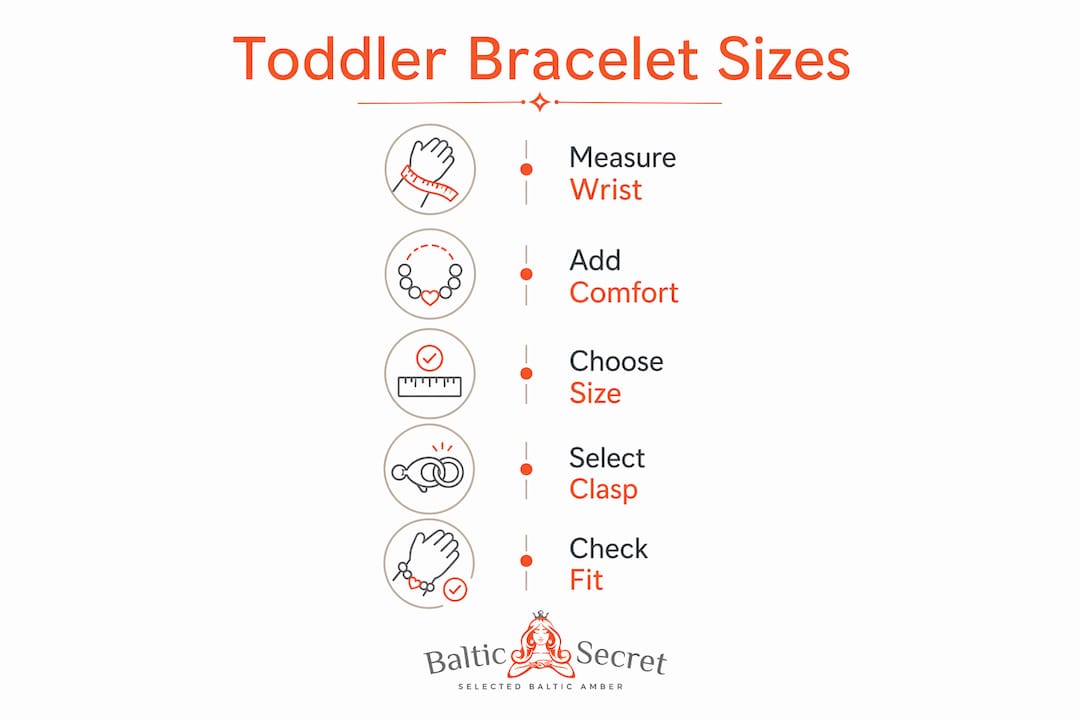
How to measure your toddler’s wrist for amber bracelet sizing
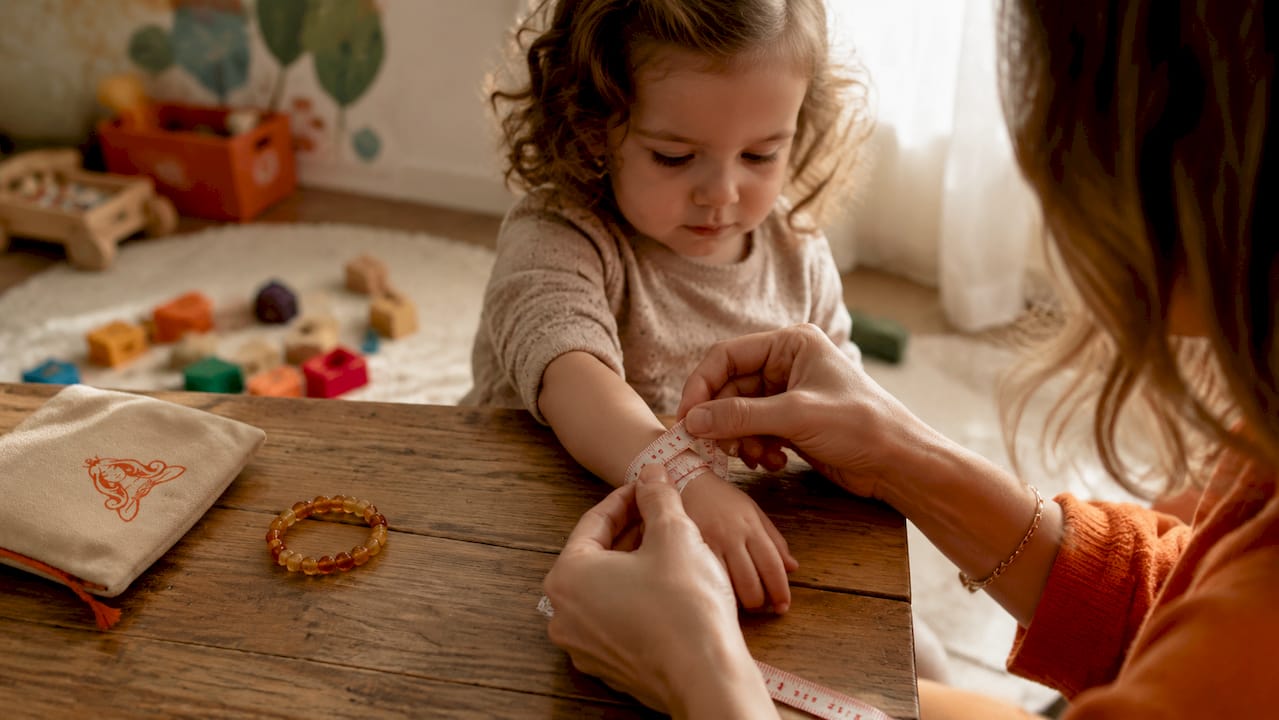
Accurate measurement is the foundation of every good amber bracelet fitting guide. Toddlers rarely hold still, so your technique matters as much as your tools.
Step-by-step measuring method
- Gather your materials. Use a soft fabric measuring tape or a piece of non-stretch string and a ruler. Never use a metal tape measure on a toddler’s wrist.
- Choose the right moment. Measure when your child is calm, seated, and distracted with a toy or snack. A squirming toddler produces an inaccurate reading.
- Find the measurement point. Wrap the tape or string around the wrist just below the wrist bone, where the bracelet will actually sit.
- Record the circumference. Note the number in centimeters. If you used string, lay it flat against a ruler.
- Add the comfort allowance. Add 2 to 2.5 cm to the raw measurement to account for comfortable movement and minor growth. This allowance keeps the bracelet from pinching without making it loose enough to slide off.
- Verify with the one-finger test. Once you have a target size, confirm it by checking that one small finger fits between the bracelet and the wrist. That gap is the safety benchmark used by most reputable amber jewelry makers.
What average toddler wrist measurements look like
Most toddlers between 12 and 36 months have a wrist circumference of roughly 11 to 13 cm. After adding the comfort allowance, the target bracelet length lands between 13 and 15.5 cm. These numbers align with the standard “baby” sizing offered by brands like Binnie Beads, whose flagship bracelet measures 15 cm in total length. Knowing this range helps you filter out products that simply do not come in appropriate sizes for young children.
Pro Tip: Measure your toddler’s wrist twice on the same day, once in the morning and once in the afternoon. Slight swelling from activity can add a few millimeters, and averaging the two readings gives you a more reliable target size.
What are the standard sizes for toddler amber bracelets?
Toddler amber bracelet sizes follow a narrower range than adult jewelry, and understanding the options prevents you from accidentally ordering a bracelet designed for an older child or an adult.
Common size ranges and what they mean
The table below compares the most common toddler bracelet sizes you will encounter when shopping for amber jewelry for children.
| Size label | Typical length | Best fit for |
|---|---|---|
| Newborn / Infant | 12 to 13 cm | Babies under 6 months |
| Baby | 14 to 15 cm | 6 to 18 months |
| Toddler | 15 to 16 cm | 18 months to 3 years |
| Small child | 16 to 17 cm | 3 to 5 years |
The baby size at 15 cm is the most commonly purchased for children in the 12 to 18 month window. That size point matters because it is where many parents first introduce amber jewelry during the peak teething phase. Buying one size up from the measured fit is a reasonable strategy if you expect the bracelet to be worn for more than a few months.
Elastic vs. screw clasp bracelets
The closure type affects both fit and safety in ways that pure length measurements cannot capture. Elastic bracelets are flexible and easy to slip on and off, which makes daily wear practical. Screw clasp bracelets, by contrast, can be adjusted to a precise fit and are harder for a toddler to remove independently. For parents prioritizing security over convenience, a screw clasp is the stronger choice. Elastic styles work well when the measured fit is accurate and the bracelet is not worn unsupervised.
Bead size also plays a role. Smaller beads, typically 4 to 6 mm in diameter, sit closer together and create a more flexible bracelet that conforms to the wrist. Larger beads add weight and rigidity, which can make the bracelet feel bulky on a small wrist. Most toddler-specific amber bracelets use beads in the 4 to 5 mm range for this reason.
Pro Tip: If you are buying a bracelet as a gift and cannot measure the child’s wrist directly, choose an adjustable bracelet style or select the next size up within the toddler range. A slightly larger bracelet with a secure clasp is safer than one that is too tight.
Tips for balancing fit, safety, and comfort
The best amber bracelets for toddlers combine the right length with specific safety construction features. Size alone is not enough.
- Prioritize individually knotted beads. The safest amber bracelets are knotted before and after each bead. If the string breaks, only one bead can come loose rather than the entire bracelet scattering across the floor. This single construction detail separates quality amber jewelry from cheap alternatives.
- Remove the bracelet during sleep and bathing. Amber jewelry should not be worn overnight or in water. Sleep introduces entanglement risks, and prolonged water exposure weakens the string over time.
- Check the fit weekly. Toddlers grow fast. A bracelet that fit perfectly at 14 months may be noticeably tighter by 16 months. A weekly two-second check takes no effort and catches problems before they become safety issues.
- Watch for skin reactions. Genuine Baltic amber is hypoallergenic, but the string material or clasp metal can occasionally cause mild irritation. If you notice redness around the wrist, remove the bracelet and inspect the materials.
- Supervise all wear. Supervision is recommended whenever a child wears amber jewelry, regardless of how well it fits or how secure the clasp is. Safety features reduce risk; they do not eliminate it.
“A bracelet that’s too tight can feel uncomfortable, and one that’s too loose may slide off and get lost.”
This principle captures the entire fitting challenge in one sentence. Both failure modes, too tight and too loose, create real problems. The one-finger clearance rule keeps you in the safe zone between them.
Pro Tip: Review the amber jewelry safety guide at Balticsecret before your first purchase. It covers clasp types, bead knotting standards, and when to replace a bracelet, all in one place.
Common mistakes when choosing toddler amber bracelet sizes
Parents who are new to amber jewelry for children make a predictable set of sizing errors. Recognizing them in advance saves you a return shipment and, more importantly, keeps your child safe.
- Relying on age ranges alone. Age labels on amber bracelets are rough guides, not precise fits. A large 18-month-old and a small 2-year-old can have identical wrist measurements. Always measure the actual wrist before ordering.
- Buying too loose for comfort. A bracelet with more than one finger of clearance risks sliding off and becoming a choking hazard. Parents sometimes assume looser is safer. It is not.
- Ignoring growth between purchases. Toddler wrists grow roughly 0.5 to 1 cm per year on average. A bracelet bought at 12 months may be too tight by 18 months. Build in the 2 to 2.5 cm comfort allowance from the start, or plan to recheck sizing every few months.
- Choosing bracelets without safety knots. Cheap amber bracelets skip the individual bead knotting step to cut production costs. If the string breaks on an unknotted bracelet, every bead becomes a potential choking hazard. This is a non-negotiable safety feature, not an optional upgrade.
- Skipping the brand’s sizing chart. Different brands use different size labels. A “toddler” bracelet from one maker may measure 14 cm; from another, it may measure 16 cm. Always cross-reference the brand’s specific length in centimeters against your measured wrist size, not just the label.
Key takeaways
Choosing the right amber bracelet toddler size requires measuring the actual wrist, adding a comfort allowance, and selecting a bracelet with individually knotted beads and a secure clasp.
| Point | Details |
|---|---|
| Measure the wrist directly | Use a soft tape or string just below the wrist bone, then add 2 to 2.5 cm for comfort. |
| Target the 14 to 16 cm range | Most toddlers aged 12 to 36 months fit a bracelet between 14 and 16 cm in length. |
| One-finger clearance is the standard | You should fit exactly one small finger between the bracelet and the wrist for a safe, snug fit. |
| Knotted beads are non-negotiable | Individually knotted beads prevent bead scatter if the bracelet breaks, reducing choking risk. |
| Supervise all wear | No safety feature replaces active supervision when a toddler is wearing amber jewelry. |
What I’ve learned from watching parents size amber bracelets
Parents consistently underestimate how fast toddler wrists grow and overestimate how much a loose bracelet can be tolerated safely. I have seen parents buy a bracelet two sizes up thinking it will “last longer,” only to end up with a piece that slides to the elbow and catches on everything. The one-finger rule is not a suggestion. It is the line between a bracelet that works and one that creates a new hazard.
My honest recommendation: buy adjustable or buy the exact measured size. Do not guess. The measuring process takes under two minutes, and it removes nearly all the uncertainty from the purchase. If you are shopping for a gift, choose an adjustable bracelet rather than a fixed size. A bracelet that fits is a bracelet that gets worn safely.
— Baltic Secret
Find the right fit with Balticsecret’s toddler amber collection
Baltic Secret sources all amber directly from Lithuania and offers a curated range of child-safe amber bracelets built with individually knotted beads. Every piece is certified authentic Baltic amber, handcrafted to meet the safety standards parents need when choosing amber jewelry for children.

The Baltic Secret sizing guide walks you through wrist measurement, size selection, and clasp options so you can order with confidence. Customer support is available to help match your toddler’s measured wrist size to the right product. Browse the full children’s amber collection to find bracelets sized specifically for toddlers, with detailed length specifications listed for every product.
FAQ
What size amber bracelet fits most toddlers?
Most toddlers aged 12 to 36 months wear a bracelet between 14 and 16 cm in length. Always measure the actual wrist and add 2 to 2.5 cm for a safe, comfortable fit.
How do I know if an amber bracelet is too tight?
You should be able to fit one small finger between the bracelet and your toddler’s wrist. If you cannot, the bracelet is too tight and risks restricting circulation or causing skin irritation.
Are elastic or clasp amber bracelets safer for toddlers?
Screw clasp bracelets are generally more secure because they can be adjusted to a precise fit and are harder for toddlers to remove. Elastic styles work well when the fit is accurate and the child is supervised.
Should amber bracelets be worn during sleep?
No. Amber bracelets should be removed before sleep and bathing. Overnight wear introduces entanglement risks, and water exposure weakens the bracelet string over time.
Do I need individually knotted beads on a toddler amber bracelet?
Yes. Individually knotted beads are a critical safety feature. If the bracelet breaks, knotting prevents all beads from scattering at once, which significantly reduces the choking hazard for young children.
Recommended
- Infant Bracelet Size Guide: Measurements, Safety & Fit – Baltic Secret
- Premium Amber Teething Necklace & Bracelet for Babies / Polished / Mul – Baltic Secret
- Baltic Amber Teething Necklace Baby & Children | Balticsecret – Baltic Secret
- Amber Teething Necklace & Bracelet For Children / Extra Safe & Authent – Baltic Secret