28 of 32 Failed Safety Checks: Amber Bracelet Safety for Children

Amber bracelets carry real strangulation and choking risks for babies and toddlers, so pediatric and product safety guidance treats them as an item for supervised, older-child wear only, never for sleep or unsupervised play. Follow three rules if you choose one anyway: never let an infant wear one unsupervised, remove it during sleep and bathing, and buy from a seller that documents construction and safety details on the product page.
TL;DR:
- The safety risks from amber bracelets include strangulation, especially if caught on furniture or clothing, and choking if beads scatter upon clasp failure.
- Buyers should verify construction features such as breakaway clasps, bead knotting, and sturdy thread before purchasing, and ask sellers specific safety questions.
- Parents must remove amber jewelry during sleep, bathing, and unsupervised play to prevent hidden dangers from tightening or breakage.
- Using CE-marked silicone or wood teethers is safer than jewelry for teething relief, with a focus on tested, infant-approved materials.
- Responsible sellers provide transparent sourcing, sizing, safety warnings, and clear maintenance instructions to help parents make safe choices.
Table of Contents
- Gintaro Apyrankės Vaikams Saugumas: What the Risks Actually Are
- What Should You Check Before Buying an Amber Bracelet?
- How Should Parents Supervise a Child Wearing Amber?
- Are There Safer Alternatives for Teething Relief?
- How Does Baltic Secret Document Safety on Its Products?
- A Safety-First Editorial Note
- Choosing a Safer Amber Bracelet for Your Child
- Sources
- FAQ
Gintaro Apyrankės Vaikams Saugumas: What the Risks Actually Are
Amber jewelry for children sits in an odd category. It looks like a simple accessory, but it behaves like a small-parts product once a toddler starts pulling on it or a baby rolls onto it during a nap. The Lithuanian phrase gintaro apyrankės vaikams saugumas (amber bracelet safety for children) covers the gap between how the product is marketed and the safety considerations it requires.
Strangulation is the risk parents underestimate most. A bracelet or necklace can catch on a crib rail, a stroller buckle, or another child’s finger, and tighten in seconds. Supervision helps, but it can’t cover every second of a nap, a car ride, or the two minutes you spend answering the door. That’s the core argument against unsupervised wear at any age, and it’s why pediatric-safety guidance recommends removing amber jewelry the moment a child is out of direct sight.
Choking and ingestion come next. If a single knot fails or a clasp opens, beads can scatter and end up in a toddler’s mouth. Bead size and finish matter here: smaller, highly polished round beads are easier to swallow and harder to grip, while larger, irregularly shaped beads are marginally safer but still not risk-free.
Skin irritation is a smaller but real concern, especially with prolonged contact, moisture, or lower-quality polish work. And it’s worth separating the marketing from the evidence: succinic acid release and pain relief claims for amber are largely anecdotal, not clinically established.
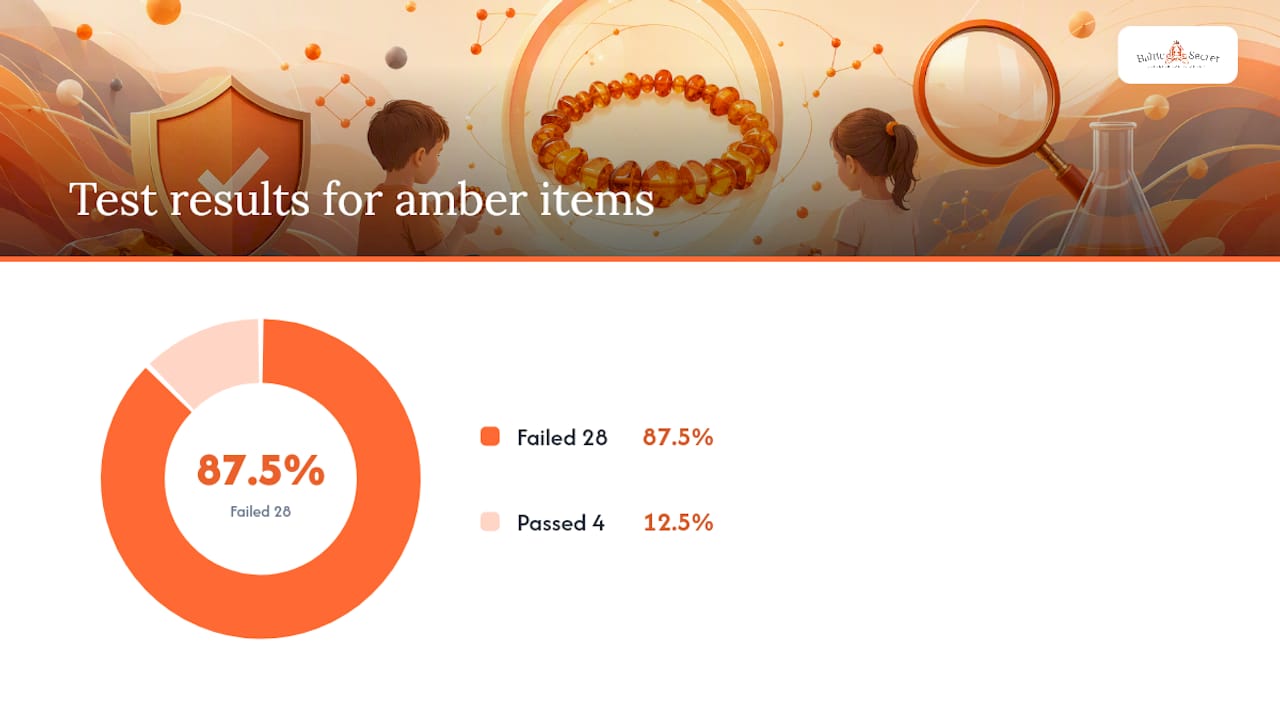
The scale of the labeling problem is bigger than most parents assume. A Tavovaikas tested 32 amber necklaces and bracelets sold for children and found that 28 failed to meet safety requirements, many without any age guidance or warning label at all.
That means the burden falls on you, the buyer, to check what the seller hasn’t.
- Strangulation risk from catching on furniture, cribs, or other children
- Choking risk if a knot or clasp fails and beads separate
- Skin irritation from prolonged wear or lower-grade polishing
- Unverified therapeutic claims that shouldn’t factor into safety decisions
What Should You Check Before Buying an Amber Bracelet?
A safer bracelet starts with construction, not appearance. Here’s the order to check things in, from most to least critical:
- Fastening type. Look for a breakaway clasp designed to pop open under pressure, or a single continuous piece with no clasp at all. A flimsy plastic clasp that isn’t specifically breakaway tested adds risk rather than removing it.
- Knotting between beads. Each bead should be individually knotted on strong thread. If the string ever breaks, you lose one bead instead of the entire strand scattering across the floor.
- Bead size. Larger beads are harder to swallow than small, tightly rounded ones. If a bead fits entirely inside a toilet paper tube, treat it as a choking hazard for a young child.
- Thread material. Ask what the string is made from. Reinforced polyester or capron cord holds up far better than basic elastic or thin nylon under repeated tugging.
- Seller transparency. A trustworthy product page states age guidance, includes a written safety warning, and names a clear return policy. In the EU, look for CE marking or an equivalent compliance note when the item is marketed toward infants.
Product listings that do this well, like those from Elegantiškai, typically spell out bead knotting and thread type directly in the description, which is a good sign you’re dealing with a seller who has actually thought about failure points.
Pro Tip: Before buying, email the seller and ask two direct questions: “What happens if the string breaks?” and “Is this clasp breakaway tested?” A seller who answers clearly and specifically is worth trusting more than one who repeats marketing copy.
How Should Parents Supervise a Child Wearing Amber?
Buying the right bracelet solves only half the problem. The other half is what happens once it’s on your child’s wrist every day.
Remove it in four situations without exception: sleep, bath time, unsupervised play, and any activity where it could snag, like climbing equipment or car seats. These aren’t optional precautions. Infants and toddlers can’t signal that something is tightening around their wrist or neck, so the safety window closes long before you’d notice a problem visually.
Inspect the bracelet before every wear, not just occasionally. Check the following:
- String tension, looking for stretching or fraying
- Clasp function, confirming it opens and closes as intended
- Hairline cracks in individual beads
- Overall wear pattern compared to when you bought it
Retire the item the moment any of these show damage. A practical routine that works well: do a quick clasp check every morning before putting it on, and a more thorough tensile check on the cord weekly. Photograph the bracelet’s condition at purchase and after each inspection so you have a clear before-and-after reference if wear starts creeping in.
Supervision needs differ by age. Infants and toddlers under three need continuous, close supervision any time jewelry is worn, no exceptions. Older children who understand not to chew or pull on their bracelet can wear one with periodic rather than constant supervision, though the sleep and bath removal rules still apply.
Clean beads with a soft, dry cloth only, and store the bracelet away from direct sunlight and moisture when it’s not being worn. That single habit meaningfully extends the life of the knots and thread. For more on avoiding common mistakes with teething jewelry specifically, see Baltic Secret’s guide to teething jewelry mistakes.
Are There Safer Alternatives for Teething Relief?
If the goal is soothing a teething baby rather than dressing them, a purpose-built teether beats jewelry every time. Amber bracelets weren’t engineered to withstand intense chewing, and beaded jewelry used as a teether is one of the more avoidable choking risks parents create without realizing it.
Look for teethers that carry CE marking and are made from medical-grade silicone or approved untreated wood, since these materials and their manufacturing are tested specifically for infant mouthing, unlike decorative jewelry. Toy and teether safety guidance consistently points parents toward this category over anything with loose or strung beads.
Skip frozen teethers, which can be too hard on sensitive gums, and choose coolable, refrigerator-safe options instead. They deliver the same relief without the bruising risk of a solid frozen surface.
- CE-marked silicone or wood teethers built for mouthing
- Refrigerable (not frozen) options for gentler cooling
- Supervised chew toys tested and rated for infant use, not decorative items repurposed as teethers
If you want a tactile item for your child beyond a teether, look at gift options genuinely designed and tested for young children’s play rather than accessories borrowed from adult jewelry categories.
How Does Baltic Secret Document Safety on Its Products?
A responsible seller doesn’t just claim safety. It shows its work on the product page itself, and that’s the standard worth holding any amber retailer to.
Some sellers publish sourcing information tracing amber back to the Baltic region, along with sizing charts, care instructions, and use recommendations directly on product listings. Its teething-focused safety guide walks through age considerations and supervision rules in more depth than a typical product description, and its comparison of bracelets versus necklaces for toddlers helps parents weigh which format fits their situation.
None of that amounts to a medical claim. Certain sellers are upfront that reputed therapeutic properties of amber, like the succinic acid theory behind teething relief, remain anecdotal rather than clinically proven. Some brands emphasize transparency with honest sourcing, clear sizing, and written care instructions instead of vague marketing language.
- Documented amber sourcing from the Baltic region
- Sizing details specific to child wrist measurements
- Written care and maintenance instructions
- Explicit use recommendations, including when to remove the item
Parents evaluating any seller, not just this one, should expect the same four things before buying.
A Safety-First Editorial Note
We built this guide around one principle: a bracelet is not a toy, and it’s not a medical device, no matter how it’s marketed. Our position is that supervision and construction quality matter more than any claimed benefit. If you have questions about a specific product’s fastening, bead size, or age fit, reach out to us directly before you buy rather than after.
— Baltic Secret
Choosing a Safer Amber Bracelet for Your Child
If you’ve decided an amber bracelet fits your family’s routine, construction quality is what separates a reasonable choice from an avoidable risk. Baltic Secret’s extra-safe children’s amber bracelet is built around the checklist covered above: individually knotted beads, sizing options matched to wrist measurements, and a fastening designed with breakaway safety in mind rather than appearance alone.
Many listings include sizing guidance, and it is recommended to read the age notes and care instructions on product pages before purchase. If you’re comparing formats for a toddler specifically, the full children’s amber collection breaks down bracelets, necklaces, and anklets side by side so you can match the construction to your child’s age and how closely you can supervise them day to day. Check the current sizing chart and safety notes, then decide what fits your household.
Sources
- Tavovaikas
- Kramtukai kūdikiams. Viskas, ką turi žinoti tėvai. | Japoko
- Tamsaus gintaro apyrankė vaikams (įvairūs dydžiai) - Elegantiškai
This article is general information, not a substitute for advice from a qualified doctor. Consult a qualified healthcare professional about your own circumstances before acting on anything here.
FAQ
Is It Safe for a Baby to Wear an Amber Bracelet While Sleeping?
No. Remove any amber bracelet or necklace before sleep, since unsupervised wear during naps or nighttime is when strangulation and choking risks are highest.
What Age Is Appropriate for an Amber Bracelet?
There’s no single approved age, but guidance consistently favors older, closely supervised children over infants and toddlers, who can’t signal distress from tightening or choking.
What Should I Do if My Child Puts a Bead in Their Mouth?
Remove the bead immediately, check the rest of the bracelet for loose or missing beads, and retire the item if the string or knots show any damage.
Are Amber Bracelets Better Than Silicone Teethers for Teething Pain?
No. CE-marked silicone or wood teethers are built and tested for intense mouthing, while amber bracelets are decorative and were never designed for chewing.
How Often Should I Inspect My Child’s Amber Bracelet?
Check the clasp before every wear and test the cord’s tension weekly, retiring the bracelet at the first sign of fraying, cracked beads, or a loosening knot.