1.44% Succinic Acid in Amber, No Skin Transfer, Safety for Kids & Pets

Wearing intact Baltic amber against your skin does not deliver measurable therapeutic effects. The strongest peer-reviewed testing found no meaningful succinic acid transfer from whole beads under skin-like conditions. What amber does offer is real, just not clinical: a warm, tactile feel, a genuine link to centuries of tradition, and a comfort factor for parents and pet owners that has nothing to do with chemistry. The sections below walk through the science, the folklore, and how to wear amber safely.
TL;DR:
- Peered-reviewed studies show that intact Baltic amber beads do not release measurable succinic acid into the skin, meaning it does not deliver anti-inflammatory benefits through wear.
- The historical and cultural appeal of amber provides symbolic, tactile, and identity-related benefits that are genuine but unrelated to any pharmacological effects.
- Most skin reactions to amber jewelry are caused by metal clasps, cords, or chemicals in manufacturing, not the amber itself.
- Safety recommendations advise against unsupervised wearing of amber jewelry on infants and recommend breakaway or screw clasps for pets to prevent ingestion hazards.
- Authentic amber sourcing, proper clasp types, and careful handling are essential for safe, meaningful use of amber jewelry, not unproven health claims.
Table of Contents
- What the research actually shows about gintaro poveikis odai
- Why people have trusted amber for thousands of years anyway
- What happens on your skin day to day
- Keeping amber safe for kids and pets
- How to choose and care for amber jewelry
- What trustworthy sourcing looks like
- Where the amber conversation usually goes wrong
- Ready to shop authentic, safety-checked amber
- Sources
What the research actually shows about gintaro poveikis odai
Baltic amber does contain succinic acid, a compound folk medicine has credited with anti-inflammatory powers for generations. The question researchers actually tested was whether that compound moves from a solid bead into your skin during normal wear. It largely does not.
A peer-reviewed lab study simulated the conditions a bead experiences resting against skin: phosphate-buffered saline at pH 5.5 (close to skin’s natural pH) and octanol, both held at 37°C to mimic body temperature. Intact beads, whether light or dark in color, released no measurable succinic acid into either solution. The only exception showed up when light-colored beads physically fragmented in octanol, releasing a small amount.
- Each bead tested contained roughly 1.44% succinic acid by weight, confirmed through HPLC analysis
- Intact medium and dark beads released nothing detectable into skin-simulating fluid
- Fragmented light beads released a small amount by weight, only after breaking apart in octanol
- Even when researchers tested succinic acid directly on human macrophages, it failed to produce a consistent anti-inflammatory response at concentrations the skin could tolerate
The bottom line: succinic acid only became active in a way that mattered at concentrations high enough to be cytotoxic to cells, not something that happens from wearing a necklace or bracelet. That result matters for anyone weighing amber for its supposed anti-inflammatory action. The compound is there. The delivery mechanism people assume exists, simply is not, at least not from an intact bead sitting on skin for a normal wear cycle.
Researchers have not exhaustively tested every other compound in amber’s chemical makeup, so treat this as the best current evidence rather than a final word. But the transdermal absorption story that circulates in parenting forums and pet-owner groups does not hold up under lab conditions.
Why people have trusted amber for thousands of years anyway
None of this makes amber’s popularity a mystery. Amber has functioned as a protective amulet and status symbol for over two thousand years, and that history shapes how people experience it today, even without a proven biological mechanism.
Pliny the Elder wrote about amber’s supposed medicinal properties in the first century AD, and Getty Museum research documents its widespread use as jewelry, amulets, and trade goods across the ancient Mediterranean. Archaeological work in the Baltic region backs this up: amber shows up consistently in burial sites, worn as personal protection and passed down as a marker of status and heritage, according to scholarly analysis of Western Balt culture.
That legacy explains three things that are entirely real, even without a clinical mechanism behind them:
- The ritual of putting on a piece connected to family tradition can genuinely lower stress, the same way any meaningful object does
- Amber conducts heat poorly, so it warms quickly against skin and feels almost alive rather than cold like most stones
- Wearing something tied to heritage carries identity value that has nothing to do with pharmacology and everything to do with meaning
None of that is a placebo dressed up as science. It is a separate, legitimate category of benefit: symbolic and sensory, not medicinal.
What happens on your skin day to day
Most skin issues blamed on amber are not caused by the amber itself. Amber is a fossilized resin, chemically inert against skin in its natural state. When someone reacts to a piece of amber jewelry, the more likely culprit is something else in the design.
Common triggers behind reported irritation:
- Metal clasps or settings, especially nickel-containing alloys, which are a well-known cause of contact dermatitis
- Adhesives or coatings used in manufacturing, particularly on lower-quality pieces
- Cords or elastic strands that trap sweat, oils, and bacteria against the skin
- Perfumes, lotions, or sunscreen applied near the jewelry, which can react with cord material or degrade adhesives over time
If you notice redness, itching, or a rash after wearing a piece, remove it and check whether the irritation lines up with metal contact points rather than the amber beads themselves. Most reactions resolve once the offending clasp or cord is swapped out.
Amber is also a soft stone, ranking around 2 to 2.5 on the Mohs hardness scale, softer than quartz or glass. That softness is part of why it feels warm and gentle against skin, but it also means rough handling, harsh chemicals, or constant friction can wear it down faster than harder gemstones.
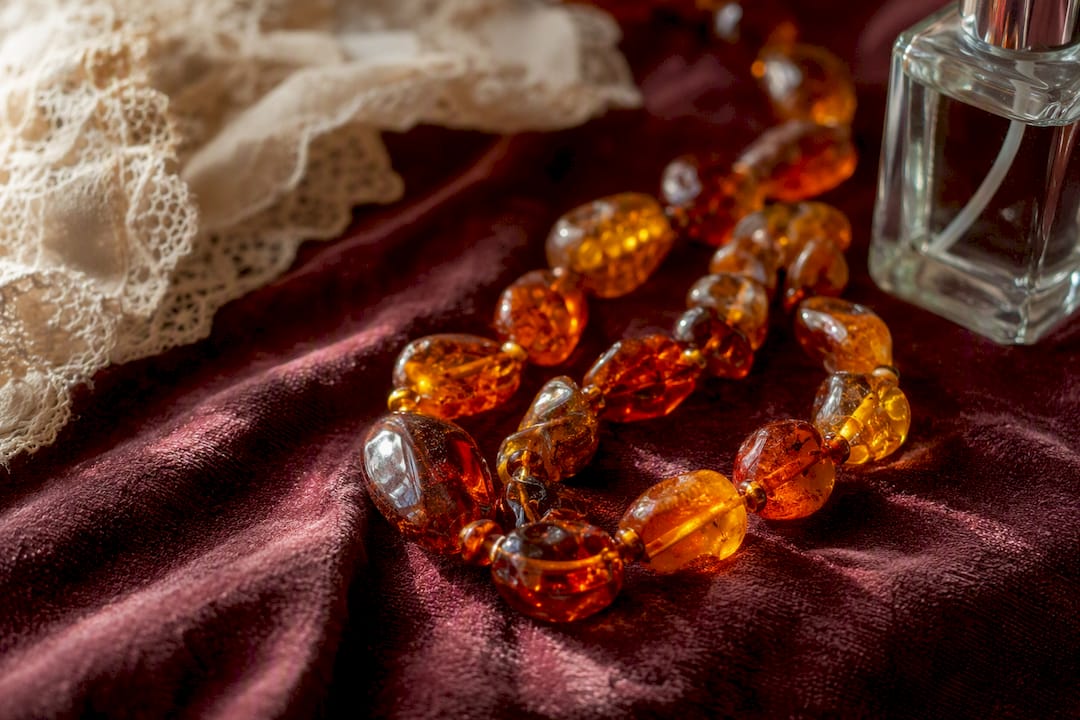
Pro Tip: Clean amber with lukewarm water and a soft cloth only. Skip alcohol-based wipes, ultrasonic cleaners, and perfume sprays near the piece. Alcohol dulls amber’s natural shine and can weaken cord fibers over time.
Keeping amber safe for kids and pets
Safety guidance for amber jewelry on children and animals is not optional reading, and the two categories carry different specific risks.
For infants, an amber necklace should never be worn unsupervised, full stop. Pediatric safety organizations consistently flag necklaces as a strangulation and choking risk for babies left alone, including during naps or overnight sleep in a crib. If you want your child to wear amber, supervised bracelet or anklet wear during waking hours is a safer starting point than a necklace, and teething toys remain the better option for actual teething relief.
For older children, check that beads are individually knotted so a broken cord does not scatter small pieces, and that the clasp is a screw-type or safety design rather than a simple hook. Remove any necklace before naps, bedtime, bath time, or rough play, regardless of the child’s age.
Pets bring a different risk profile. Dogs and cats will chew, and a swallowed bead or broken clasp piece is a real ingestion hazard.
- Choose a breakaway or screw-clasp collar designed to release under pressure rather than a fixed loop
- Monitor a new collar closely during the first few days to see how your pet reacts to it
- Remove the collar during unsupervised time if your pet shows any interest in chewing it
Pro Tip: Check your pet’s amber collar weekly for loose beads or a stretched clasp mechanism. A worn clasp is the most common failure point, not the amber itself.
How to choose and care for amber jewelry
Authentic amber and imitation plastic or resin can look nearly identical to an untrained eye, so buying from a source that documents provenance matters more than most shoppers realize.
What to look for before buying:
- Clear sourcing claims tied to the Baltic region, not vague “natural stone” language
- Product photos showing texture, color variation, and bead shape rather than stock imagery
- Size charts specific to children, adults, or pets, since bead diameter and cord length change the safety profile
- Explicit clasp type listed (screw, safety, or breakaway) rather than left unstated
- Care instructions included on the product page itself
Once you own a piece, care is simple and low effort:
- Wipe beads with a damp soft cloth after wear, especially in warm weather when skin oils build up
- Store the piece separately from harder jewelry to prevent scratching, since amber’s softness makes it vulnerable to abrasion
- Keep it away from perfume, hairspray, and alcohol-based products, which can dull the surface over time
- Inspect the cord and clasp every few weeks for stretching or fraying
- Have a jeweler restring or repair a piece rather than continuing to wear a visibly worn cord
What trustworthy sourcing looks like
Amber’s value depends heavily on where it comes from and how transparently a seller shares that information. Baltic Secret sources its amber directly from Lithuania, one of the world’s primary sources of genuine Baltic amber, and documents authenticity alongside practical product details rather than relying on vague marketing claims.
Before buying any piece, look for the same details a reputable seller like Baltic Secret publishes on its children’s necklace and bracelet pages:
- Bead size and length options matched to age or use case
- Clasp type and how it functions
- Material composition, including cord type
- Care instructions specific to the piece
Reading those specifics before checkout takes two minutes and tells you more about a seller’s honesty than any marketing claim on the homepage.
Where the amber conversation usually goes wrong
The biggest mistake in how people talk about amber is treating it as either miracle medicine or worthless folklore. Both extremes miss what the evidence actually supports.
The lab data on succinic acid release is clear enough that anyone selling amber as a treatment for inflammation, teething pain, or anxiety is overstating what one peer-reviewed study found. That should not be controversial, and readers deserve to hear it plainly rather than buried under marketing language.
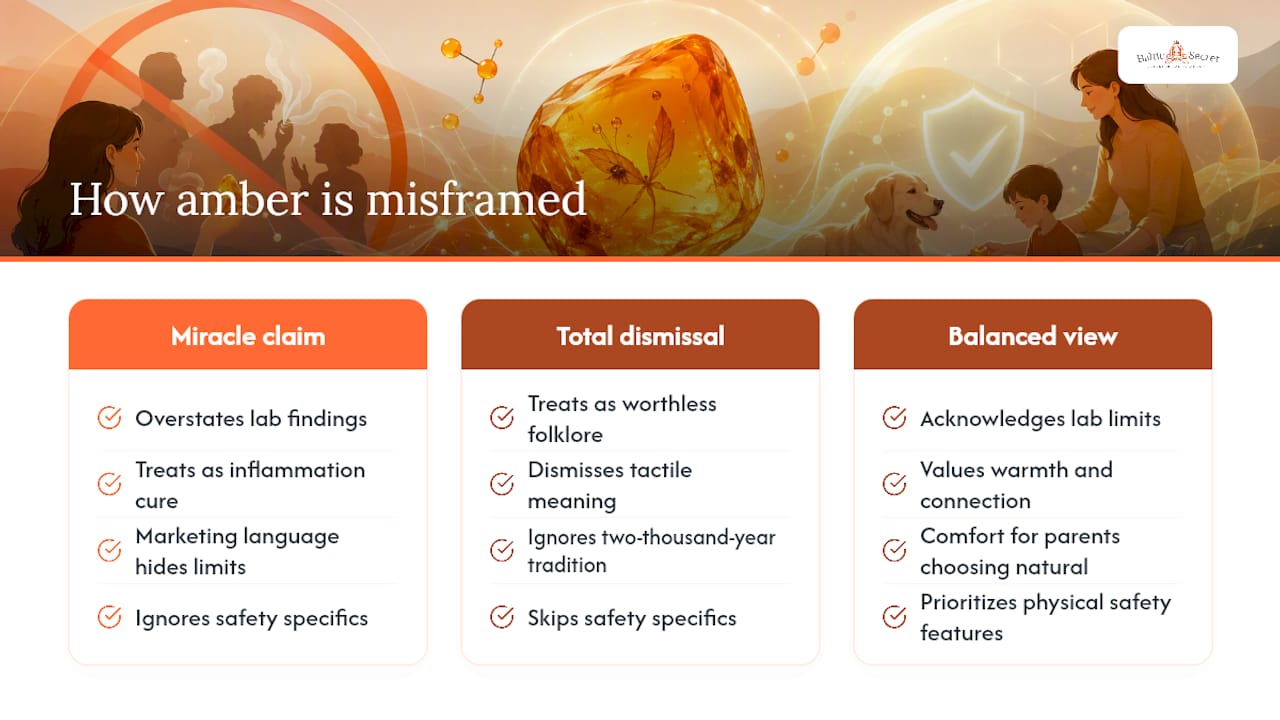
But dismissing amber entirely, as some skeptics do, ignores a legitimate category of value: the tactile warmth, the connection to a two-thousand-year tradition, the comfort a parent feels choosing something natural over plastic. Those are not consolation prizes. They are the actual reason amber has survived as an object of meaning for this long.
Where conventional advice falls short is in safety specifics. Too many buying guides mention “check for authenticity” without ever explaining what a screw clasp looks like versus a fixed loop, or why a necklace and a bracelet carry different risk profiles for an infant. Prioritize the physical safety features first. Everything else about amber, the folklore included, is worth enjoying once the basics are covered.
— Baltic Secret
Ready to shop authentic, safety-checked amber
If you have read this far, you already know amber’s real value is honest craftsmanship and thoughtful design, not unproven medical claims. That is exactly where a direct-from-source seller earns trust: you get amber sourced from Lithuania, clasp types spelled out on the page, and sizing built around actual use, not guesswork.
Two categories are worth a closer look depending on your household. Parents shopping for children will find sizing and safety details laid out on the teething necklace and bracelet pages, including cord type and clasp mechanism for each option. Pet owners looking for a natural collar alternative can check the amber tick collar for dogs, built with a breakaway design rather than a fixed loop.
Before buying anywhere, it is worth comparing how a seller documents safety, the way a veterinary practice documents care standards for pet products generally. Browse the full Baltic Secret collection and check the specs against what this guide covered: bead size, clasp type, and cord material, before you check out.
This article is general information, not a substitute for advice from a qualified doctor. Consult a qualified healthcare professional about your own circumstances before acting on anything here.
Sources
- Baltic amber teething necklaces: could succinic acid leaching from beads provide anti-inflammatory effects?
- The Allure of Amber: Getty Research on amber
- Traces of Antique Idea About Amber’s Therapeutic Qualities in the Culture of Western Balts
- Amber jewellery guide — types & care