Identifying Genuine Baltic Amber Inclusions: A Buyer's Guide

Baltic amber inclusions are fossilized organic materials, most commonly insects, trapped inside ancient tree resin that hardened over 34 to 54 million years during the Eocene epoch. Identifying genuine Baltic amber inclusions separates a piece worth collecting from an expensive fake. The amber market is flooded with copal, plastic, and resin imitations, many carrying injected or 3D-printed insects that fool casual buyers. This guide covers the visual cues, at-home tests, and scientific methods you need, including the saltwater float test, UV fluorescence, and FTIR spectroscopy reports, to verify authenticity before you buy.
What are genuine Baltic amber inclusions and how do you recognize them?
Insects make up over 98% of all animal inclusions found in Baltic amber, while vertebrate inclusions such as lizards and feathers represent less than 0.5% of specimens. That ratio matters because it tells you what to expect in a legitimate piece. If a seller is offering a lizard inclusion at a budget price, skepticism is warranted.
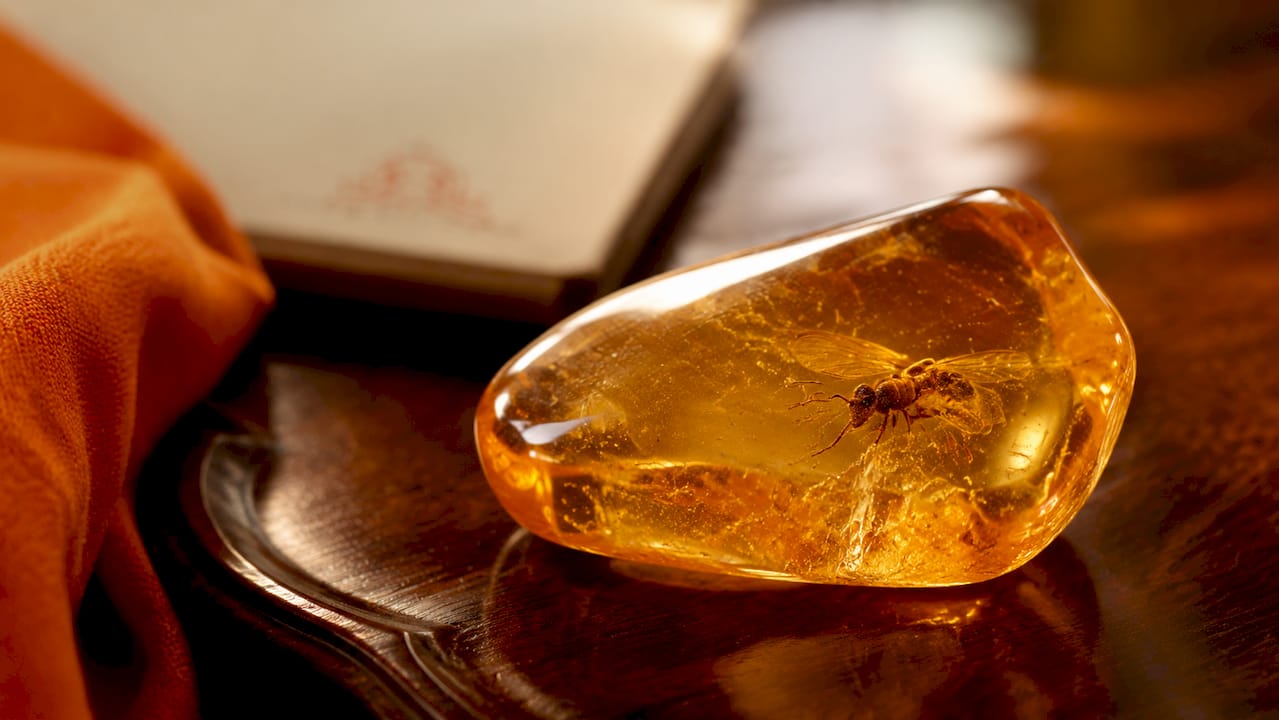
Common inclusions are ants, flies, spiders, and beetles, while rarer finds include plant fragments, feathers, and small vertebrate remains. Authentic specimens show these organisms in random, often awkward positions, as if they were caught mid-movement and engulfed by flowing resin. The resin did not wait for a photogenic pose.
Here are the key visual characteristics of genuine inclusions:
- Random orientation. The insect or organic material sits at an angle, partially obscured, or twisted. Nature does not center subjects.
- Resin flow lines. Authentic amber shows layered flow patterns around the inclusion, sometimes called “halos,” caused by successive resin deposits.
- Microscopic air bubbles. Small, irregular bubbles cluster near the inclusion or scatter through the amber. They form naturally as resin cures and are nearly impossible to replicate convincingly.
- Color variation. Baltic amber ranges from pale yellow and cognac to green and rare blue hues. A single piece often shows subtle tonal shifts rather than uniform color.
- Organic debris. Genuine specimens frequently contain plant fibers, bark fragments, or soil particles alongside the main inclusion. Fakes tend to be suspiciously clean.
A perfectly centered, flawlessly preserved insect in crystal-clear amber with no bubbles or debris is a red flag, not a selling point. Real amber is messy in the best possible way.
How to spot real Baltic amber with simple at-home tests
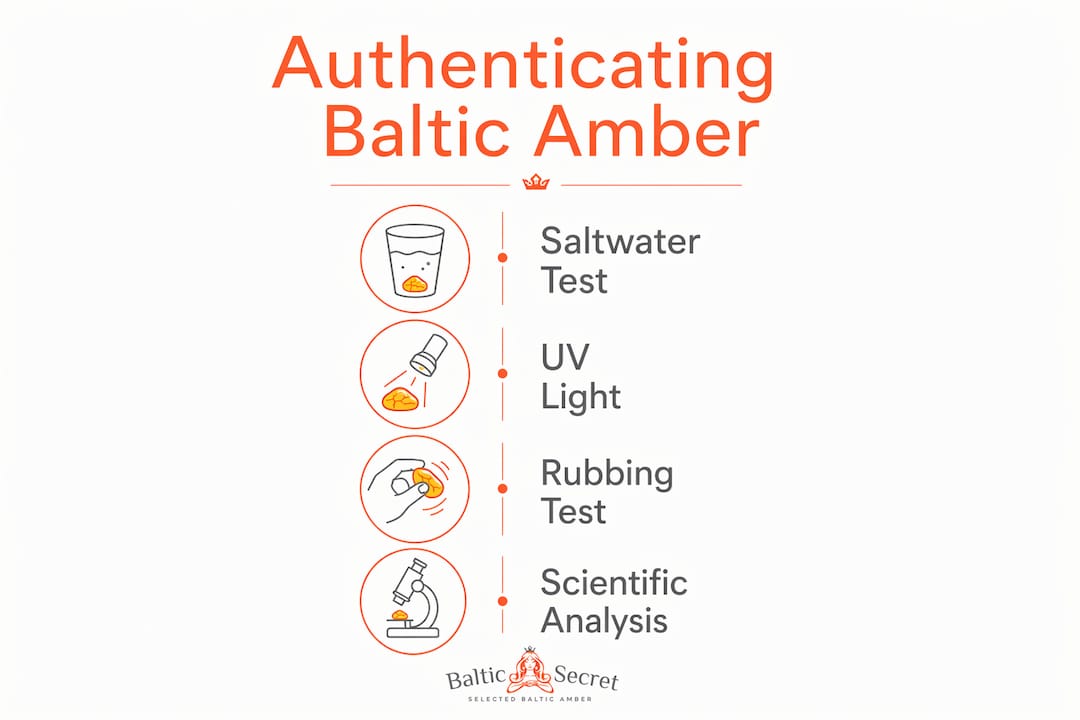
Non-destructive at-home tests give you a reliable preliminary screen before spending serious money. No single test is definitive, but running three or four together builds a strong picture of authenticity.
-
Saltwater float test. Mix 1 part salt to 2 parts water and drop the specimen in. Genuine amber floats because its density sits around 1.05 to 1.10 g/cm³, while most plastics and glass imitations sink. Copal, a younger and cheaper resin often sold as amber, also floats, so this test screens out plastics but does not distinguish amber from copal.
-
UV light fluorescence. Baltic amber fluoresces pale blue-green under ultraviolet light. This reaction comes from the succinic acid content unique to Baltic amber. Plastics and most synthetic resins either do not fluoresce or glow a different color entirely. UV flashlights cost under $15 and are worth keeping in your testing kit.
-
Rubbing test. Rub the piece briskly against a cloth for 20 to 30 seconds. Genuine Baltic amber produces a faint pine scent when warmed by friction. Plastic fakes either have no scent or emit a chemical odor. Copal smells sweet and slightly different from the drier, resinous pine note of true amber.
-
Static electricity test. After rubbing, hold the piece near small paper scraps or hair. Genuine amber builds a static charge and attracts lightweight materials. Glass does not. This test is less reliable on its own but adds one more data point.
Avoid destructive tests such as the hot needle or acetone soak. Both damage the surface and reduce the piece’s value, and neither is necessary when non-destructive options exist.
Pro Tip: Run the saltwater test, UV test, and rubbing test together on any piece before purchasing. Agreement across all three gives you strong preliminary confidence. Disagreement across any two means you need professional verification before committing.
What scientific methods confirm Baltic amber inclusion authenticity?
At-home tests screen out obvious fakes. For high-value specimens, scientific verification is the only way to be certain.
FTIR spectroscopy is the gold standard for distinguishing authentic Baltic amber from copal or synthetic resins. FTIR, which stands for Fourier Transform Infrared Spectroscopy, reads the molecular fingerprint of the resin. Baltic amber produces a characteristic absorption pattern called the “Baltic shoulder” in the 1150 to 1250 cm⁻¹ range, caused by its high succinic acid content. No imitation replicates this signature. Lab reports from FTIR testing are available from university geology departments, gemological labs, and specialist amber testing services.
Key scientific and provenance verification methods include:
- Micro-CT scanning. This imaging technology creates a three-dimensional map of the internal structure without touching the specimen. It reveals whether an inclusion is genuinely embedded in the resin matrix or injected into a drilled cavity. Injected fakes show sharp, clean boundaries around the inclusion. Natural embedment shows gradual resin flow.
- Entomologist or paleobotanist analysis. A specialist can confirm whether an insect or plant fragment is consistent with Eocene-era species. Modern insects placed in resin are anatomically different from their 40-million-year-old ancestors.
- Chain-of-custody documentation. Reputable sellers provide paperwork tracing the specimen from the Baltic region, typically Lithuania, Latvia, or the Kaliningrad area of Russia, to the point of sale. No documentation means no verifiable origin.
- Independent lab testing window. Before purchasing high-value amber, confirm the seller allows returns pending independent lab verification. Sellers who refuse this condition are telling you something important.
“High-value pieces should have lab reports to confirm authenticity. FTIR spectroscopy offers the only reliable molecular fingerprint to distinguish authentic fossilized Baltic amber from copal or synthetics.” — Provenance verification guidance
Lab-verified amber commands higher prices, and for good reason. A piece with an FTIR report and documented provenance from Lithuania is not just more trustworthy. It holds its value far better over time.
Common red flags and mistakes when evaluating amber inclusions
Most buyers who get fooled by fake amber make the same set of mistakes. Knowing the patterns protects you.
- Perfectly centered inclusions. Natural inclusions tend to be randomly positioned, obscured, or angled. A specimen where the insect sits dead-center in a flawless, bubble-free matrix is almost certainly injected or 3D-printed.
- Suspiciously low prices for rare inclusions. A lizard or feather inclusion in Baltic amber is genuinely rare. If the price matches a common ant inclusion, the rarity is fabricated.
- Pressure sales and refusal of documentation. Legitimate sellers welcome questions about provenance and testing. Sellers who push urgency or dismiss requests for lab reports are not selling what they claim.
- Overreliance on a single test. The float test alone does not distinguish amber from copal. UV fluorescence alone does not rule out certain synthetic resins. Only a combination of tests, or professional verification, gives you real confidence.
- Misleading geographic claims. “Baltic amber” is a specific designation. Amber from the Dominican Republic, Myanmar, or Mexico has different properties and different inclusion types. Sellers who blur these distinctions are either uninformed or deliberately misleading.
- Uniform color throughout the piece. Genuine Baltic amber shows natural color variation and often contains cloudiness or inclusions of organic debris. A piece with perfectly uniform, saturated color has likely been dyed or is not amber at all.
Pro Tip: Before buying any amber with inclusions online, ask the seller for a close-up photograph under UV light and a second image showing the inclusion from a different angle. Genuine sellers have nothing to hide. Sellers who cannot or will not provide these images are a clear signal to walk away.
You can also examine an authentic Baltic amber specimen to calibrate your visual expectations before evaluating unfamiliar pieces.
Key takeaways
Genuine Baltic amber inclusions are identified through a combination of visual inspection, non-destructive at-home tests, and scientific verification, with no single method sufficient on its own.
| Point | Details |
|---|---|
| Insects dominate real inclusions | Over 98% of genuine Baltic amber inclusions are insects, randomly positioned with visible resin flow. |
| Use multiple at-home tests | Combine the saltwater float, UV fluorescence, and rubbing tests for reliable preliminary screening. |
| FTIR is the definitive test | Only FTIR spectroscopy provides the molecular fingerprint that confirms authentic Baltic amber. |
| Red flags are visual and behavioral | Centered inclusions, no documentation, and pressure sales are stronger warning signs than any single test. |
| Provenance documentation matters | Chain-of-custody paperwork from Lithuania or Latvia adds verifiable value and long-term confidence. |
Why I think most buyers underestimate the visual training step
Studying confirmed museum-grade amber collections is the single most underrated step in amber authentication, and almost no one does it before their first purchase. Experts recommend exposure to known authentic specimens to calibrate visual expectations, and the Amber Museum in Gdansk, Poland is one of the best places in the world to do exactly that.
Here is what I have found after years of working with Baltic amber: the tests matter, but your eye matters more at the point of purchase. FTIR reports are not available at a market stall or a trade show. What you have in the moment is your trained perception. Buyers who have spent time with verified specimens develop an instinct for the subtle wrongness of fakes. The resin looks too clean. The insect looks too perfect. The color is too uniform. These are not scientific observations, but they are real signals.
Technology is changing this field. Portable Raman spectroscopy devices are becoming more accessible, and some specialist dealers now offer on-site molecular testing. That is a meaningful shift. But technology supplements judgment; it does not replace it.
My honest advice: before you spend significant money on amber with inclusions, visit a museum collection or handle verified specimens from a trusted source. Buy a lower-cost piece with a known inclusion type first. Learn what random positioning, natural bubbles, and resin flow actually look like in your hands. Then scale up your purchases with real confidence rather than hope.
— Amber
Explore authentic Baltic amber from Balticsecret
Balticsecret sources all amber directly from Lithuania, where every piece carries verified provenance and reflects the natural characteristics described in this guide. The collection includes polished cognac amber necklaces and raw unpolished pieces that display genuine inclusions, resin flow patterns, and the natural color variation that distinguishes real Baltic amber from imitations. Balticsecret provides certificates of authenticity and supports independent lab verification, so you can buy with the same confidence a collector would. Whether you are choosing amber for its aesthetic beauty, gemstone value, or natural healing properties, every piece is crafted to meet the standards this guide describes.
FAQ
What are the most common types of Baltic amber inclusions?
Insects are the most common inclusions, making up over 98% of animal finds, with ants, flies, spiders, and beetles appearing most frequently. Rare inclusions include lizards, feathers, and plant fragments.
How does the saltwater test work for amber authenticity?
Dissolve 1 part salt in 2 parts water and place the amber in the solution. Genuine amber floats due to its low density, while glass and most plastics sink. Note that copal also floats, so this test alone does not confirm authentic Baltic amber.
What does genuine Baltic amber look like under UV light?
Authentic Baltic amber fluoresces pale blue-green under ultraviolet light, a reaction caused by its succinic acid content. Plastics and synthetic resins either do not fluoresce or show a different color response.
Can you identify fake amber inclusions visually?
Yes, in many cases. Fake inclusions are often perfectly centered, surrounded by unusually clear resin with no bubbles or debris, and show sharp boundaries rather than natural resin flow. Real inclusions sit at random angles with organic material nearby.
What is FTIR spectroscopy and why does it matter for amber?
FTIR spectroscopy reads the molecular structure of the resin and identifies the “Baltic shoulder” absorption pattern unique to genuine fossilized Baltic amber. It is the only test that definitively distinguishes authentic amber from copal or synthetic imitations.