Baltic Amber Authentic vs Fake: How to Tell the Difference

Baltic amber is fossilized tree resin that formed roughly 44 million years ago along the shores of what is now the Baltic Sea, and its unique chemical composition makes it testable in ways most imitations cannot replicate. The market for amber jewelry is flooded with counterfeits made from plastic, glass, copal, and synthetic resins. Knowing how to distinguish baltic amber authentic vs fake pieces protects your investment and guarantees you get the real wellness and aesthetic value you are paying for. Simple home tests, combined with a trained eye for natural imperfections, catch the vast majority of fakes before you spend a dollar.
What physical properties make Baltic amber unique and testable?
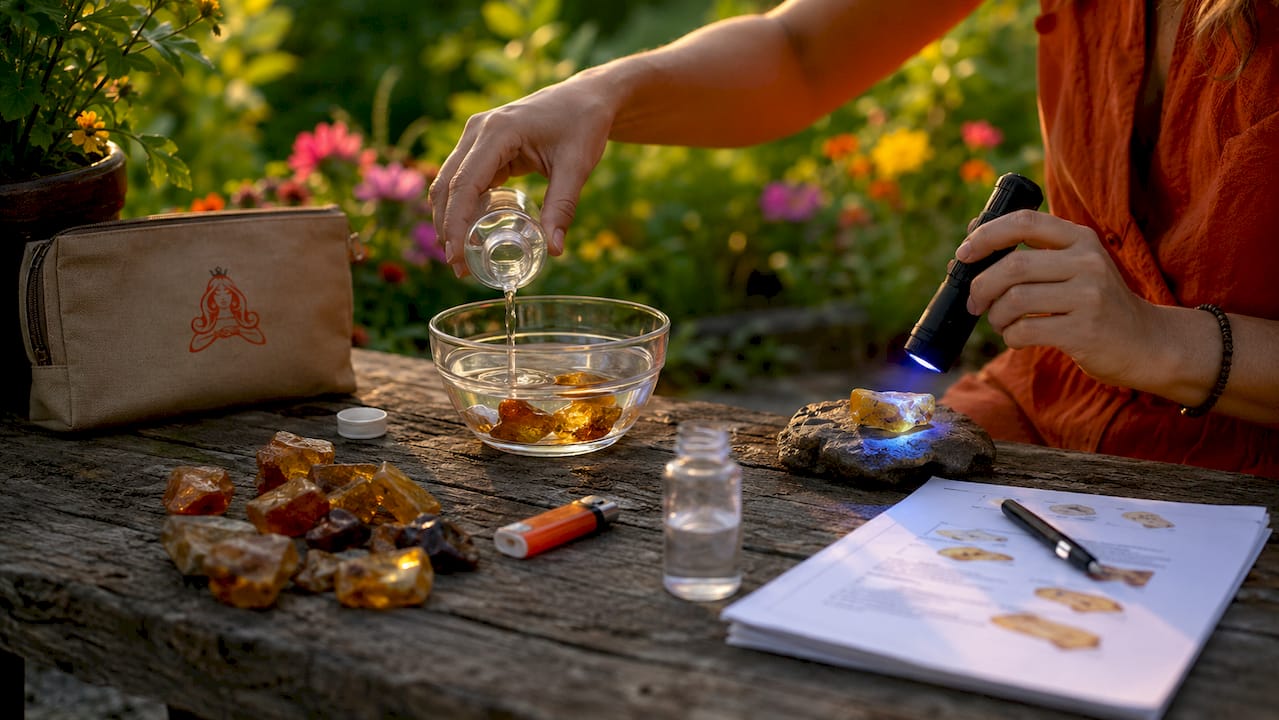
Baltic amber, known scientifically as succinite, carries a chemical fingerprint no imitation can fully copy. Its succinic acid content, which ranges from 3–8% of its total composition, is the defining marker of genuine Baltic amber from the Lithuania and wider Baltic region. That acid content is what makes laboratory testing so reliable, and it also influences several physical properties you can observe at home.
The key properties that set authentic succinite apart:
- Density. Baltic succinite’s density of 1.05–1.10 g/cm³ causes it to float in saturated saltwater. Most plastics and glass sink immediately.
- UV fluorescence. Genuine Baltic amber fluoresces pale blue-white or greenish under 365 nm UV light. Other ambers and most fakes show weaker or differently colored reactions.
- Warmth and feel. Real amber feels warm to the touch, unlike glass, which feels cold and heavy.
- Scent. Rubbing or gently heating authentic amber releases a faint, sweet pine resin smell. Plastics produce a sharp, chemical odor.
- Natural inclusions. Genuine pieces contain air bubbles, flow lines, and sometimes real prehistoric fossils. These irregularities are random, never perfectly centered.
These properties work together as a filter system. No single property is conclusive on its own, but together they build a strong case for or against authenticity. Understanding the quality grading differences in Baltic amber also helps you set realistic expectations for what genuine pieces look like.
How to test Baltic amber at home: step by step
Authentication follows a clear decision tree: start with non-destructive tests, then move to more revealing ones only if needed. Home tests work best as filters to exclude obvious fakes rather than as conclusive proof.
-
Saltwater float test. Dissolve roughly one part table salt in four parts warm water. Drop your amber piece into the solution. Authentic Baltic amber floats in this mixture. Glass and most dense plastics sink. Copal and some lightweight plastics may also float, so this test narrows the field but does not end the investigation.
-
UV fluorescence test. Use a 365 nm UV flashlight in a darkened room. Hold it close to the piece. Real Baltic amber glows pale blue-white or greenish. A dull, absent, or bright-white neon glow suggests a fake or a different type of resin.
-
Static charge test. Rub the piece vigorously on a wool cloth for 20–30 seconds, then hold it near small paper scraps. Authentic amber builds a static charge and attracts the paper. Glass does not. This test is easy and completely non-destructive.
-
Scent and hot-needle test. Press a heated needle tip against a hidden spot on the piece. Real amber releases a sweet pine resin smell and produces fine white smoke. Copal smells sharper and may soften. Plastic smells acrid and melts. Use this test only when the piece value justifies the minor surface damage.
-
Magnification inspection. Use a jeweler’s loupe or a 10x magnifying glass. Look for random air bubbles, flow lines, and naturally positioned inclusions. Genuine prehistoric insect inclusions appear off-center, with tiny air bubbles around them. Perfectly centered, pristine insects are a red flag.
Pro Tip: Run at least three of these tests before drawing a conclusion. A piece that passes the float test but fails the UV test and shows a perfect centered insect is almost certainly fake.
What are the most common fakes and how do they differ?
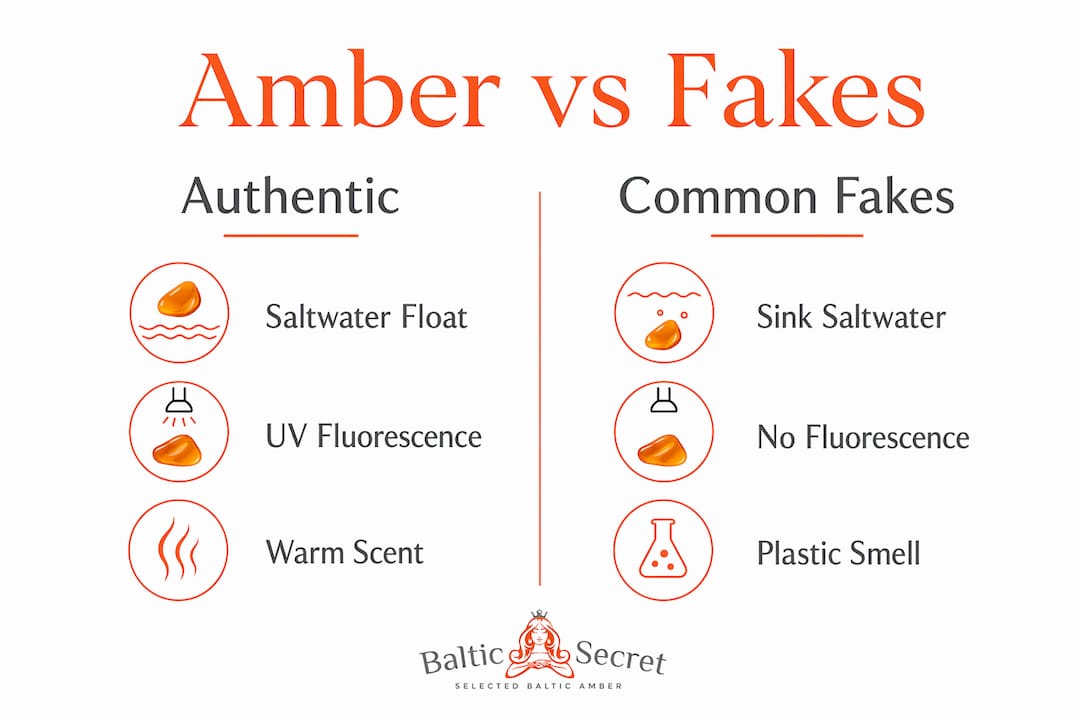
The amber market contains several well-known imitation materials, each with distinct tells. Recognizing them by category makes identification faster.
Copal: the most deceptive substitute
Copal is young tree resin, sometimes only a few hundred to a few thousand years old, and it closely resembles amber visually. Copal is softer than amber, scratches easily, and turns tacky when touched with acetone on a cotton swab. That stickiness is the fastest way to separate copal from genuine Baltic amber. Copal also smells sharper when heated and lacks the distinctive Baltic shoulder absorption that lab testing reveals.
Plastic, glass, and synthetic resins
| Material | Saltwater test | Scent when heated | UV fluorescence |
|---|---|---|---|
| Genuine Baltic amber | Floats | Sweet pine resin | Blue-white or greenish |
| Copal | Floats | Sharp, resinous | Weak or similar to amber |
| Plastic | Sinks (most types) | Acrid, chemical | Absent or neon white |
| Glass | Sinks | None | None |
| Pressbernstein (pressed amber) | Floats | Pine resin (contains real amber) | Similar to amber |
Plastic and glass are the easiest fakes to catch. Both sink in saltwater, and glass feels cold and heavy in the hand. Plastic melts and smells chemical under heat.
Pressbernstein and polybern
Pressbernstein, also called pressed amber or polybern, is made by fusing small genuine amber pieces under heat and pressure. It contains real amber, so it passes the float and scent tests. The tell is in the visual texture: pressed amber often shows a swirling, cloudy pattern under magnification rather than the random natural flow lines of a single piece. It is not always sold dishonestly, but it should be labeled and priced accordingly.
Fake inclusions
Insect inclusions in authentic Baltic amber show natural, random positioning with tiny air bubbles around the specimen. Fakes often feature modern insects embedded in clear resin, positioned dead-center for visual appeal. A modern insect in perfect condition, with no deterioration and no surrounding air bubbles, is almost always a planted fake.
Deceptive branding is also common. Beads labeled as amber at tourist markets are very often fake. False certification stamps, including imitations of the SBM (Staatliches Bernstein-Museum Königsberg) mark, appear on counterfeit pieces. Always verify certification through the issuing organization.
When should you get professional lab authentication?
Home tests catch most fakes, but they have real limits. No single test fully distinguishes amber from copal or pressed materials. When the stakes are high, professional testing removes all doubt.
FTIR spectroscopy is the gold standard for Baltic amber authentication. The technique detects a characteristic absorption feature near 1,250 cm⁻¹, known as the Baltic shoulder, which is caused by succinic acid and is unique to Baltic succinite. No imitation material replicates this signature. Lab FTIR is mostly valuable for collectors and high-value purchases; it is less commonly required for everyday consumer buys.
Lab authentication makes sense in three situations. First, when you are buying a piece worth several hundred dollars or more. Second, when provenance matters, such as for collectors verifying a piece’s origin in the Baltic region. Third, when multiple home tests give conflicting results and you cannot reach a clear conclusion.
To find a reputable authentication service, contact gemological laboratories, natural history museums with paleontology departments, or established amber trade organizations in Lithuania, Poland, or Germany. The Baltic vs Dominican amber comparison also illustrates why geographic origin matters and why lab confirmation of the Baltic shoulder is the only way to confirm true succinite origin.
Key takeaways
Authentic Baltic amber passes a combination of tests that no single imitation material can replicate, making a multi-test approach the most reliable method for consumers.
| Point | Details |
|---|---|
| Use multiple tests | Saltwater, UV, scent, and static tests together give far stronger results than any one test alone. |
| Copal is the hardest fake to catch | Acetone stickiness and magnification inspection are the fastest ways to separate copal from genuine amber. |
| Inclusions reveal authenticity | Natural inclusions are random and imperfect; perfectly centered insects in clear resin signal a fake. |
| Lab FTIR confirms origin | FTIR spectroscopy detects the Baltic shoulder near 1,250 cm⁻¹ and is the only definitive proof of succinite origin. |
| Buy from certified sources | Trusted sellers provide certificates of authenticity; genuine pieces vary in size, shape, and show minor natural imperfections. |
What I have learned after years of working with Baltic amber
The most common mistake buyers make is trusting one test too much. A piece that floats in saltwater feels warm and smells faintly of pine when scratched is still not confirmed authentic. Copal passes all three of those tests. The acetone swab and magnification step are where most people stop short, and that is exactly where sellers of copal count on you stopping.
The second mistake is chasing visual perfection. Genuine Baltic amber from Lithuania is not a flawless material. It has flow lines, tiny bubbles, color variations, and surface irregularities. A piece that looks too clean, too uniform, or too perfectly golden should raise your suspicion, not your desire. The imperfections are the proof.
Suspiciously low prices are another reliable warning sign. Certified authentic pieces from reputable vendors reflect the real cost of sourcing, grading, and crafting genuine succinite. A price that seems too good to be true almost always means the material is not what it claims to be.
At Baltic Secret, we source directly from Lithuania and provide certificates of authenticity with our products. We have seen enough counterfeits to know that the best protection for any buyer is education first, then a trusted source. Start with the tests above, learn to read what you see, and buy from sellers who welcome your questions rather than deflect them.
— Baltic Secret
Authentic Baltic amber jewelry from a trusted source
Baltic Secret specializes in genuine Baltic amber products sourced directly from Lithuania, covering jewelry for children, adults, and pets.
Every piece in the Baltic Secret collection comes with authenticity guarantees, so you never have to run a saltwater test on your purchase. Browse authentic amber jewelry for the whole family, from safe children’s necklaces to natural pet collars designed for daily wear. Each product is crafted from genuine succinite with clear sizing, safety features, and care instructions included.
FAQ
What is the fastest way to test Baltic amber at home?
The saltwater float test is the fastest first step. Dissolve one part table salt in four parts warm water and drop the piece in. Genuine Baltic amber floats; glass and most plastics sink.
Can copal pass the same tests as real Baltic amber?
Copal passes the saltwater float and basic scent tests, making it the hardest fake to catch at home. The acetone stickiness test and FTIR spectroscopy reliably separate copal from genuine succinite.
What does authentic Baltic amber look like under UV light?
Genuine Baltic amber glows pale blue-white or greenish under 365 nm UV light. Fakes typically show no fluorescence, a dull reaction, or an unnatural bright-white glow.
Are insect inclusions in amber always real?
No. Fakes often contain modern insects embedded in clear resin, positioned perfectly at the center of the piece. Real prehistoric inclusions appear randomly positioned, with visible air bubbles and signs of age around the specimen.
When does professional FTIR testing make sense?
FTIR testing is worth the cost for high-value purchases, provenance disputes, or when home tests give conflicting results. It detects the Baltic shoulder absorption near 1,250 cm⁻¹, which is unique to genuine Baltic succinite and cannot be faked.