Best Amber Jewelry Investment Pieces: A Collector's Guide

The best amber jewelry investment pieces fall into four categories: inclusion specimens (amber with visible insects or plant matter trapped inside), large transparent cognac beads, rare-color pieces in green or blue, and museum-quality cabochons. These are what serious collectors buy, and they are what hold or appreciate in value over time. As a baseline expectation: specimen-grade amber with compelling inclusions can sell for thousands of dollars, while mass-market fashion beads rarely exceed a few hundred. Amber is a collectible first, not a liquid financial instrument, and anyone buying it as a pure financial play should go in with that understanding.
The shortlist of piece types worth considering:
- Inclusion specimens set as pendants or cabochons: A clear, intact insect or plant inclusion is the single strongest value driver in the amber market. These pieces trade at exponential premiums over clean amber.
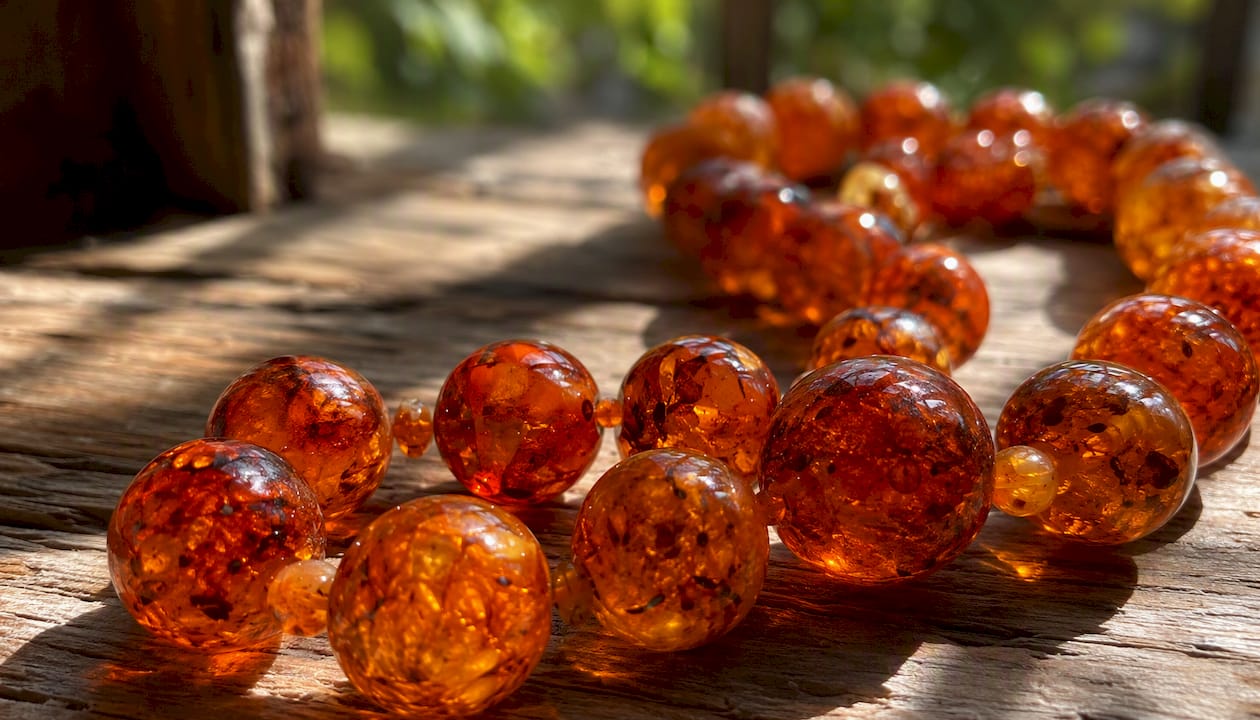
- Large transparent cognac bead necklaces: Size plus clarity is a rare combination. Beads over 10 grams of clean, reddish-brown amber command significant premiums.
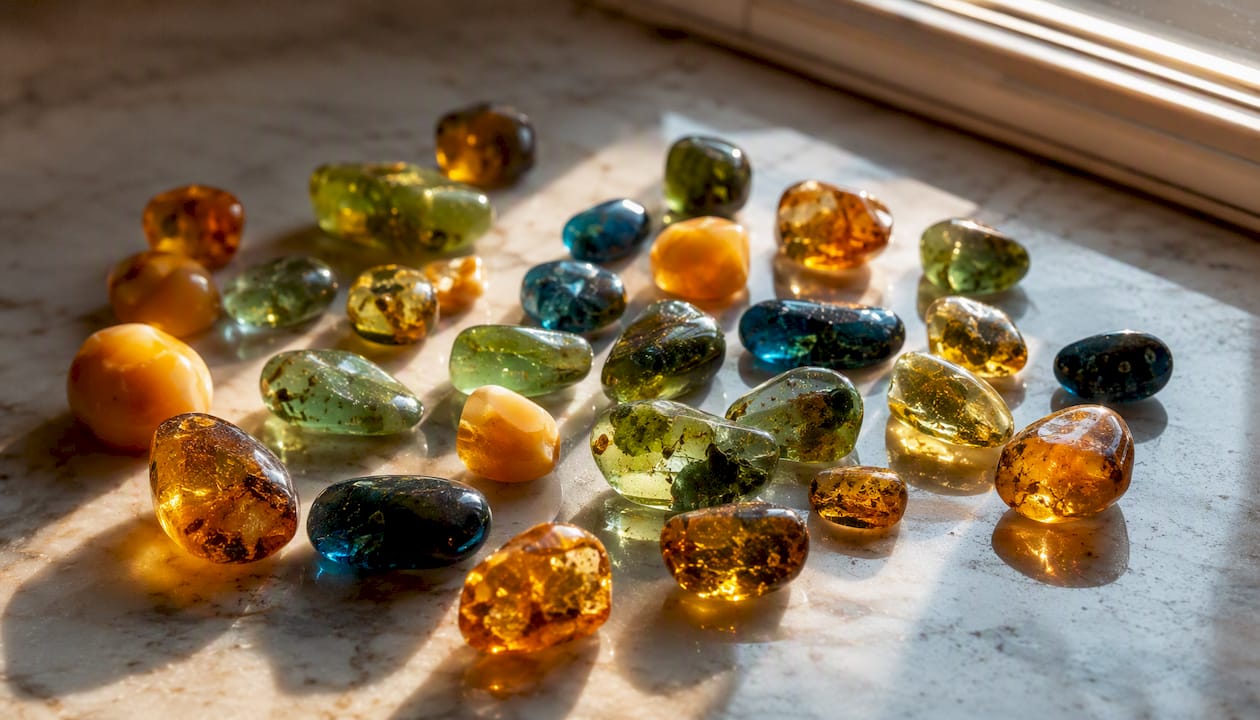
- Rare-color pieces (green, blue, butterscotch): Natural green and blue amber are genuinely scarce. Buyers pay for the color itself, independent of inclusions.
- Museum-grade specimens: Non-wearable pieces sold by weight at auction, often to institutions or advanced collectors.
- Certified Baltic amber from documented sources: Provenance matters as much as the piece itself. Uncertified amber, regardless of appearance, is harder to resell.
Amber’s investment value concentrates in rarity, not wearability. The pieces that hold value longest are the ones a collector would want to own even if they could never wear them.
According to Britannica, amber is fossilized tree resin with a color range spanning white to deep reddish-brown, and Baltic amber from the Baltic Sea region has historically commanded the strongest market recognition.
Table of Contents
- What drives the value of amber jewelry?
- Which amber piece types are actually investment-grade?
- How do you verify authenticity and provenance before buying?
- What are realistic U.S. price ranges and resale expectations?
- How to store amber so it keeps its value
- What should you ask a seller before buying?
- Why buy from a certified specialist like Baltic Secret?
- Key Takeaways
- The collector mindset vs. the investor mindset
- Baltic Secret makes it easier to source authenticated Baltic amber in the U.S.
- Useful sources and further reading
What drives the value of amber jewelry?
The GIA’s amber quality factors lay out a clear hierarchy: transparency and color sit at the top, followed by size, inclusions, and condition. Here is how each factor plays out in practice.
Primary value drivers:
- Size and weight: Amber is traded by weight in grams, not carats. The Gem Society notes the common trade conversion of 1 gram ≈ 5 carats. Larger pieces are rarer, and large transparent beads are especially scarce.
Secondary factors:
Pro Tip: The single strongest premium driver is a clear, intact insect inclusion that is visually interesting at arm’s length. If you need a loupe to appreciate it, the market will price it accordingly.
Which amber piece types are actually investment-grade?
Not all amber jewelry belongs in the same conversation. Here is how the categories break down, with realistic price context for the U.S. market.
Inclusion specimens as pendants or cabochons
These are the crown jewel of amber collecting. A piece containing a well-preserved, clearly visible insect, spider, or plant fragment set in a pendant or cabochon can fetch prices that dwarf equivalent clean amber. According to the Gem Society, inclusion-rich specimens trade at large premiums and can reach auction-grade status. Entry-level inclusion pendants with small or partial inclusions start in the $150–$500 range. Pieces with whole, identifiable insects in clear amber can run $1,000 to several thousand dollars depending on the species and visual quality.
Large transparent cognac necklaces and statement beads
Size and clarity together are rare. A strand of large, clean, reddish-brown Baltic amber beads represents real material value because producing them requires sourcing large raw pieces with minimal internal flaws. Finished, rounded beads cost more per gram than rough material because of manufacturing loss and labor. Quality cognac bead necklaces in the U.S. market typically range from $200 to $800 for mid-size beads, with large statement pieces from certified sources running higher.
Rare-color pieces: green, blue, and butterscotch
Natural green and blue amber are not simply color variations. They are genuinely uncommon, and buyers pay for that scarcity. Butterscotch amber, with its creamy opaque character, occupies a different aesthetic niche and attracts a loyal collector segment. These pieces price above comparable cognac amber of the same weight.
Museum-grade specimens
These are non-wearable pieces, often raw or minimally processed, sold primarily by weight at specialist auctions or through dealer networks. They sit outside the jewelry category but are worth knowing about if you are considering amber as a collectible asset rather than wearable jewelry.
Investment-grade amber is not defined by how beautiful a piece looks in a display case. It is defined by what a knowledgeable second buyer would pay for it.
How do you verify authenticity and provenance before buying?
Fakes and treated amber are common enough in the U.S. market that skipping verification is a real financial risk. The GIA notes that Baltic amber often commands a premium, which also makes it a target for substitution with copal (young resin), plastic, or glass.
Buyer’s verification checklist:
- Request a lab report from an independent gemological lab (GIA-trained appraisers or equivalent).
- Ask for high-resolution photos of all faces of the piece, with inclusions documented separately.
- Get the weight in grams and dimensions in millimeters in writing.
- Request full treatment disclosure: has the piece been heat-clarified, oiled, or dyed?
- Ask for provenance documentation: where was the raw amber sourced, and who processed it?
- Confirm the return policy before purchasing. A seller who will not accept returns on a high-value piece is a red flag.
Common tests and their limits:
DIY tests like the hot needle test (genuine amber smells like pine resin) and UV fluorescence (Baltic amber typically fluoresces blue-white) can catch obvious fakes. Specific gravity testing (amber floats in saturated saltwater, most plastics sink) is more reliable. None of these replace a professional lab report for a high-value purchase.
What destroys resale value:
- Heat or oil treatment to improve clarity (detectable under magnification)
- Reconstructed or pressed amber (small fragments fused under heat and pressure, sold as solid pieces)
- Dyed amber (color is artificial, not natural)
- Copal sold as amber (much younger resin, not true fossilized amber)
A certificate of authenticity from the seller is a starting point, not a finish line. For any piece above $500, an independent appraisal is worth the cost.
What are realistic U.S. price ranges and resale expectations?
| Category | Typical U.S. Price Range | Rarity / Provenance | Resale Channels | Care Needs |
|---|---|---|---|---|
| Fashion beads (mass-market) | — | Low; often untreated but uncertified | General marketplaces | Basic; avoid heat and chemicals |
| Quality jewelry (certified Baltic) | — | Moderate; certified source, documented | Specialty dealers, Etsy | Controlled storage, soft pouch |
| Inclusion pendants (entry-level) | $150–$500 | Higher; partial or small inclusions | Specialist dealers, auction | Climate-controlled storage |
| Inclusion specimens (whole insect) | $1,000 to several thousand dollars | High; intact, visible, well-centered | Auction houses, consignment | Conservation-grade packing |
| Rare-color pieces (green, blue) | — | High; natural color, certified | Specialist dealers | UV-protected storage |
Amber is traded by weight, with 1 gram approximating 5 carats in trade calculations. That conversion matters when comparing per-gram prices across sellers.
Resale realities:
Liquidity in the amber market is limited compared with gold or diamonds. Auction houses handle high-value specimens but take 15–25% buyer’s premiums and equivalent seller’s commissions. Specialist dealers offer faster sales but typically at 30–50% below retail. Consignment through a reputable dealer is the middle path: slower, but closer to fair market value. Expect resale to take weeks to months for quality pieces, longer for the highest-value specimens.
Amber is a collectible. Past price performance in the collector market does not guarantee future returns, and anyone treating it as a primary financial investment should consult a financial advisor.
How to store amber so it keeps its value
Amber is organic, and it behaves like one. The GIA notes that fine translucent pieces can darken with prolonged exposure, and that cutting and polishing remove the harder natural surface, accelerating oxidation. Storage is not optional for pieces you intend to resell.
Do:
- Store in a soft pouch or acid-free box away from direct sunlight.
- Keep at stable room temperature; avoid attics, cars, and windowsills.
- Wrap high-value pieces individually to prevent contact scratches.
- Clean with a soft, dry cloth only.
Don’t:
- Expose to perfumes, hairspray, or household cleaners.
- Use ultrasonic cleaners (vibration damages amber).
- Store near heat sources or in high-humidity environments.
- Leave pieces in direct UV light for extended periods.
For heirloom amber jewelry, the stakes are higher. A piece that has survived decades in good condition is worth protecting with the same care a museum would apply.
Pro Tip: For specimen-grade pieces worth over $1,000, use conservation-grade archival boxes with silica gel packets to maintain stable humidity. A stable environment is the single most cost-effective preservation investment you can make.
What should you ask a seller before buying?
A short checklist you can run through before committing to any purchase:
- Does the seller provide a certificate of authenticity and provenance documentation?
- Are high-resolution photos available, including close-ups of any inclusions?
- Is the weight in grams and the dimensions listed explicitly?
- Has the piece been treated (heat, oil, dye)? Is that disclosed in writing?
- What is the return policy, and is a buyback or consignment option available?
- Is an independent lab report available, or can one be obtained before purchase?
- How long has the seller been operating, and are there verifiable customer reviews?
Red flags that should stop the purchase:
- No provenance documentation or vague sourcing claims (“Baltic region” with no specifics)
- Weight and dimensions not listed, or inconsistent across photos
- Pressure pricing (“only one left,” “price goes up tomorrow”)
- No returns accepted on high-value pieces
- Inclusions described in text but not visible in photos
- Certificates issued only by the seller, with no independent verification
On pricing: if a seller’s price is dramatically below market for a piece with claimed inclusions, that is not a deal. It is a signal. Negotiate on documented pieces with clear provenance; walk away from anything where the documentation is the weak link.
Why buy from a certified specialist like Baltic Secret?
The trust signals that matter most when buying investment-grade amber are sourcing transparency, documentation quality, and seller accountability. Baltic Secret sources authentic Baltic amber directly from Lithuania, which is the origin point for the world’s most recognized and commercially valued amber deposits.
What Baltic Secret provides:
- Direct sourcing from Lithuanian artisans and suppliers, with product pages that document material origin.
- Detailed product listings with high-resolution photography and specific product information.
- Safety guidance and size specifications for children’s and pet products, reflecting a commitment to accurate, responsible product information.
- Educational content on amber’s properties, care, and origins, so buyers understand what they are purchasing.
Buying from a specialist who sources directly from the Baltic region removes one of the biggest risks in the amber market: the uncertified middleman who cannot tell you where the raw material came from.
For buyers interested in artisanal amber necklaces with documented craftsmanship, Baltic Secret’s product pages offer the kind of detail that supports both personal enjoyment and informed purchasing decisions.
Safety note: The FDA advises against amber teething necklaces for infants due to strangulation and choking risks. A published study of 101 families found no scientific evidence supporting transdermal succinic acid absorption from amber beads. Baltic Secret provides safety guidance on its children’s product pages; always follow those guidelines and consult your pediatrician. This article is general information, not medical or financial advice.
Key Takeaways
Investment-grade amber concentrates value in inclusion specimens, large transparent cognac beads, and rare colors, with provenance documentation being the non-negotiable requirement for any serious purchase.
| Point | Details |
|---|---|
| Prioritize inclusions and rare colors | Whole insect inclusions and natural green or blue amber command the highest collector premiums. |
| Weight drives pricing | Amber trades by weight; 1 gram ≈ 5 carats, and larger certified pieces cost more per gram due to manufacturing loss. |
| Insist on documentation | Lab reports, provenance records, and certificates of authenticity are required for any piece you expect to resell. |
| Set realistic liquidity expectations | Amber is a collectible, not a liquid asset; resale through specialist dealers or auction takes weeks to months. |
| Baltic Secret for certified sourcing | Baltic Secret sources directly from Lithuania and provides detailed product documentation for U.S. buyers. |
The collector mindset vs. the investor mindset
Most people who buy amber with “investment” in mind are actually collectors who want their purchase to hold value. That is a reasonable goal. It is a different goal from expecting amber to perform like a financial instrument with predictable returns, and conflating the two leads to disappointment.
The collector mindset focuses on rarity, aesthetics, and provenance. A collector buys the piece that is genuinely hard to find, documents it carefully, stores it properly, and accepts that the resale timeline is uncertain. The payoff is owning something rare and beautiful, with the possibility of future appreciation. That is a legitimate reason to buy amber.
The investor mindset demands liquidity, documented returns, and clear exit channels. Amber does not reliably deliver those. The market for high-value specimens is thin, prices are set by specialist dealers and auction results rather than any public exchange, and there is no amber index to benchmark against.
The practical advice: buy the best piece you can authenticate and afford, treat storage as seriously as the purchase itself, and do not count on resale within a short window. If the piece gives you genuine pleasure to own and you have done the verification work, the financial upside is a bonus rather than the premise.
Baltic Secret makes it easier to source authenticated Baltic amber in the U.S.
Collectors who have done the research know that the hardest part of buying investment-grade amber is not finding pieces. It is finding pieces with the documentation to back up the asking price.
Baltic Secret’s U.S. storefront offers handcrafted amber jewelry sourced directly from Lithuania, with product pages built around the details that matter: material origin, craftsmanship specifics, and high-resolution photography. For buyers interested in rare-color pieces, the green amber necklace and bracelet set is a strong example of the kind of documented, certified piece worth considering for a collection.
The collections span inclusion-forward pendants, large cognac bead necklaces, and artisanal statement pieces, all with the sourcing transparency that supports both personal enjoyment and informed collecting. Browse the authenticated listings at balticsecret.com/en-us to find pieces that meet the buying checklist in this guide.
Useful sources and further reading
- Amber Quality Factors
- Amber jewelry and gemstone information - Gem Society
- Knowledge and experiences of families regarding amber necklaces
- U.S. Food and Drug Administration
- Amber - Britannica
- Baltic Secret
For high-value purchases, supplement these resources with an independent appraisal from a GIA-trained gemologist and, where available, auction house records for comparable pieces. Those two data points together give you the most accurate picture of what a piece is actually worth in the current U.S. market.