Raw Green Amber: Buyer's Guide to Natural vs. Treated

Raw green amber is fossilized tree resin that can be naturally green or treated to appear green through heat-and-pressure processes. For U.S. buyers, the practical verdict is this: natural green Baltic amber exists, but it’s genuinely rare, and most vivid green pieces on the market have been treated. Buy with confidence only when a seller provides documented Baltic origin and a lab report confirming natural color.
- What to look for: FTIR spectroscopy showing the “Baltic shoulder” signature, long-wave UV fluorescence behavior, and a documented chain of custody from Lithuania or the Baltic Sea region.
- Quick buying rule: Treat any bright, peridot-like green piece as probably treated unless the seller provides lab verification. Subtle yellow-green tones are more likely natural.
- Verified path: Baltic Secret sources directly from Lithuanian suppliers and can provide authenticity documentation on request, making it a reliable starting point for U.S. buyers who want verified material.
Table of Contents
- What does raw green Baltic amber actually look like?
- Why does amber appear green — natural causes vs. market treatments?
- How rare is green amber, and what drives its price?
- What are the common uses, and is green amber safe for children?
- How can you tell if green amber is natural?
- Where is green amber found, and how do you source it in the United States?
- How do you care for raw green amber?
- Buying checklist: questions to ask before you commit
- How Baltic Secret sources and verifies its green amber
- Key Takeaways
- The case for slowing down when buying green amber
- Verified green amber from Baltic Secret, ready to ship to the U.S.
- Research and further reading
What does raw green Baltic amber actually look like?
“Raw” in the amber world has a specific meaning. A raw amber stone is unpolished and naturally shaped, showing the original surface texture from the earth or sea. It hasn’t been cut, tumbled, or faceted. The contrast matters because polishing removes the outer crust and can dramatically change how color reads, sometimes revealing a greener interior or masking surface oxidation.
According to GIA, “sea amber” — pieces naturally smoothed by tidal action — is a distinct collector category that often commands a premium over earth-mined raw pieces because the surface is already refined without mechanical polishing. Raw earth amber typically has a rougher, sometimes chalky crust.
Core physical properties of Baltic amber:
- Hardness: 2–2.5 on the Mohs scale, meaning a fingernail can scratch it
- Specific gravity: approximately 1.05–1.10, light enough to float in saturated salt water
- Luster: resinous, warm
- Structure: amorphous (no crystal lattice), which is why it chips rather than cleaves
- Transparency: ranges from fully transparent to translucent to completely opaque (cloudy)
The transparency spectrum matters for green color specifically. Transparent pieces show color most vividly; cloudy or “bony” amber diffuses light and can appear more muted. Inclusions — trapped plant material, insects, or air bubbles — interact with light in ways that sometimes produce subtle greenish tones in otherwise yellow amber.
| Property | Typical Baltic Amber Value |
|---|---|
| Mohs hardness | 2–2.5 |
| Specific gravity | ~1.05–1.10 |
| Refractive index | 1.05–1.10 |
| Transparency | Transparent to opaque |
| Luster | Resinous |
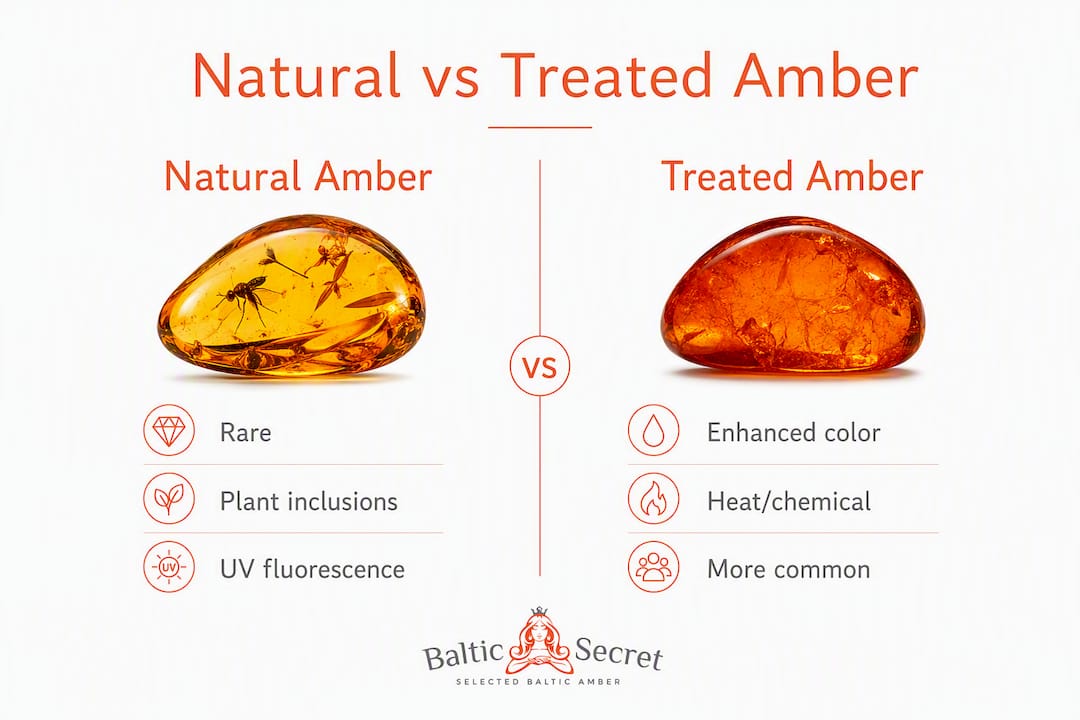
Green hues in Baltic amber range from a pale, almost sage yellow-green to a saturated peridot-like green. The pale end is more likely natural; the vivid end almost always points to treatment. Collectors who know this tend to prize the subtle tones precisely because they’re harder to fake convincingly.
Why does amber appear green — natural causes vs. market treatments?
Green color in amber has two very different origins, and telling them apart is the central challenge for any buyer.
Natural causes are relatively uncommon. Green tones can result from plant inclusions embedded in the resin during fossilization, or from a rare fluorescence phenomenon where the amber absorbs UV light and re-emits it in the green-yellow spectrum. This fluorescence is a genuine optical property of certain Baltic specimens, and GIA notes that attractive bluish or greenish fluorescence can increase value when it’s natural. The key word is “natural” — the fluorescence should be consistent across the piece, not concentrated at the surface.

Treatments are far more common. The most widespread method is autoclave heat-and-pressure processing, which can transform amber or even copal (younger, less-polymerized resin) into a material with a green hue. A peer-reviewed study published in Gems & Gemology confirmed that the bright, peridot-like green seen in many market samples is typically produced this way rather than occurring naturally. Other treatments include surface dyeing, backing with colored foil, and stabilizing agents applied to porous specimens.
Visual clues that suggest treatment:
- Uniform, saturated green color with no variation or zoning
- Color concentrated near the surface rather than running through the piece
- Whitish-blue fluorescence under long-wave UV light (a known treatment marker)
- Absence of natural inclusions in a piece marketed as “natural”
Pro Tip: Before buying, ask the seller to photograph the piece under a long-wave UV lamp. Natural green amber typically shows a different fluorescence pattern than heat-treated material, which tends to glow whitish-blue. A seller who can’t or won’t do this is a red flag.
Treated pieces aren’t worthless. Many buyers want the green color for aesthetic reasons and don’t care whether it’s natural. The problem is paying natural-green prices for treated material. Sellers are ethically obligated to disclose treatment, and reputable ones do.
How rare is green amber, and what drives its price?
Green amber is a relatively rare color variety in the amber market. That figure covers all green amber, including treated pieces. Genuinely natural deep-green Baltic specimens are rarer still, which is why serious collectors pay a significant premium for verified natural color.
Rarity note: Natural green Baltic amber accounts for a small fraction of total amber production. Deeper greens in the market are frequently treated, which means verified natural green commands a collector premium that treated green simply cannot match.
The main value drivers, in rough order of importance:
- Color origin: Natural green outprices treated green among collectors, sometimes by a wide margin
- Color intensity and saturation: Deeper, more even natural green is more valuable than pale or uneven tones
- Clarity and transparency: Clear, transparent pieces show color best and command higher prices
- Size and carat weight: Larger raw specimens are exponentially rarer
- Inclusions: A complete insect or plant inclusion in green amber can push a single piece into the hundreds or thousands of dollars
- Documented Baltic origin: Provenance paperwork adds measurable value at auction and in collector markets
On pricing: wholesale raw amber specimens frequently trade in low-dollar-per-carat ranges, while rare inclusion-bearing or deep-color collector pieces can reach hundreds to thousands per piece depending on quality and provenance. A small, treated green bead might cost a few dollars. A natural green Baltic specimen with a trapped insect and a lab report could sell for several hundred dollars or more at auction.
Collectors who know the market tend to prize subtle, naturally occurring yellow-green tones more highly than vivid treated green. The logic is straightforward: natural green Baltic specimens are exceedingly rare, and market preference for verified natural color drives value more than raw color intensity alone.
What are the common uses, and is green amber safe for children?
Raw green amber has a wider range of uses than most buyers initially expect.
Common uses:
- Specimen collecting: Unpolished raw pieces displayed in mineral collections or used as natural art objects
- Cabochons and beads: Cleaned and shaped (but not faceted) for use in pendants, rings, and bracelets
- Polished green amber jewelry: Necklaces, earrings, and bracelets where the green color is the primary draw
- Teething necklaces and bracelets: Marketed for infants and toddlers based on claims about succinic acid absorption
The teething jewelry category requires a direct, honest conversation about safety. Amber teething necklaces are marketed on the premise that succinic acid in the amber absorbs through a baby’s skin and reduces teething discomfort. There is no clinical evidence supporting this mechanism. The American Academy of Pediatrics and the FDA have both raised concerns about amber teething jewelry due to choking and strangulation risks.
For parents who still choose amber jewelry for children, the design details matter enormously. Baltic Secret’s children’s jewelry incorporates safety clasps, breakaway features, and clear sizing guidance. These design elements reduce but do not eliminate risk. Check that any children’s piece has a documented return policy and explicit safety disclosures before purchasing.
For adult jewelry and collecting, green amber carries no safety concerns beyond its softness. Avoid wearing it during activities that could scratch or chip it.
How can you tell if green amber is natural?
Authentication works in layers. Start with what you can see, then move to simple at-home tests, and finally to lab-grade verification for high-value pieces.
Visual checks first
- Surface texture: Raw amber has an irregular, sometimes crusty exterior. Polished pieces should show consistent luster without pitting or surface crazing that might indicate a coating.
- Color zoning: Natural color in amber tends to vary slightly through the piece. Perfectly uniform, saturated green is a treatment signal.
- Inclusions: Look for plant material, insects, or air bubbles. Their presence doesn’t guarantee natural color, but their absence in a “natural” specimen is suspicious.
- Microscopy photos: Ask the seller for high-resolution macro or microscope images. Natural inclusions have specific morphology that’s hard to fake.
At-home tests and their limits
- Salt-water float test: Dissolve roughly 2.5 tablespoons of salt per cup of water. Amber floats; most glass and plastic imitations sink. This tests material type, not color origin or treatment status. Amber’s specific gravity of ~1.05–1.10 makes it buoyant in saturated brine, but some treated or composite pieces may still float.
- Long-wave UV lamp: Shine a UV lamp on the piece in a dark room. Natural Baltic amber typically shows a blue-white or pale yellow fluorescence. Whitish-blue fluorescence that’s unusually bright and surface-concentrated often indicates heat treatment.
- Hot-point and solvent tests: These can confirm resin composition but damage the piece. Skip them for any specimen you intend to keep or sell.
Lab-grade verification
The gold standard is FTIR spectroscopy, which can identify the “Baltic shoulder” — a specific absorption feature around 1150–1250 cm⁻¹ that indicates Baltic origin. Combined with 13C NMR analysis, these tests can also reveal treatment history. Lab access is required, and testing can be expensive, but for a high-value natural green specimen, it’s the only way to be certain.
Pro Tip: When contacting a seller about a green amber piece, ask specifically: “Can you provide an FTIR report showing the Baltic shoulder, and does the report address whether the color is natural or treated?” A seller with legitimate natural green stock will know exactly what you’re asking.
Where is green amber found, and how do you source it in the United States?
The Baltic Sea region — primarily Lithuania, Latvia, and the Kaliningrad enclave of Russia — produces the most commercially significant amber in the world. Baltic amber is distinguished from Dominican and Mexican amber by its age (roughly 44 million years old), its chemical composition, and the FTIR Baltic shoulder signature. Dominican amber, found primarily in the Dominican Republic and parts of Mexico, is younger and chemically distinct, though it can also occur in green varieties due to fluorescence.
For U.S. buyers, Lithuanian-origin amber carries the strongest provenance documentation because Lithuanian suppliers have established export and certification practices. Documented Baltic origin increases value and provides a paper trail for authentication.
U.S. sourcing channels:
- Specialist e-commerce vendors with documented Lithuanian or Baltic sourcing and available lab reports (Baltic Secret is one such option)
- Mineral and gem shows (Denver Gem & Mineral Show, Tucson Gem Show) where dealers sometimes carry raw Baltic specimens
- Auction platforms where provenance documentation varies widely — always request lab reports before bidding on high-value pieces
- Local gemstone dealers who specialize in organic gems; availability of green Baltic amber specifically is limited
Timeline expectations: ordering from a verified e-commerce vendor typically means delivery within one to two weeks for U.S. addresses. Finding a specific natural green Baltic specimen with lab documentation can take longer, especially if you’re looking for inclusion-bearing pieces or collector-grade material. Be prepared for a search that spans weeks or months if natural color is non-negotiable.
How do you care for raw green amber?
Amber is soft and chemically sensitive. The care rules are simple but worth following consistently.
Daily wear:
- Keep amber away from perfumes, hairspray, and household solvents — these can cloud or dissolve the surface
- Remove amber jewelry before swimming, showering, or doing dishes
- Avoid direct, prolonged sunlight exposure, which can cause surface oxidation and color shift over time
- Don’t store amber loose with harder gemstones; even a quartz crystal will scratch it
Cleaning:
- Warm water and a small amount of mild soap, applied with a soft cloth
- Pat dry immediately; don’t soak
- No ultrasonic cleaners, steam cleaners, or chemical jewelry dips
Storage:
- Wrap pieces individually in soft cloth or store in a padded box
- Keep away from direct sunlight and heat sources
- For long-term storage, avoid sealed airtight plastic containers, which can trap moisture and off-gassing from the resin itself
Pro Tip: Collectors who prefer raw or minimally polished amber (“sea amber” in particular) often find that less-aggressively polished surfaces are more stable over time. Heavy polishing thins the outer oxidized layer, exposing fresher resin that can shift color more readily when exposed to light and air.

Buying checklist: questions to ask before you commit
Questions to ask every seller
- What is the documented origin? Ask for the specific country and region, not just “Baltic.”
- Is there a lab report? Request an FTIR report showing the Baltic shoulder, and ask whether the report addresses color origin (natural vs. treated).
- What is the exact weight and measurement? Get carat weight and dimensions in writing before purchase.
- Has the piece been treated? Ask directly about heat treatment, dyeing, backing, or surface stabilizers. A reputable seller will answer clearly.
- What is the return policy? For any piece over $50, insist on a documented return window.
- Are high-resolution photos available? Request macro or microscope images showing inclusions and surface texture.
- What are the shipping and import expectations for U.S. delivery? Confirm delivery timelines and whether duties apply.
Price expectations for U.S. buyers
Raw wholesale amber trades in low-dollar-per-carat ranges for common colors. Green amber commands a premium: treated green pieces in jewelry-grade quality typically run higher than equivalent yellow or cognac pieces, while verified natural green Baltic specimens with documentation can reach significantly higher prices per carat. Collector pieces with insect or plant inclusions in green amber can sell for hundreds to thousands of dollars per piece, depending on the quality of the inclusion and the strength of the provenance documentation.
Pricing signal: If a seller is offering “natural green Baltic amber” at prices comparable to common yellow amber with no lab documentation, treat that as a red flag. Verified natural green costs more because it’s genuinely rarer.
Red flags to avoid
- Vague origin claims (“European amber,” “natural amber” with no country specified)
- No lab report available, or a seller who dismisses the request
- Inconsistent or low-resolution photos that don’t show inclusions or surface detail
- Sellers who can’t explain the difference between natural and treated green color
For high-value pieces (collector specimens over $200–$300), consider requesting certified returns and, for new sellers, third-party escrow. Platforms like PayPal Goods & Services offer basic buyer protection; for very expensive specimens, a formal escrow service adds another layer.
How Baltic Secret sources and verifies its green amber
Baltic Secret maintains direct sourcing relationships with Lithuanian suppliers, which means the chain of custody from Baltic Sea region to U.S. buyer is documented rather than assumed. For buyers who’ve read this far and understand what “documented origin” actually means, that distinction matters.
Trust signals Baltic Secret provides:
- Documented Baltic origin for amber stock, with Lithuania as the primary sourcing region
- Authenticity documentation available on request, including FTIR-style verification for selected pieces
- High-resolution product photography showing surface texture, color, and where available, inclusions
- Safety-designed children’s jewelry with breakaway clasps and clear sizing guidance, as seen in the premium children’s amber necklace and bracelet
- Clear return policies and product guarantees
Baltic Secret offers both raw green amber pieces and finished green amber jewelry, including the luxurious green amber bead necklace and bracelet set for buyers who want a polished, wearable piece rather than a raw specimen. For buyers who want to verify a specific piece’s authenticity before committing, contacting Baltic Secret directly to request documentation is the recommended first step.
Key Takeaways
Verified natural green Baltic amber is rare, worth the extra verification effort, and available through documented-origin sellers like Baltic Secret.
| Point | Details |
|---|---|
| Natural green is rare | Green amber comprises roughly 2% of amber finds; verified natural deep green is even more rare and commands a collector premium. |
| Vivid green usually means treated | Bright, peridot-like green is typically produced by heat-and-pressure treatment; ask for FTIR documentation before paying natural-color prices. |
| Lab verification is the standard | Request an FTIR report showing the Baltic shoulder and a treatment disclosure before buying any green amber above entry-level prices. |
| Children’s jewelry requires safety design | Amber teething jewelry carries choking and strangulation risks; choose pieces with breakaway clasps and supervise wear at all times. |
| Baltic Secret offers verified options | Baltic Secret sources directly from Lithuania and provides authenticity documentation, making it a reliable path for U.S. buyers. |
The case for slowing down when buying green amber
Most buyers who get burned on green amber make the same mistake: they prioritize color over documentation. A vivid green piece is visually compelling, and sellers know it. The problem is that treated green can look identical to natural green without spectral analysis. Paying collector prices for treated material isn’t just a financial loss; it undermines the entire point of buying something rare.
The practical split is this: if you’re buying green amber for its appearance and you’re comfortable with treated material, say so and pay treated prices. There’s nothing wrong with that purchase. But if you want natural Baltic green because you understand what makes it genuinely rare, then documentation isn’t optional. An FTIR report with a Baltic shoulder confirmation and a treatment disclosure is the minimum. Anything less is a guess dressed up as a guarantee.
U.S. buyers should also factor in search time. Verified natural green Baltic amber isn’t sitting in bulk inventory at most vendors. Expect to spend time finding the right piece, and expect to pay more than you would for treated green. That’s not a problem with the market; it’s the market accurately reflecting what natural green Baltic amber actually is.
Verified green amber from Baltic Secret, ready to ship to the U.S.
Buyers who’ve done the research know what separates a trustworthy amber purchase from a gamble: documented Lithuanian origin, authenticity verification, and a seller who answers direct questions about treatment.
Baltic Secret delivers exactly that. The U.S. store carries green amber jewelry and raw amber pieces sourced directly from Lithuania, with authenticity documentation available on request. The luxurious green amber bead necklace and bracelet set is a strong starting point for buyers who want polished green amber with verified Baltic origin. For parents, the children’s line includes safety-designed pieces with breakaway clasps. Every order ships with a clear return policy. Browse the full collection at Baltic Secret’s U.S. store and contact the team directly if you want documentation for a specific piece before you buy.
Research and further reading
The sources below are the most useful for buyers who want to go deeper on green amber identification, lab testing, and market pricing.
| Source | Best used for |
|---|---|
| GIA Amber Quality Factors | Understanding value drivers: size, color, clarity, inclusions, and the “sea amber” vs. raw distinction |
| GIA Amber Buyer’s Guide | Color modification, fluorescence, and what to ask a seller before buying |
| Gems & Gemology: Green Amber FTIR/NMR Study | Lab-level detail on treatment detection, FTIR Baltic shoulder, and NMR markers for green amber |
| GemRockAuctions Amber Information | Market pricing context, rarity estimates, and collector-grade vs. jewelry-grade distinctions |
How to use these when talking to a seller: Cite the Gems & Gemology study when requesting FTIR documentation and ask specifically whether the report addresses the Baltic shoulder absorption feature. Reference GIA’s buyer’s guide when asking about color modification disclosures. If a seller is unfamiliar with these sources, that’s useful information about their expertise level.
This article provides general educational information about amber identification and purchasing. It is not professional gemological advice. For high-value purchases, consult a certified gemologist or request testing from a recognized gemological laboratory.