Grading Baltic Amber Quality: Buyer's Guide

Grading Baltic amber quality is the process of evaluating a specimen’s physical properties, visual characteristics, and provenance documentation to determine its authenticity and true market value. Whether you are buying a polished necklace for daily wear, selecting beads for a child, or building an investment collection, the same core framework applies: inspect clarity and color, test physical properties, verify inclusions, and confirm certification. This guide covers every layer of that process, from simple at-home checks to laboratory-grade spectroscopy, so you can assess any piece with confidence.
What physical and visual characteristics determine Baltic amber quality?
Baltic amber quality assessment starts with what you can see and measure without any equipment. The industry term for this material is succinite, the fossilized resin of ancient conifer trees from the Baltic Sea region, and understanding its natural range of appearances is the foundation of any grading Baltic amber quality guide.
Clarity and color
Clarity in Baltic amber runs a spectrum from fully transparent to completely opaque, and market value depends heavily on where a specimen falls. Transparent pieces with a warm cognac or honey tone command premium prices because they allow light to pass through and reveal internal features. Opaque or “milky” amber, sometimes called bone amber, is less rare but has its own collector appeal, particularly in antique jewelry. The color range itself is remarkable: yellow, orange, cognac, green, blue, and even rare red amber all exist naturally, and rarer colors carry higher price tags.
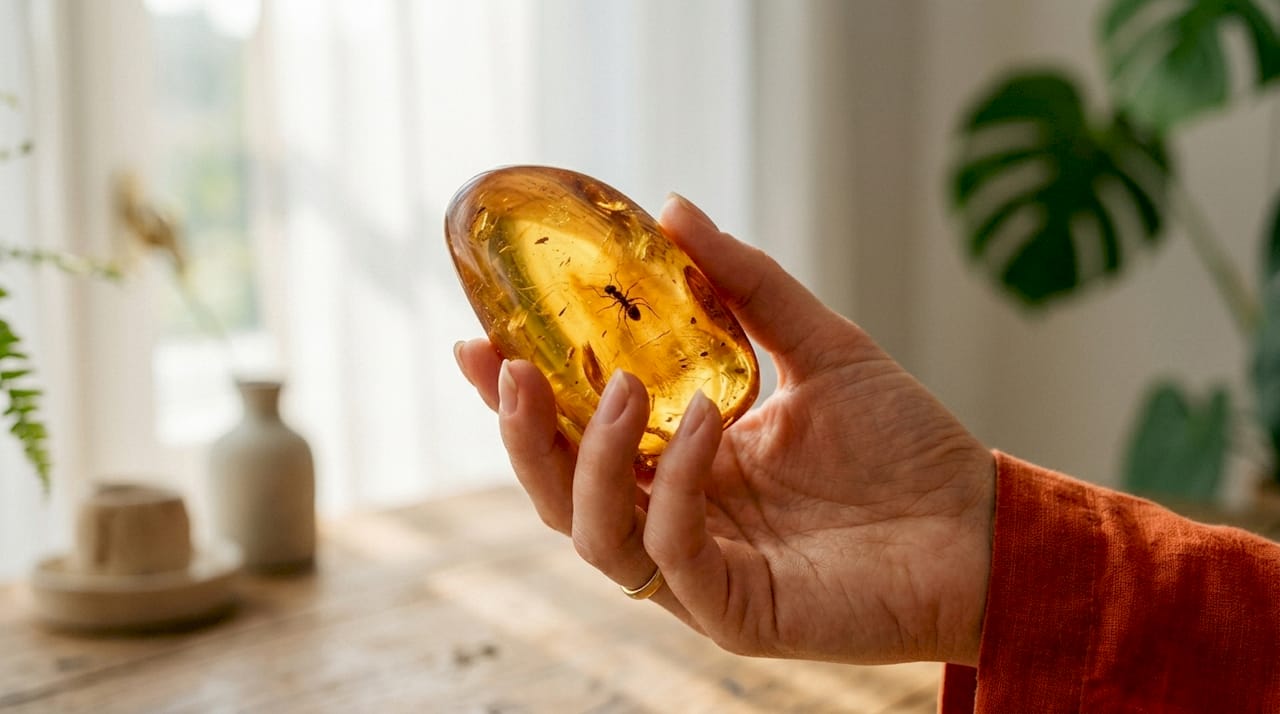
Inclusions are the single most exciting quality factor in amber grading. An insect, plant fragment, or air bubble trapped inside a piece 44 million years ago is a direct window into prehistoric life. Highly valued specimens feature clearly visible insect inclusions with intact limbs and natural positioning. What separates a genuine inclusion from a reconstructed fake is the surrounding matrix: authentic inclusions show chaotic, asymmetric patterns in the resin around them, while reconstructed amber displays suspicious uniformity or perfect symmetry that no natural process produces.
Physical properties that matter
Baltic amber sits at roughly 2 to 3 on the Mohs hardness scale and carries a specific gravity of 1.05 to 1.09. These numbers matter because they underpin the most reliable non-destructive screening tests. A piece that feels unusually heavy for its size, or that scratches too easily, is worth scrutinizing further. Natural amber also builds up a static charge when rubbed against wool, a property that plastic and glass imitations do not replicate reliably.
Pro Tip: Hold a suspected piece of amber up to a strong light source and rotate it slowly. Genuine Baltic amber shows depth and subtle internal cloudiness or flow patterns. Plastic imitations look flat and uniform throughout.
One critical distinction for buyers is the difference between natural, treated, and reconstructed amber. Natural amber is unaltered beyond cutting and polishing. Treated amber may be heat-clarified or pressure-treated to change its appearance. Reconstructed amber, sometimes called pressed amber, is made from small fragments fused under heat and pressure. Physical tests alone cannot reliably separate treated or reconstructed pieces from natural ones, which is why visual inspection must be paired with additional methods.
Which simple at-home tests help with grading and authenticity?
Practical amber quality assessment does not require a laboratory to get started. Several accessible tests provide useful preliminary evidence, and using them together significantly raises your confidence level before committing to a purchase.
-
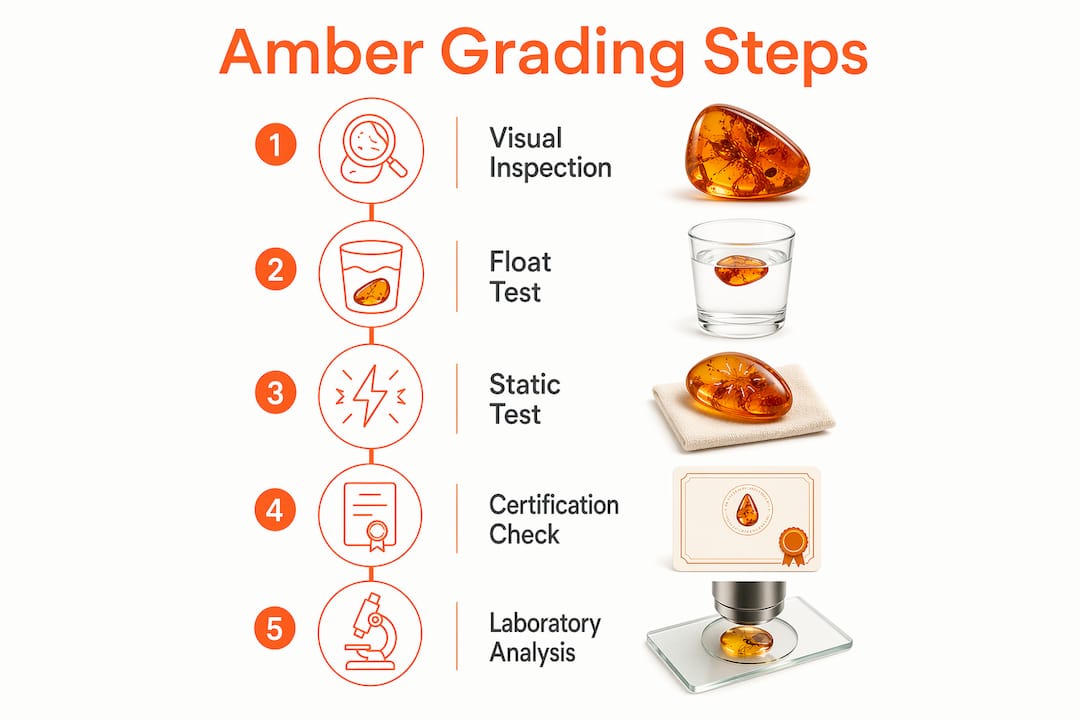
Saltwater float test. Dissolve 2 to 3 tablespoons of salt in a glass of water and drop your specimen in. Authentic Baltic amber floats because its specific gravity falls below that of saturated saltwater. Glass and most stones sink immediately. Some plastics also float, so this test screens out obvious fakes but does not confirm authenticity on its own.
-
Static electricity test. Rub the piece vigorously against a wool cloth for 20 to 30 seconds, then hold it near small pieces of paper or tissue. Genuine amber attracts the paper through static charge. Plastic imitations rarely generate the same effect. This test is quick and leaves no marks on the specimen.
-
Scratch and hardness check. Use a copper coin or your fingernail carefully on an inconspicuous spot. Amber at 2 to 3 Mohs scratches with moderate pressure. Glass will not scratch at all, and soft plastics scratch too easily. Approach this test with caution on finished jewelry, since it can damage a polished surface.
-
Heated scent test. Touch a hot needle to a hidden area of the piece and smell the result. Authentic Baltic amber produces a distinctive resinous, incense-like scent. Plastic smells acrid and chemical. This test is destructive at the contact point, so reserve it for loose beads or raw specimens rather than finished pieces.
-
Magnified visual inspection. Use a 10x loupe or jeweler’s magnifier to examine inclusions and surface texture. Genuine inclusions show irregular, organic positioning. Bubbles in natural amber are elongated and random. Perfectly round bubbles in a uniform pattern indicate glass or resin casting.
Pro Tip: Never rely on a single test result. Combining float, static, and visual checks with at least one confirmatory method gives you a defensible assessment. For any piece above $100 in value, treat home tests as screening only and follow up with professional analysis.
The reason no single home test is definitive is that treated and reconstructed amber can pass individual checks. A piece of pressed amber floats, generates static, and smells like resin when heated, because it is made from real amber fragments. Only the combination of tests, plus attention to inclusion patterns and surface flow lines, reveals the reconstruction.
How do certification and provenance affect amber grading?
Documentation is the layer of amber quality assessment that most buyers overlook, and it is the one that matters most for investment purchases. A certificate without verifiable metadata is worth nothing. A well-documented provenance trail, on the other hand, protects your purchase and supports resale value years later.
The two most recognized bodies in Baltic amber certification are the National Amber Chamber in Gdansk, Poland, and the International Amber Association (IAA). Both organizations maintain standards for authenticity verification and treatment disclosure. When a seller provides a certificate, check for these specific elements:
- A unique specimen ID that matches a marking on the piece itself
- The full name and contact details of the issuing laboratory or gemologist
- The report date and a clear statement of any treatments applied
- The analyst’s signature and credentials
Certification documents must include this metadata to enable traceability. Without a unique ID tied to the physical specimen, there is no way to confirm the certificate belongs to the piece you are holding. Sellers who offer vague “certificates of authenticity” printed on their own letterhead without lab backing are not providing meaningful documentation.
For investment buyers, the provenance trail extends beyond the certificate itself. Ask the seller directly: Was this piece heat-treated or clarified? Is it natural, treated, or reconstructed? What is the geographic source? A reputable seller sources directly from Lithuania or the Kaliningrad region of Russia and can answer these questions without hesitation. Re-test certificates older than three years before resale, since grading standards evolve and older reports may not reflect current laboratory methods.
One important reality: no unified government standard governs Baltic amber certification globally. This means the buyer carries the responsibility of verification. Buying from established retailers who source directly from the Baltic region and provide lab-backed documentation is the most reliable way to reduce that risk.
What advanced scientific methods are used in professional amber grading?
Laboratory analysis is the definitive tier of Baltic amber grading, and two techniques stand above all others: Fourier Transform Infrared spectroscopy (FTIR) and Raman spectroscopy.
FTIR works by measuring how a material absorbs infrared light across a range of wavelengths. Baltic amber succinite produces a characteristic absorption peak at 1250 to 1175 cm-1, a spectral fingerprint tied directly to its succinic acid content. No other fossil resin or synthetic material produces exactly this pattern. A 2025 peer-reviewed study confirmed these IR absorption bands as definitive markers for Baltic amber identification, making FTIR the gold standard for high-value authentication.
Raman spectroscopy complements FTIR by assessing the maturity of the resin at a molecular level. Younger or less-mature resins, sometimes sold as amber but technically classified as copal, show different Raman profiles than true fossilized amber. This distinction matters because copal can pass visual and physical tests but lacks the geological age and chemical stability of genuine Baltic amber.
| Method | What it detects | Best use case |
|---|---|---|
| FTIR spectroscopy | Succinic acid absorption bands at 1250 to 1175 cm-1 | Confirming Baltic amber vs. other resins or fakes |
| Raman spectroscopy | Resin maturity and molecular structure | Distinguishing true amber from copal |
| Succinic acid chemical test | Presence of succinic acid as a chemical marker | Secondary confirmation for investment pieces |
| Physical property testing | Specific gravity and hardness ranges | Initial screening and sorting |
The practical implication for buyers is straightforward. FTIR is the most reliable method for confirming Baltic amber authenticity and should be requested for any specimen valued above a few hundred dollars. Many gemological laboratories, including those affiliated with the Gemological Institute of America (GIA) and independent Baltic amber specialists in Lithuania and Poland, offer FTIR testing for a modest fee. The cost of a lab report is trivial compared to the risk of paying investment prices for a pressed or synthetic piece.
Baltic amber grading is shifting toward objective scientific verification, with FTIR increasingly replacing appearance-only assessments for serious collectors. Visual grading remains useful for comparing pieces within a confirmed-authentic collection, but it cannot stand alone as the basis for a significant purchase.
Key takeaways
Grading Baltic amber quality requires combining physical inspection, at-home tests, certification verification, and laboratory analysis to confirm authenticity and assess true value.
| Point | Details |
|---|---|
| Visual inspection is the starting point | Assess clarity, color, and inclusion naturalness before applying any tests. |
| Home tests screen but do not confirm | Use saltwater float, static, and scent tests together, never in isolation. |
| Certification requires verifiable metadata | Demand unique specimen IDs, lab names, and report dates on any certificate. |
| FTIR is the definitive grading tool | Request FTIR analysis for any piece valued above a few hundred dollars. |
| Inclusions signal authenticity | Natural inclusions show chaotic, asymmetric patterns; uniform patterns indicate reconstruction. |
Why I trust the multi-layer approach over any single test
I have handled hundreds of Baltic amber pieces over the years, and the single biggest mistake I see buyers make is trusting one test too much. Someone floats a bead, it rises to the top, and they are convinced. But pressed amber floats too. It smells right when heated. It even generates static. The only thing that gives it away is the flow lines under magnification and, ultimately, a lab report.
The second mistake is over-valuing certificates without reading them carefully. I have seen beautifully printed documents that list no lab name, no specimen ID, and no analyst signature. They look official and say nothing. A certificate from the International Amber Association or a named gemological laboratory with a traceable ID is a completely different document from a seller’s self-issued “authenticity card.”
What I find genuinely underappreciated is the inclusion assessment. Most buyers focus on whether an inclusion is present, but the real skill is reading how it sits in the resin. A genuine insect inclusion is surrounded by stress fractures and irregular flow patterns from the original entrapment. A planted inclusion in reconstructed amber sits in clean, undisturbed resin. That difference is visible under a 10x loupe and takes about 30 seconds to check once you know what you are looking for.
For anyone buying authentic amber pendants or investment-grade pieces, patience is the real advantage. Take the time to request documentation, apply multiple tests, and send high-value specimens to a lab. The amber market rewards educated buyers.
— Amber
Authentic Baltic amber from a source you can trust
Balticsecret sources every piece directly from Lithuania, where Baltic amber has been harvested and crafted for centuries. Each product in the collection, from polished amber necklaces and bracelets to certified children’s jewelry, comes with full authenticity backing and transparent treatment disclosure. For parents choosing a safe, certified children’s necklace, or collectors seeking verified specimens, Balticsecret provides the documentation and sourcing transparency this guide recommends. Every piece is graded for quality before it reaches you, so the work of verification is already done.
FAQ
What is the most reliable way to grade Baltic amber at home?
The most reliable at-home approach combines the saltwater float test, static electricity test, and magnified visual inspection of inclusions. No single home test confirms authenticity, so always use at least three methods together before drawing a conclusion.
How do I know if a Baltic amber certificate is legitimate?
A legitimate certificate includes a unique specimen ID, the issuing laboratory’s name and contact details, the report date, and the analyst’s signature. Certificates without a traceable lab name or specimen ID provide no meaningful verification.
What does FTIR spectroscopy prove about Baltic amber?
FTIR spectroscopy identifies Baltic amber by its characteristic absorption peak at 1250 to 1175 cm-1, a spectral fingerprint tied to succinic acid content that no other resin or synthetic material replicates exactly.
Is transparent or opaque Baltic amber more valuable?
Transparent amber with warm cognac or honey tones and clearly visible insect inclusions commands the highest market prices. Opaque or milky amber has collector appeal but generally trades at lower values than high-clarity specimens.
What is the difference between natural, treated, and reconstructed Baltic amber?
Natural amber is unaltered beyond cutting and polishing. Treated amber has been heat-clarified or pressure-processed to change its appearance. Reconstructed amber is made from fused fragments and can pass most home tests, making laboratory analysis the only reliable way to distinguish it from natural material.