Does Amber's Succinic Acid Actually Soothe? The Science

Baltic amber contains succinic acid, but the peer-reviewed evidence says intact, polished beads do not release it under skin-like conditions, and succinic acid did not reduce inflammation in laboratory testing at safe concentrations. The main study behind this conclusion, published in BMC Complementary Medicine and Therapies, soaked real amber beads in fluid matched to skin pH and body temperature for weeks and measured nothing. A companion analysis in the same peer-reviewed dataset tested succinic acid directly against human immune cells and found no consistent anti-inflammatory action at levels a body could tolerate.
That does not mean every amber necklace claim is worthless or that the stone itself is fake. It means the specific mechanism sellers describe, warmth releasing succinic acid into skin, does not hold up once you put it under lab conditions.
Here is what this article covers next:
- Why the leaching and anti-inflammatory claims fail under testing
- The real physical safety risks of children’s and pets’ amber jewelry
- How to verify a piece is genuine Baltic amber before you buy
- Where succinic acid actually shows measurable biological activity
- What Baltic Secret does differently with certified, safety-checked pieces
TL;DR:
- Intact Baltic amber beads do not release measurable amounts of succinic acid under skin-like conditions, even after weeks of exposure.
- Laboratory tests show no consistent anti-inflammatory effect from succinic acid at safe concentrations, and higher doses prove toxic to immune cells.
- Broken or fragmented beads are both a choking hazard and the only scenario where trace amounts of succinic acid might be present on the skin.
- Authenticity verification should include infrared spectroscopy or origin documentation, as appearance alone is insufficient to confirm genuine Baltic amber.
- Baltic Secret offers certified Baltic amber jewelry with safety features like knotted beads and safety-release clasps, emphasizing genuine provenance over unproven health claims.
Table of Contents
- What the Lab Evidence Says About Gintaro Rūgštis Nauda
- Is Amber Jewelry Safe for Babies and Pets?
- How Do You Know if Amber Is Real?
- How Does Succinic Acid Work in the Body?
- What Does the Research Say About Ingested Succinic Acid?
- Are There Side Effects From Succinic Acid?
- Where Else Does Succinic Acid Come From?
- Natural vs. Synthetic Succinic Acid: Does the Source Matter?
- Our Take: Sell the Stone, Not the Science
- Get Certified Baltic Amber Without the Unproven Claims
- Key Takeaways
- Sources
What the Lab Evidence Says About Gintaro Rūgštis Nauda
Gintaro rūgštis, the Lithuanian term for succinic acid, is genuinely present in Baltic amber. The resin, technically called succinite, contains roughly 3 to 8 percent succinic acid by weight locked into its structure. The question that matters for anyone shopping for a soothing necklace or collar isn’t whether the compound exists. It’s whether wearing the jewelry does anything with it.
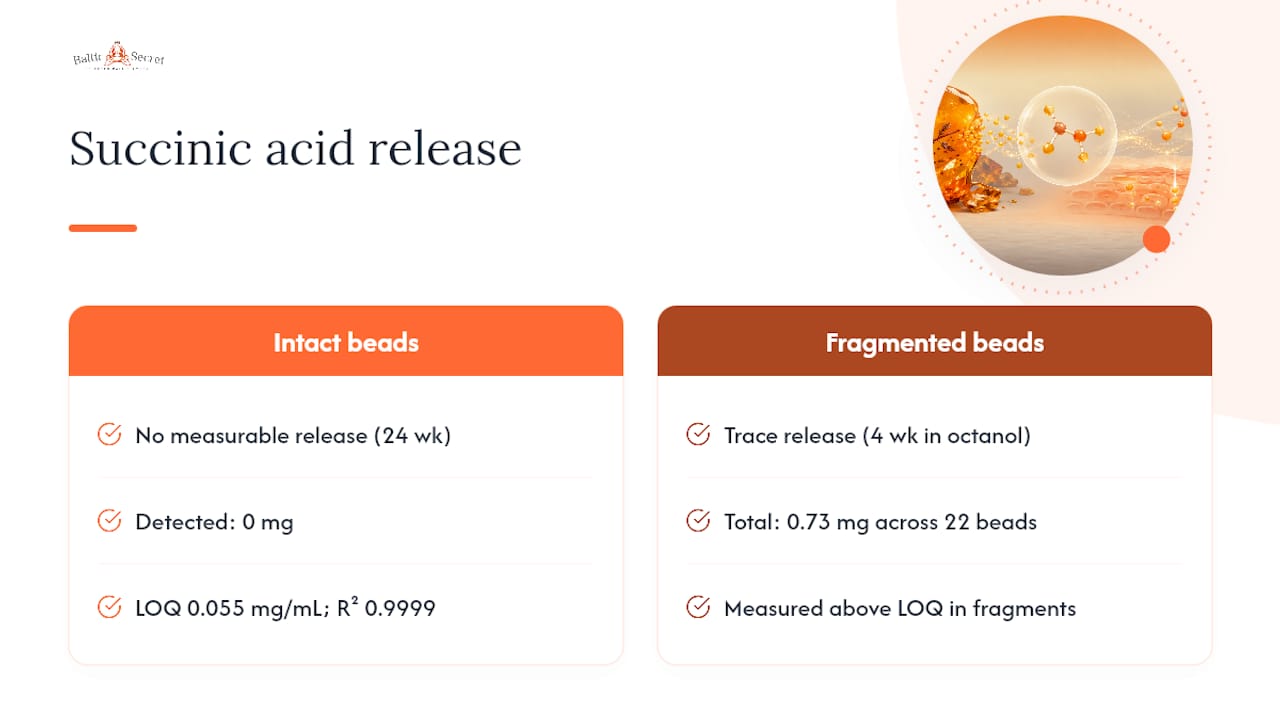
The most direct answer comes from a study that measured succinic acid in real teething necklace beads using HPLC, a standard chromatography method for isolating and quantifying compounds. They then submerged intact beads in phosphate-buffered saline at pH 5.5 (matching skin’s natural acidity) and in octanol at 37°C (mimicking skin lipids at body temperature) for up to 24 weeks.
No measurable succinic acid leached out of intact beads during that entire period.
The only beads that released anything were fragmented, light-colored ones, and even those gave up just 0.73 mg total across 22 beads over four weeks in octanol. The researchers backed this with tight analytical controls: a limit of quantification of 0.055 mg/mL and a standard curve with an R² of 0.9999, meaning the “no release” finding isn’t a measurement gap. It’s a real result.
The same research team ran macrophage assays, exposing immune cells to succinic acid and measuring inflammatory markers including IL-1α, IL-1β, IL-8, TNFα, and PGE2. At concentrations low enough to be safe, there was no consistent drop in these markers. At concentrations high enough to show any biological effect, the cells showed signs of toxicity rather than a therapeutic response.
Separate analytical chemistry work confirms Baltic amber can be chemically fingerprinted. Free succinic acid in Baltic amber extracts runs 50 to 400 parts per million, a signature other fossil resins don’t share, which is genuinely useful for authentication. But detectable-in-a-lab-extract and available-through-skin-contact are two entirely different claims, and only the second one matters for the “wear it and feel calmer” pitch. Commentary summarized by ScienceDaily makes the same point: the succinic acid in amber is mostly bound into the resin’s macromolecular structure, not sitting loose and ready to transfer to skin.
Is Amber Jewelry Safe for Babies and Pets?
The chemistry question turns out to be less urgent than the physical one. Amber jewelry on a baby or a small pet carries mechanical risks that exist whether or not succinic acid does anything at all.
The hazards are well established and worth taking seriously:
- Choking. A bead that separates from a broken strand is small enough for an infant to swallow or aspirate.
- Strangulation. Necklaces worn during sleep or unsupervised play can catch on crib rails, furniture, or a child’s own hands.
- String and clasp failure. Cheap elastic or thread degrades with saliva, washing, and repeated pulling, raising the odds of a strand snapping.
- Skin irritation. Some children react to the cord material or metal clasp components rather than the amber itself.
Consumer health resources including BabyCenter are blunt about this: there’s no clinical evidence the necklaces relieve teething pain, and the physical risks are real regardless of the chemistry debate. The safest general rule is to remove any necklace before sleep or unsupervised time, whether it’s on a baby or a toddler still exploring the world mouth-first.
There’s a chemistry footnote worth knowing here too. Remember that only fragmented beads released any trace succinic acid in testing. That means a broken bead is worse on two fronts at once: it’s the choking hazard everyone worries about, and it’s also the only scenario where any of the marketed compound would actually reach skin, in trace amounts nobody has shown to be therapeutic.

Pro Tip: Check every bead on a child’s or pet’s amber piece monthly by running the strand between your fingers. Any bead that feels loose, chipped, or has a hairline crack means the whole piece gets retired, not repaired.
Stick to screw clasps or safety-release clasps rather than simple knots, and keep pieces away from water exposure beyond a quick wipe, since prolonged wetting weakens most stringing materials faster than the amber itself degrades. For pets, our guide to monitoring collar wear covers collar-specific inspection routines.
How Do You Know if Amber Is Real?
Authenticity and safety are the same conversation, in practice. A seller who can’t answer questions about origin usually hasn’t thought hard about safety features either.
Ask for an infrared spectroscopy report or a stated succinic acid content range before you buy. IR spectroscopy identifies amber’s molecular fingerprint and is the standard method labs use to confirm Baltic origin versus copal, plastic, or other imitation resins. A seller who can point to testing, even informally, is operating differently from one who just says “genuine amber” on a product tag.
Physical checks you can do yourself:
- Weight. Real amber is light, roughly the density of water, so a piece that feels unusually heavy for its size may be glass or resin.
- Color range. Baltic amber runs from pale honey to deep cognac to cherry red; uniform, glassy, perfectly consistent color across every bead is a red flag for plastic.
- Warmth response. Amber warms quickly against skin and feels slightly resinous rather than cold like glass or metal.
- Inclusions. Genuine amber sometimes shows tiny natural imperfections or organic inclusions; suspiciously flawless beads deserve a second look.
For babies and pets specifically, look for bead sizes appropriate to the wearer (avoid tiny beads that separate easily), knotting between every bead so a break doesn’t scatter the whole strand, and a clear return policy that signals the seller stands behind their claims.
| What to check | Why it matters |
|---|---|
| IR spectroscopy or origin certificate | Confirms Baltic amber versus imitation resin or plastic |
| Knots between beads | Limits how many beads scatter if the strand fails |
| Clasp type | Screw or safety-release clasps reduce strangulation risk |
| Seller transparency | Refusal to discuss testing or safety is a warning sign |
Walk away from prices that seem too low for “certified” amber. Genuine Baltic material, properly sourced and safety-tested, has a cost floor that rock-bottom pricing usually can’t meet. Our authentic amber collar checklist walks through the same verification steps for pet owners.
How Does Succinic Acid Work in the Body?
Succinic acid isn’t a novel or exotic compound. It’s a normal intermediate in the citric acid cycle (also called the Krebs cycle), the metabolic pathway every cell uses to convert food into usable energy. In that role, succinate acts as both a metabolic fuel and a signaling molecule, binding to a specific receptor called SUCNR1 found on various cell types, including some immune cells.
This dual role, energy metabolism plus cell signaling, is why succinic acid shows up in research on inflammation, metabolic regulation, and even wound healing, but almost all of that research examines succinate generated or introduced inside the body through metabolism or ingestion. It’s a different exposure route entirely from a compound theoretically migrating out of a solid amber bead through intact skin.
The receptor-binding activity explains why isolated succinic acid, at the right concentration and delivery method, can influence immune cell behavior in a lab dish, which is exactly what the macrophage assays tested for amber-derived succinic acid specifically. The mechanism is biologically real. The dose and delivery method proposed by amber jewelry sellers simply doesn’t match how that mechanism has been shown to work.
Succinic acid’s biological relevance, in short, is well documented in metabolic and cell-signaling research. What isn’t documented is a pathway by which sitting in a bead and warming against skin gets it into that system in a meaningful amount.
What Does the Research Say About Ingested Succinic Acid?
Most of the clinical and biochemical interest in succinic acid centers on ingestion or controlled delivery, not topical exposure. Research in this space treats succinic acid as a metabolic intermediate or a food-grade additive rather than a jewelry ingredient, and the two bodies of literature rarely overlap.
Some early-stage pharmaceutical research treats amber and related resins as a chemical resource worth investigating for drug development, an entirely different application from wearing a necklace. That distinction matters because it’s easy to see a headline about amber’s chemistry and assume it validates the jewelry claim; it doesn’t. Work in this space is about isolating and testing specific compounds in controlled formulations, the kind of study that takes years and produces a pharmaceutical candidate, not a bead you wear on a wrist.
For anyone comparing sources of succinic acid, it also helps to know it’s already present in some fermented foods, certain fruits, and as a naturally occurring metabolic byproduct in every human cell. That ubiquity is part of why researchers find it interesting as a signaling molecule, and part of why it’s hard to isolate amber’s specific contribution to any health outcome. The honest summary of the research landscape is that succinic acid, as a molecule, has legitimate biochemical interest attached to it. Baltic amber jewelry, as a delivery method for that molecule, does not have supporting evidence behind it.
Are There Side Effects From Succinic Acid?
At normal metabolic levels, succinic acid isn’t something the body treats as foreign. It’s produced internally as part of routine cellular energy production, so there’s no meaningful “side effect” profile at the concentrations naturally present in the body.
The picture changes at high, non-physiological concentrations. The macrophage testing that evaluated amber-derived succinic acid found that concentrations high enough to produce any measurable cellular effect also produced signs of toxicity rather than a therapeutic benefit. That’s a useful data point for anyone assuming “natural” automatically means “no downside”: dose determines outcome here, the same way it does for nearly every compound in biochemistry.
For amber jewelry specifically, this concern is somewhat theoretical since intact beads don’t release measurable succinic acid to skin in the first place. But it reinforces a broader point worth remembering if you encounter succinic acid marketed in other consumer contexts: more isn’t automatically safer or more effective, and concentration matters as much as source.
There’s no established data suggesting topical or trace exposure to succinic acid from jewelry causes contact irritation on its own. Reported skin reactions to amber jewelry are far more often tied to the cord, thread, or metal clasp components than to the amber itself.
Where Else Does Succinic Acid Come From?
Baltic amber isn’t succinic acid’s only source, and it’s worth knowing what else is out there if you’re evaluating claims about the compound in general.
Succinic acid occurs naturally in a range of foods, including rhubarb, fermented products, and certain cheeses, and it’s produced industrially at scale for use as a food acidity regulator, listed under the additive code E363. It’s also manufactured synthetically through chemical processes and, more recently, through fermentation using engineered microorganisms, a production method that’s grown because succinic acid serves as a building block for biodegradable plastics and other industrial chemicals.
In supplement form, succinic acid shows up occasionally as an isolated ingredient in metabolic-support formulations, usually as succinic acid or a succinate salt in capsule or powder form. These formulations deliver a controlled, measurable dose through ingestion, the same exposure route the metabolic research above actually studies.
That’s the key structural difference from amber jewelry: a supplement capsule delivers a known quantity through a digestive pathway with decades of absorption research behind it. A solid amber bead relies on an unproven transfer mechanism through intact skin that laboratory testing has specifically failed to detect. Both contain the same molecule. Only one has a demonstrated way of getting it into the body in a measurable amount.
Natural vs. Synthetic Succinic Acid: Does the Source Matter?
Chemically, succinic acid from Baltic amber and succinic acid produced synthetically or through fermentation are the identical molecule. Once isolated and purified, a lab cannot tell a “natural” succinic acid molecule apart from a synthetic one, because there’s no structural difference between them.
Where the sources genuinely differ is in form and delivery, not in the molecule’s underlying chemistry. Amber’s succinic acid is bound into a solid resin matrix that lab testing shows does not release it under skin contact. Synthetic or fermentation-derived succinic acid used in supplements or food additives is isolated, purified, and dosed at a known concentration, typically for ingestion.
This means the “natural is automatically better” framing doesn’t really apply here, because the natural version, as delivered through jewelry, hasn’t been shown to deliver anything at all. If a study eventually demonstrates a genuine benefit from ingested or topically applied succinic acid, that benefit would come from the concentration and delivery method used in that specific research, not from whether the original molecule started in a fossilized tree resin or a fermentation tank.
For amber jewelry buyers, the practical takeaway is to stop evaluating “natural amber” against “synthetic supplement” as if picking a winner and focus instead on what the jewelry itself can actually deliver: an authentic, well-made natural stone with genuine provenance, worn for its beauty and heritage rather than a chemical mechanism the evidence doesn’t support.
Our Take: Sell the Stone, Not the Science
The honest position, based on where the research actually lands, is that Baltic amber is a genuine, beautiful natural material with real provenance and craft behind it, and the succinic acid soothing story doesn’t survive contact with a lab bench. Those two facts aren’t in tension. A piece of jewelry can be entirely worth buying, wearing, and gifting without a chemical mechanism attached to it.
Where the conventional retail pitch falls short is treating “contains succinic acid” as equivalent to “delivers succinic acid,” when the best available testing says intact beads don’t do the second thing. That gap between what’s technically true and what’s practically true is exactly where misleading marketing lives, in amber and in plenty of other product categories.
What we’d prioritize instead: buy amber because it’s a genuine Baltic material with a fascinating geological history, verify that origin with real documentation, and treat any soothing or therapeutic language as a bonus story rather than the reason for the purchase. Safety features and honest sourcing are the things a good seller can actually prove.
— Baltic Secret
Get Certified Baltic Amber Without the Unproven Claims
Baltic Secret sells amber for what it verifiably is: genuine, Lithuania-sourced Baltic amber, not a chemistry claim we can’t back up. Every piece is sourced directly rather than through resellers, and product pages list bead sizes, clasp types, and safety features so parents and pet owners can make an informed choice before checkout.
For babies and toddlers, the premium polished teething necklace and bracelet set uses knotted stringing between beads and a screw clasp designed to break away under pressure rather than tighten. Our teething beads safety guide covers monitoring routines you should pair with any necklace purchase, and pet owners can check bead durability and fit against our amber collar comparison before choosing a size. If a metal clasp component is a concern for sensitive skin, hypoallergenic stainless steel options from partner sources are worth comparing against standard clasps.
Browse the full Baltic Secret amber collection to see sizes, certifications, and care instructions for every piece before you buy.
Key Takeaways
Baltic amber’s soothing reputation rests on succinic acid that intact beads do not measurably release, so the real value of the jewelry lies in authenticity and craftsmanship, not an unproven chemical mechanism.
| Point | Details |
|---|---|
| Intact beads don’t release succinic acid | Lab testing over 24 weeks found no measurable release under skin-like pH and temperature. |
| No verified anti-inflammatory effect | Macrophage assays showed no consistent benefit at safe concentrations, and toxicity at high ones. |
| Broken beads raise two risks at once | Fragmented beads are both a choking hazard and the only scenario with trace chemical release. |
| Verify origin before buying | Ask for IR spectroscopy results or origin documentation, not just a “genuine amber” label. |
| Baltic Secret sells certified, safety-featured pieces | Direct Lithuania sourcing with listed sizes, clasps, and care guidance on every product page. |
Sources
- Baltic amber teething necklaces: could succinic acid leaching from beads provide anti-inflammatory effects?
- Baltic amber teething necklaces: could succinic acid leaching from beads provide anti-inflammatory effects? (PMC)
- Method for evaluating free succinic acid in ambers (2009, John Wiley & Sons)
- Do amber teething necklaces work? | BabyCenter