How to Measure a Bracelet: Wrist Sizing Made Simple

Wrap a flexible tape measure or a piece of string just below your wrist bone, pull it snug but not tight, and read the number in centimeters. That’s your wrist circumference. From there, the rule is simple: add 0.5 cm if you want a snug fit, 1.0 cm for a regular everyday fit, or 1.5 cm if you like a bracelet that moves and swings a little. Many women have wrist measurements within a typical adult range, and men generally have larger wrist sizes, so if your tape reads within common adult sizes, you’re in normal territory.
- Measure below the wrist bone, hand relaxed, palm up
- Snug fit: wrist + 0.5 cm
- Regular fit: wrist + 1.0 cm
- Loose fit: wrist + 1.5 cm
Quick reference: A 16 cm wrist with a regular fit needs a 17 cm bracelet.
Key Takeaways
Accurate bracelet sizing comes down to one measurement, taken correctly below the wrist bone, plus a deliberate choice about how loose you want the fit.
| Point | Details |
|---|---|
| Measure below the wrist bone | Use a flexible tape or string with hand relaxed, palm up, for the most accurate reading. |
| Apply the right allowance | Add 0.5 cm for snug, 1.0 cm for regular, or 1.5 cm for a loose fit. |
| Round up between sizes | If your measurement falls between two chart rows, choose the larger size for comfort. |
| Adjust for bracelet type | Beaded, chain, and bangle styles each need different allowances based on construction. |
| Check Baltic Secret for amber pieces | Baltic Secret recommends a +1.0 cm allowance for adult amber bracelets and offers custom sizing support for children’s pieces. |
Table of Contents
- Tools and Simple Prep for Measuring Your Wrist
- Step-by-Step: How to Measure Your Wrist for a Bracelet
- What Bracelet Length Should You Actually Buy?
- Bracelet Size Chart: Wrist Circumference to Length
- How Bracelet Style Changes the Fit
- Baltic Secret’s Approach to Sizing and Safety
- What Most Sizing Guides Get Wrong
- Ready to Find Your Perfect Amber Bracelet Size
- Sources
Tools and Simple Prep for Measuring Your Wrist
A soft, flexible tape measure, the kind used for sewing, gives the cleanest reading because it follows the curve of your wrist without adding pressure. No tape on hand? A strip of string or a narrow piece of paper works fine as long as you lay it flat against a ruler afterward.
A few details change the outcome more than people expect:
- Measure with your hand relaxed and palm facing up, not clenched
- Skip the measurement right after being outside in cold weather, since cold can shrink hand and wrist tissue slightly
- For a child’s wrist, measure gently and expect a smaller allowance than an adult’s
- If you’re sizing for a bangle, you’ll also need to measure across the widest part of your hand, not just the wrist
Retail sizing guides consistently point to the same setup: relaxed hand, wrist bone as the landmark, and room temperature skin, according to Juvela’s sizing guide.
Step-by-Step: How to Measure Your Wrist for a Bracelet
Getting an accurate number takes less than two minutes once you know where to place the tape and how to read it.
- Find the measurement point. Locate the wrist bone, the small bump on the outside of your wrist, and position the tape just below it, where a bracelet would naturally sit.
- Wrap the tape snugly. It should hug your skin without pinching. If you’re using string instead, wrap it once around your wrist and mark the spot where the ends overlap with a pen.
- Read the number in centimeters. For string or paper, lay it flat against a ruler and measure from the starting point to your overlap mark, a method Mejuri’s sizing guide also recommends for anyone without a tape measure on hand. Measure twice and average the two readings if they differ by more than a couple of millimeters.
- Adjust for children or stacked bracelets. Kids’ wrists change fast, so measure again every few months rather than assuming last year’s number still fits. If you plan to stack two or three bracelets on the same wrist, add a little extra room to each one so they don’t crowd together and pinch.
Pro Tip: Measure your wrist in the evening rather than first thing in the morning. Hands and wrists tend to swell slightly by the end of the day, so an evening measurement gives you a more realistic “worst case” size that a bracelet will still fit comfortably.
The full method traces back to a straightforward local standard: measure the wrist just below the bone with a flexible tape, and if you’re using string, mark the overlap and check it against a ruler, as outlined in this guide to measuring wrist circumference.
What Bracelet Length Should You Actually Buy?
Your wrist number isn’t the number you order. The bracelet you buy needs a little extra length built in, and how much extra depends on how loose you like it and what kind of bracelet you’re buying.
The baseline allowance most retailers use:
- Snug fit: wrist measurement + 0.5 cm
- Regular fit: wrist measurement + 1.0 cm
- Loose fit: wrist measurement + 1.5 cm
That’s the standard most jewelry sizing calculators build on, including Juvela’s conversion tool, and it works well for simple chain or beaded bracelets. But construction changes the math. Charm bracelets and multi-link designs often need more room than that, sometimes up to 2.5 cm extra, because the added weight and hardware sit differently against the skin than a plain chain does, according to James Avery’s sizing guide. Leather cord bracelets usually stretch a little with wear, so err toward the snug end. Elastic bracelets are the most forgiving since they flex to fit a range of wrist sizes automatically.
If your measurement lands right between two chart sizes, say 16.4 cm, round up rather than down. A bracelet that’s a touch loose is comfortable; one that’s too tight can leave marks or feel restrictive by the end of the day. When in doubt, an adjustable clasp or extension chain removes the guesswork entirely, which is why many jewelers steer uncertain buyers toward those designs in the first place.
Bracelet Size Chart: Wrist Circumference to Length
Once you have your wrist number in centimeters, this chart gets you to a bracelet length fast, no calculator required.
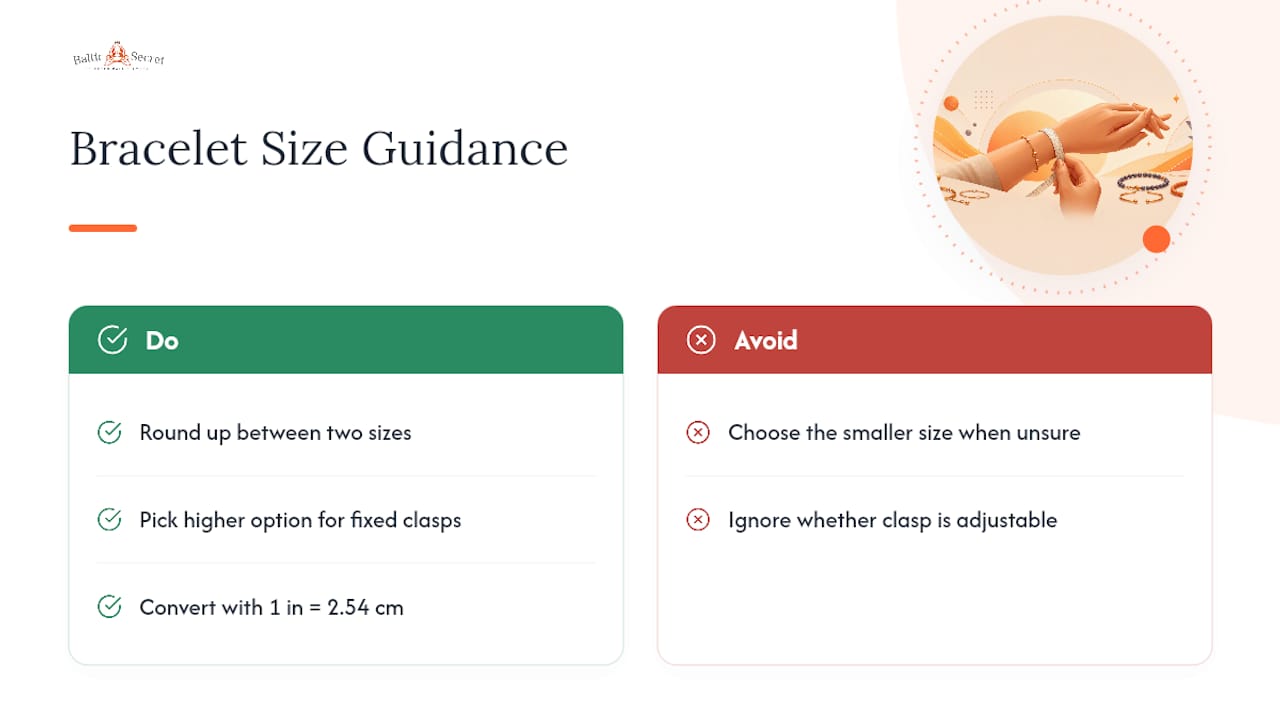
Since 1 inch equals 2.54 cm, you can convert either direction if a size chart you’re shopping from only lists inches. Retail conversion charts commonly show a 16.5 cm adult wrist mapping to a 17 to 18 cm bracelet, which lines up closely with the ranges above. If your wrist sits at the edge of two rows, treat the higher option as the safer pick, especially for anything with a fixed clasp rather than an adjustable one.
How Bracelet Style Changes the Fit
The chart above assumes a standard chain-and-clasp bracelet, but not every style behaves the same way on the wrist.
- Beaded or elastic bracelets stretch to fit a range of wrists, but thicker beads (10mm and up) take up more visual and physical space, so they often sit slightly tighter than a thin chain of the same measured length.
- Chain bracelets with a clasp depend on where the clasp sits. A clasp that rests on top of the wrist bone rather than beside it will feel tighter than the same length worn correctly.
- Bangles and cuffs aren’t measured at the wrist at all. You need to slide them over your hand, so measure across your knuckles (excluding the thumb) and round up to the next half centimeter for comfort.
- Stacked bracelets need extra breathing room. Add roughly 0.3 to 0.5 cm of allowance per additional piece so they don’t bunch up or pinch when your wrist bends.
Bead thickness alone can shift how a bracelet sits, which is worth checking on any product page that lists bead diameter before you order.
Baltic Secret’s Approach to Sizing and Safety
Baltic Secret builds its amber bracelets around the same measure first, order second principle covered above, but with tighter tolerances for children’s pieces. Amber beads add real weight compared to thin metal chains, so a size that feels right on paper can still sit differently once it’s on the wrist.
- For adult amber bead bracelets, Baltic Secret recommends the regular fit allowance (+1.0 cm) as the safest starting point, since beaded pieces don’t stretch like elastic or leather.
- For children, sizing errs smaller and safety features matter more than fashion: screw clasps or safety-release closures are standard on kids’ items precisely because small wrists and small parts require extra caution.
- Anyone unsure between two sizes can contact Baltic Secret’s customer support for a custom measurement check before ordering, rather than guessing on a fixed-length piece.
Pro Tip: If you’re buying for a child, measure again right before the item ships. Kids’ wrists can grow half a centimeter in just a few months, and a child-specific size guide accounts for that faster growth curve better than an adult chart ever will.
What Most Sizing Guides Get Wrong
Most sizing charts treat every bracelet like it’s made of the same material, and that’s the biggest blind spot in this whole topic. A 17 cm chain and a 17 cm chunky beaded piece do not wear the same, and treating them as interchangeable is how people end up disappointed by a bracelet that technically matches their measurement.
The conventional advice also over indexes on precision and under indexes on the allowance decision. Getting your wrist measurement to the nearest millimeter matters far less than deciding, honestly, whether you want a snug, regular, or loose fit. That’s a personal preference question, not a math problem, and no chart can answer it for you.
If there’s one thing worth prioritizing above all else, it’s this: measure in the evening, choose your fit preference deliberately, and round up rather than down whenever you’re between sizes. That single habit prevents more return requests than any amount of chart precision.
— Baltic Secret
Ready to Find Your Perfect Amber Bracelet Size
Now that you know your wrist measurement and preferred fit, choosing the right piece takes minutes, not guesswork. Baltic Secret’s amber bracelet collection is built around the same sizing logic covered here, with size details listed clearly on every product page so you’re never ordering blind.

Every piece is made from certified Baltic amber sourced and crafted in Lithuania, with safety-tested closures on children’s designs, including the screw-clasp amber bracelet for children. If your wrist measurement falls between two standard sizes, or you’re sizing for a toddler whose wrist keeps changing, reach out to Baltic Secret’s support team for a custom length before you order. Browse the current amber bracelet and necklace selection and match your measurement to the closest listed size to get started today.
Sources
- Kaip išmatuoti riešą?
- Apyrankės dydžio skaičiuoklė ir matavimo gidas | Juvela
- Bracelet Sizing 101 | Mejuri