Baltic Amber Dog Collar Explained for Pet Owners

A Baltic amber dog collar is a natural accessory made from fossilized tree resin, worn around a dog’s neck to repel fleas and ticks without chemical treatments. The collar works through two mechanisms: the release of succinic acid oils absorbed by the dog’s skin, and an electrostatic charge generated by fur rubbing against the amber beads. Baltic amber itself contains 3–8% succinic acid, a compound produced when the resin fossilizes over millions of years. Pet owners drawn to chemical-free alternatives have made these collars a growing category in natural pet care. Baltic Secret sources its amber directly from Lithuania, where the material has been harvested and crafted for centuries.
How do Baltic amber dog collars work?
The core mechanism behind an amber collar for dogs involves two distinct physical processes. Together, they create conditions that parasites find difficult to navigate.
Succinic acid release. Baltic amber releases succinic acid oils that absorb into the dog’s skin and coat. These oils create a surface barrier that interferes with a tick’s ability to detect and attach to a host.
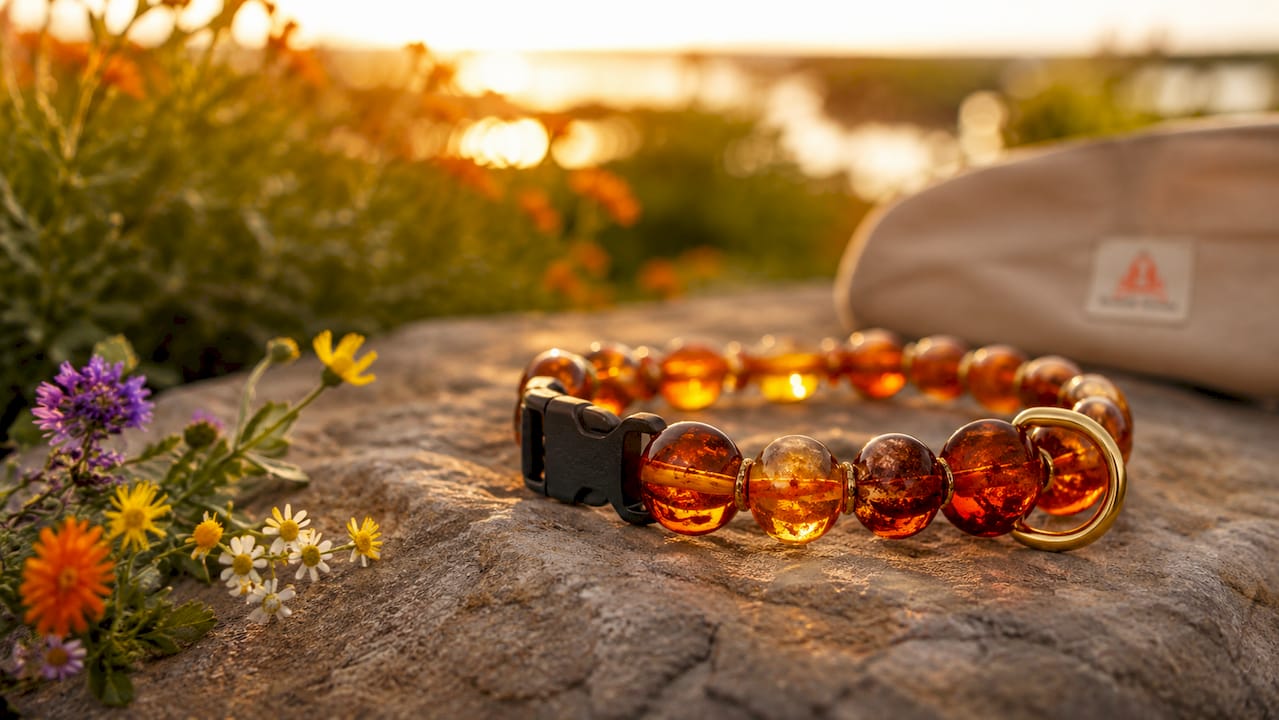
Electrostatic charge. When a dog moves, its fur rubs against the amber beads continuously. That friction generates static electricity that disrupts a tick’s navigation system. Ticks rely on sensory cues to locate a host, and a consistent electrostatic field throws off those cues.
Scent repellency. Amber emits a faint natural aroma that is imperceptible to humans but bothers fleas and ticks enough to deter them. This scent works alongside the oil and charge effects rather than replacing them.
These three factors combine to make the collar’s surface environment hostile to parasites. None of them involve pesticides, synthetic chemicals, or neurotoxins.
The honest caveat: scientific studies on amber collar efficacy are limited and have not produced definitive clinical proof. That does not mean the collars are ineffective. It means the evidence base is built largely on pet owner reports and the known chemistry of succinic acid rather than controlled trials. Pet owners should treat amber collars as a natural deterrent, not a guaranteed shield.
Pro Tip: Place the collar so the beads sit directly against your dog’s skin, not resting on top of a thick coat. Direct skin contact maximizes succinic acid absorption and improves the repellent effect.
What are the key benefits and features of Baltic amber dog collars?
The primary appeal of a dog collar with amber beads is its non-toxic profile. Amber collars repel rather than kill parasites, which means no pesticide residue on your dog’s coat, no chemical absorption through the skin, and no risk of toxicity to children who pet the dog. For households with young children or dogs with chemical sensitivities, that distinction matters enormously.

Beyond function, amber collars are genuinely attractive accessories. The beads come in a range of natural colors, from pale honey to deep cognac and even green or black varieties, depending on the amber’s origin and mineral content. Each bead is unique because fossilized resin forms differently in every piece. No two collars look exactly alike.
Key features to look for in a quality amber collar:
- Authentic Baltic amber beads. Genuine amber from the Baltic region contains the succinic acid levels needed for the repellent effect. Synthetic or imitation amber does not.
- Durable stringing material. Quality collars use synthetic fiber or metal clasps to prevent breakage during active wear. A broken collar is a choking hazard.
- Safety screw clasp. A secure clasp keeps the collar in place during play and prevents accidental release. Baltic Secret’s amber dog and cat collars feature a safety screw clasp designed for this purpose.
- Correct bead size for the dog’s size. Larger dogs need larger beads to generate sufficient electrostatic charge. Small beads on a large dog reduce effectiveness.
- Certification of authenticity. Reputable sellers provide documentation confirming the amber’s Baltic origin.
Pet owners consistently report reduced tick encounters after switching to amber collars. That anecdotal pattern, combined with the known chemistry of succinic acid, explains why amber collars are popular as natural flea prevention among owners who want to avoid synthetic chemicals.
How to properly use and care for a Baltic amber dog collar
Getting the fit right is the single most important step. A collar that sits too loose will not generate adequate friction against the fur. One that sits too tight causes discomfort and restricts movement. The standard rule for Baltic amber collar sizing for pets is the two-finger test: you should be able to slide two fingers comfortably under the collar, but not three.
Follow these steps to fit, use, and maintain the collar correctly:
- Measure your dog’s neck. Use a soft tape measure and add roughly 1–2 inches to find the right collar length. Most amber collars come in sizes labeled by neck circumference, so match that measurement to the product size chart.
- Position the beads against the skin. Part the fur at the neck and lay the collar so the beads touch skin directly. This is especially important for double-coated breeds like Huskies or Golden Retrievers.
- Allow a break-in period. Some dogs take a few days to adjust to wearing a new collar. Monitor behavior and check for any skin irritation during the first week.
- Clean the collar monthly. Wipe the beads with a damp cloth and mild soap. Avoid soaking the collar or exposing it to harsh detergents, which can degrade the amber’s surface and reduce oil release.
- Replace the collar twice yearly. Replacing amber collars twice yearly or when beads show visible wear preserves the repellent effect. Worn beads release less succinic acid and generate less static charge.
- Remove the collar during baths and swimming. Prolonged water exposure weakens the stringing material and dulls the amber surface over time.
Safety monitoring is non-negotiable. Choking and strangulation hazards are real risks with any bead collar, and pet owners should check the collar’s condition weekly. Look for fraying string, cracked beads, or a clasp that no longer locks securely. For a detailed monitoring guide, Baltic Secret’s pet collar wear guide covers what to check and how often.
Pro Tip: Store the collar in a dry, dark place when not in use. UV exposure and humidity both degrade amber over time, shortening the collar’s effective lifespan.
How do amber collars compare to other flea and tick prevention methods?
Amber collars occupy a specific position in the parasite prevention spectrum. Understanding where they fit helps pet owners make informed decisions rather than treating them as a direct replacement for all other methods.
| Feature | Amber collar | Chemical flea collar | Topical treatment |
|---|---|---|---|
| Active mechanism | Repels via oils and static charge | Kills on contact with pesticide | Kills or repels via absorbed chemical |
| Toxicity risk | None | Moderate to high | Low to moderate |
| Effectiveness evidence | Anecdotal and limited studies | Clinically proven | Clinically proven |
| Duration per unit | 6 months with proper care | 4–8 months | 1 month per application |
| Style factor | High (natural, decorative) | Low | None |
| Safe around children | Yes | Use caution | Use caution |
The clearest difference is that amber collars repel rather than kill parasites. Chemical collars and topical treatments kill ticks on contact or after attachment. That distinction matters in high-risk tick areas, where a repellent alone may not provide sufficient protection during peak season.
Amber collars work best as part of a layered prevention approach. Pet owners in areas with heavy tick pressure often use an amber collar as a daily deterrent while adding a veterinarian-recommended treatment during peak months. For dogs with known chemical sensitivities or for owners who want to minimize pesticide exposure year-round, an amber collar as the primary tool makes sense, provided the dog is checked thoroughly after every outdoor outing. Always consult your veterinarian before changing your dog’s parasite prevention routine, especially if your area has a high incidence of tick-borne illness. For a deeper look at natural options, Baltic Secret’s guide to natural collar alternatives covers how amber fits alongside other chemical-free approaches.
Key Takeaways
A Baltic amber dog collar repels fleas and ticks through succinic acid release, electrostatic charge, and natural scent, making it the most practical natural alternative to chemical flea collars for pet owners who prioritize non-toxic daily wear.
| Point | Details |
|---|---|
| How it works | Amber releases succinic acid oils and generates static charge that disrupts parasite navigation. |
| Evidence level | Scientific studies are limited; effectiveness is supported mainly by pet owner reports and amber’s known chemistry. |
| Best use case | Use as a daily deterrent, especially for dogs with chemical sensitivities or in households with young children. |
| Sizing and fit | Apply the two-finger rule and position beads against the skin for maximum contact and repellent effect. |
| Replacement schedule | Replace the collar twice yearly or when beads show visible wear to maintain effectiveness. |
What I’ve learned from years of working with Baltic amber collars
The most common mistake pet owners make is expecting an amber collar to perform like a pesticide. It does not kill ticks. It discourages them. That is a fundamentally different job, and holding the collar to the wrong standard leads to disappointment.
What I’ve observed consistently is that amber collars perform best on dogs who wear them every day, not just during hikes or outdoor trips. The succinic acid builds up gradually in the coat and skin. A collar worn only on weekends does not have time to establish that protective layer. Daily wear is the whole point.
The style factor is underrated. Pet owners who choose amber collars often report that their dogs get more compliments than dogs wearing standard nylon or leather collars. That matters because it increases the likelihood the collar stays on the dog consistently, which directly improves its effectiveness. A beautiful collar that owners actually use beats a clinical-looking one that sits in a drawer.
My honest view on the science gap: the absence of large clinical trials does not mean amber collars are ineffective. It means the research has not caught up with the product category. The chemistry of succinic acid is well established. The electrostatic principle is real physics. What is missing is a controlled study large enough to quantify the effect size. Until that exists, informed pet owners should treat amber collars as a credible natural deterrent with a strong safety profile, not a proven pharmaceutical.
— Baltic Secret
Baltic Secret’s natural amber collars for dogs
Baltic Secret crafts its amber dog collars from genuine Lithuanian amber, sourced and authenticated at origin. Every collar ships with a certificate of authenticity, and the beads are selected for succinic acid content, not just appearance.

The collars are available in multiple sizes to fit dogs from small breeds to large ones, with sizing guidance built into each product page. Safety screw clasps and durable synthetic stringing are standard across the range. If you want a natural, non-toxic option that your dog can wear every day, Baltic Secret’s amber tick collar for dogs is the place to start. The full collection of amber pet accessories includes options for cats as well, all made to the same authenticity standard.
FAQ
What is a Baltic amber dog collar?
A Baltic amber dog collar is a pet accessory made from fossilized tree resin beads, worn to repel fleas and ticks through succinic acid release and electrostatic charge rather than chemical pesticides.
Are amber collars effective against ticks?
Amber collars are reported by pet owners to reduce tick encounters, but clinical evidence remains limited. They work best as a daily deterrent, ideally combined with regular tick checks after outdoor activity.
How do I size an amber collar for my dog?
Measure your dog’s neck circumference and match it to the product size chart. Use the two-finger rule: two fingers should fit comfortably under the collar, but not three.
How often should I replace a Baltic amber dog collar?
Replace the collar twice yearly or sooner if the beads show visible wear. Worn beads release less succinic acid and generate less static charge, reducing the collar’s repellent effect.
Is a Baltic amber collar safe for dogs?
Amber itself is non-toxic, but bead collars carry a choking risk if the string breaks. Check the collar weekly for fraying, cracked beads, or a loose clasp, and remove it during baths and unsupervised periods.