How Baltic Amber Forms Fossilized Resin: Full Guide

Baltic amber is fossilized resin produced by ancient coniferous trees during the Eocene epoch, transformed over tens of millions of years through chemical polymerization, burial, and geological transport into the golden material found along the Baltic Sea today. Understanding how Baltic amber forms fossilized resin reveals a process far more complex than simple hardening. The resin passed through five distinct maturation stages, survived burial in oxygen-poor marine sediments, and endured glacial redistribution before reaching the surface. Baltic Secret sources its amber directly from Lithuania, where this geological story is most concentrated and best preserved.
How Baltic amber forms fossilized resin: the biological starting point
Baltic amber begins as liquid resin secreted by trees belonging to the Sciadopityaceae family, the ancient relatives of the modern Japanese umbrella pine. Fourier-transform infrared spectroscopy confirmed this botanical origin, identifying chemical signatures unique to this tree family in Baltic amber samples. The single living species from this family today, Sciadopitys verticillata, gives scientists a living reference point for understanding what those Eocene forests looked like.
Resin is not sap. Trees produce resin as a defense mechanism, sealing wounds caused by insects, fungi, and physical damage. The resin composition centers on terpenoids and oleoresins, which are volatile aromatic compounds that evaporate quickly in open air. That evaporation is the first step toward fossilization. As volatiles escape, the remaining compounds begin to link together chemically in a process called polymerization.
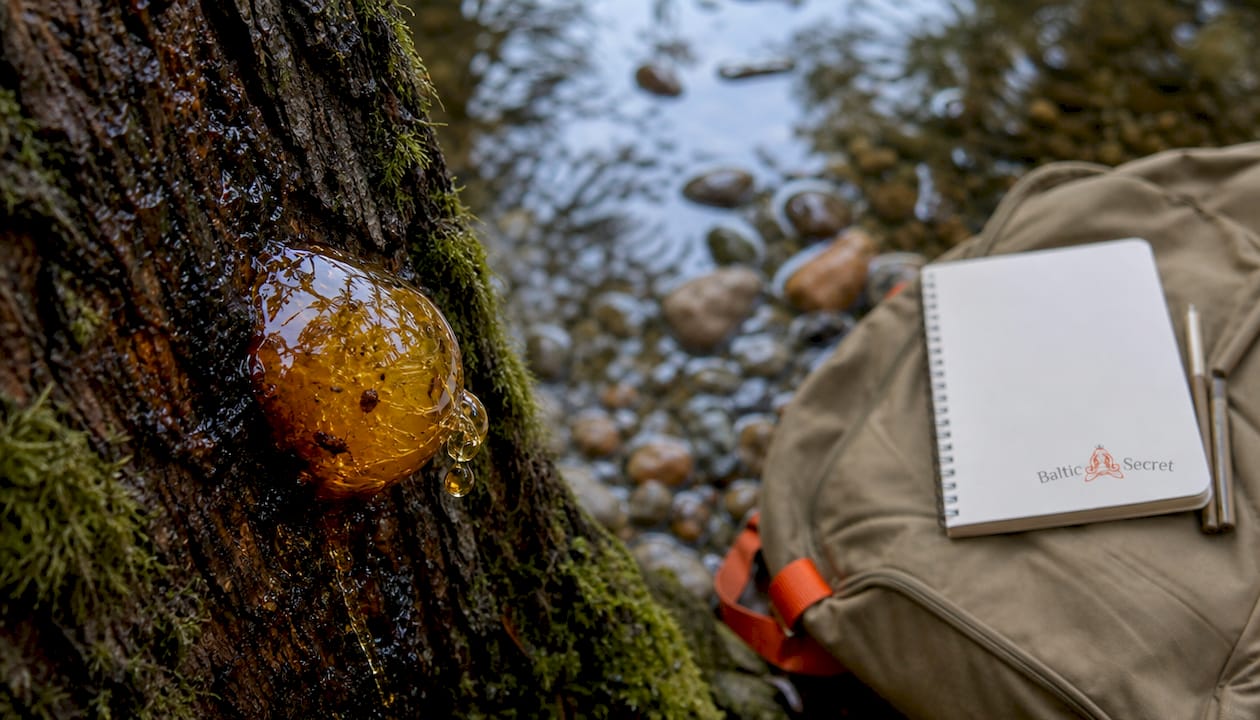
The conditions required for this early polymerization are specific. The resin needs warmth, time, and protection from immediate decay. Resin that drips into open soil and stays exposed to sunlight, rain, and microorganisms almost always degrades completely. The rare pieces that survive are those quickly buried under leaf litter, sediment, or forest debris, where oxygen levels drop and biological activity slows.
Pro Tip: When you hold a piece of Baltic amber, you are holding material that survived a geological obstacle course. Most resin from those Eocene forests never made it this far.
- Resin originates from tree wounds as a biological defense response
- Terpenoids and oleoresins form the chemical base of raw resin
- Volatile compounds evaporate first, leaving heavier molecules behind
- Early polymerization begins as the resin cools and dries
- Rapid burial is the single most critical factor for survival
How does geological burial turn resin into amber?
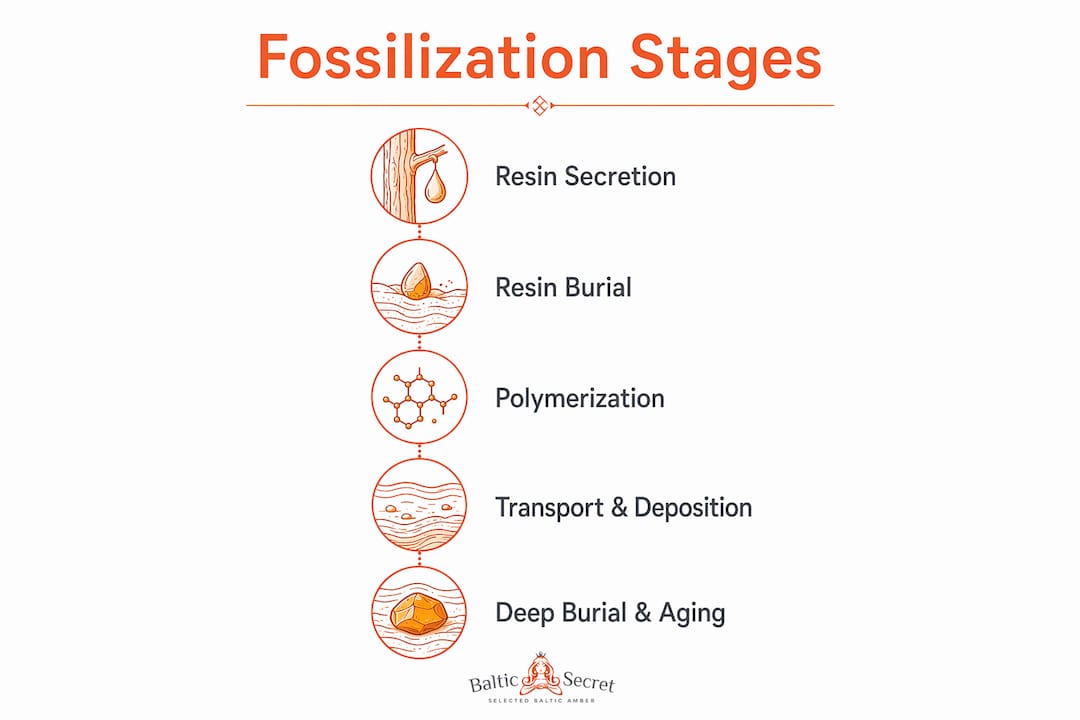
The amber fossilization process moves through five key maturation stages: secretion, accumulation, volatile loss (the copal stage), full polymerization, and eventual exposure at the surface. Each stage can take thousands to millions of years. Skipping or rushing any stage produces copal, not amber.
The five stages explained
- Secretion. Trees release resin in response to injury or stress. Large flows accumulate on bark surfaces and drip to the forest floor.
- Accumulation. Resin pools in soil, under bark, or in tree cavities. Organic material, insects, and plant fragments become trapped at this stage.
- Volatile loss (copal stage). Lighter chemical compounds evaporate. The resin hardens partially into copal, a substance that looks like amber but dissolves in solvents and lacks full chemical stability.
- Full polymerization. Heat and pressure from burial drive the remaining molecules to cross-link into a dense, stable macromolecular network. This is the point at which copal becomes true amber.
- Exposure. Erosion, glacial movement, or human excavation brings the amber back to the surface.
Baltic amber’s geological story has an unusual twist. The resin did not fossilize where the trees grew. Ancient rivers carried resin from terrestrial Eocene forests into marine environments, where it settled into sediments known as “Blue Earth.” These oxygen-poor marine sediments protected the resin from oxidation and microbial decay, creating ideal conditions for full polymerization. That anoxic burial is why Baltic amber survived when most other ancient resins did not.
Glacial activity during the Pleistocene then redistributed amber deposits across the Baltic region. Ice sheets scraped amber from its primary marine burial sites and scattered it across what is now Poland, Germany, Lithuania, Latvia, and the seabed of the Baltic Sea. This explains why amber washes up on beaches after storms.
Pro Tip: The amber you find on a Baltic beach did not form in the sea. It formed in a forest, traveled by river, spent millions of years in marine sediment, and was then pushed by glaciers to its current location.
| Property | Copal | Baltic Amber |
|---|---|---|
| Age | Hundreds to thousands of years | 35–47 million years |
| Polymerization | Partial | Full crosslinked network |
| Solvent resistance | Dissolves easily | Highly resistant |
| Mohs hardness | Soft, variable | 2.0–2.5 |
| Chemical stability | Low | High |
What makes Baltic amber different from other fossilized resins?
Baltic amber is the largest known amber deposit on Earth, exceeding 100,000 tons and accounting for roughly 80–90% of the world’s amber supply. That scale reflects both the productivity of those Eocene forests and the exceptional preservation conditions of the Baltic region. No other amber deposit comes close in volume or scientific documentation.
The chemical structure of Baltic amber sets it apart from all other fossil resins. Its crosslinked supramolecular network forms through free radical polymerization of terpenoid precursors, producing a three-dimensional molecular lattice rather than a simple polymer chain. This structure gives Baltic amber its characteristic hardness, its resistance to solvents, and its durability over geological time.
Baltic amber also contains succinic acid, a compound found in significant concentrations and used as a chemical marker for authentication. Succinic acid content distinguishes genuine Baltic amber from amber produced in other regions and from copal. Infrared spectroscopy tests measure succinic acid levels to verify authenticity.
The age range of Baltic amber deposits, primarily Eocene at 35–47 million years old, places it in a period of warm global climate and dense forest coverage across northern Europe. That warm, humid environment produced the massive resin flows needed to create deposits of this scale. Younger resins from tropical trees, often sold as amber, are almost always copal and lack the chemical stability of true Baltic amber.
- Succinic acid content is the primary chemical marker for Baltic amber
- True amber resists acetone and other common solvents; copal dissolves
- Hardness testing (Mohs 2.0–2.5) helps distinguish amber from plastic imitations
- Age alone does not define amber; full polymerization is the chemical requirement
- Baltic amber’s Eocene origin places it among the oldest and most studied fossil resins globally
How do inclusions get preserved inside Baltic amber?
Inclusions are organisms or plant material trapped in resin before it fossilized. The preservation of biological inclusions in amber results from a combination of rapid entrapment, chemical encapsulation, and anoxic burial. The resin acts as both a physical barrier and a chemical preservative, preventing the decay that destroys soft tissue in almost every other fossilization context.
When an insect landed on fresh resin, it became stuck immediately. Subsequent resin flows covered it completely, cutting off oxygen and halting bacterial activity. The resin’s molecular components filled every pore and cavity in the organism’s body, replacing air with stable chemical compounds. This process preserves microscopic details, including wing venation, compound eye structure, and even internal organs in some specimens.
Baltic amber inclusions include insects, spiders, mites, plant fragments, mosses, feathers, and in rare cases, vertebrate tissue. Each inclusion provides a direct biological sample from the Eocene ecosystem. Scientists use these specimens to reconstruct ancient food webs, track evolutionary lineages, and understand climate conditions from 35–47 million years ago. No other geological archive delivers this level of biological detail from that time period.
The chemical stability of amber during fossilization is what makes this preservation possible. A resin that degrades before full polymerization destroys its inclusions along with itself. Only amber that completes the full maturation process retains the structural integrity needed to protect biological material across geological time.
Key Takeaways
Baltic amber forms through a five-stage fossilization process that converts ancient tree resin into a chemically stable, crosslinked fossil over 35–47 million years, with burial in anoxic marine sediments as the critical preservation mechanism.
| Point | Details |
|---|---|
| Biological origin | Resin came from Sciadopityaceae family trees, confirmed by infrared spectroscopy. |
| Five-stage maturation | Secretion, accumulation, volatile loss, polymerization, and exposure define the full process. |
| Anoxic burial is critical | Oxygen-poor “Blue Earth” marine sediments prevented decay and enabled full polymerization. |
| Amber vs. copal | True Baltic amber has a crosslinked molecular network; copal is only partially polymerized. |
| Inclusions as archives | Rapid entrapment and chemical encapsulation preserve organisms in microscopic detail. |
What working with Baltic amber has taught me about geological time
Most people assume amber is a mineral. It is not. Amber is a fossilized organic resin with a chemical structure unlike anything else in geology. That distinction matters because it changes how you think about authenticity, aging, and preservation. A mineral forms through inorganic crystallization. Amber forms through biological secretion and chemical maturation. The two processes have almost nothing in common.
The geological obstacle course that resin must survive to become amber is genuinely remarkable. Most resin never makes it. It degrades in sunlight, dissolves in rain, or gets consumed by microorganisms before burial can protect it. The amber that exists today represents a tiny fraction of the resin those Eocene forests produced. That rarity is not a marketing claim. It is a geological fact.
What strikes me most about Baltic amber is its role as a time capsule. The inclusions inside are not just curiosities. They are direct biological samples from an ecosystem that no longer exists. Every piece of Baltic amber with an insect inclusion is a primary source document for Eocene natural history. The stratigraphic context of where that amber was found matters as much as the inclusion itself, because location tells scientists which layer of geological time they are reading.
The succinic acid marker and the crosslinked polymer network are not just chemical details. They are the reason you can trust that a piece of genuine Baltic amber is exactly what it claims to be. At Baltic Secret, we source directly from Lithuania because that provenance is inseparable from the science. Amber without verified origin is just a pretty stone.
— Baltic Secret
Genuine Baltic amber products rooted in 44 million years of natural history
Every piece of amber in the Baltic Secret collection carries the full geological story described in this article. The resin that became these beads and pendants secreted from Eocene trees, traveled ancient rivers, spent tens of millions of years in anoxic marine sediment, and survived glacial redistribution before reaching the Baltic coast.
Baltic Secret sources exclusively from Lithuania and guarantees authenticity through succinic acid verification and direct supply chain oversight. Whether you are looking for amber beads and accessories for children, pets, or yourself, each item reflects genuine fossilized resin with documented natural origin. The craftsmanship is handmade. The material is real. The geological history behind every piece is 35–47 million years in the making.
FAQ
What is Baltic amber made of?
Baltic amber is fossilized resin from ancient Sciadopityaceae family trees, chemically transformed through polymerization into a stable crosslinked molecular network over 35–47 million years.
How long does it take for resin to become amber?
Full fossilization requires millions of years. Resin that has only partially polymerized over thousands of years is classified as copal, not true amber.
Why is Baltic amber found near the sea if it formed in forests?
Ancient rivers transported resin from terrestrial Eocene forests to marine sediments, where anoxic burial conditions preserved it. Glacial activity later redistributed deposits across the Baltic region.
How can you tell real Baltic amber from copal or plastic?
Genuine Baltic amber contains succinic acid, resists common solvents like acetone, and has a Mohs hardness of 2.0–2.5. Copal dissolves in solvents, and plastic shows no succinic acid signature under infrared spectroscopy.
What can amber inclusions tell scientists?
Inclusions preserve insects, plants, mosses, and feathers in microscopic detail, providing direct biological evidence from Eocene ecosystems that no other fossil type can match.