Amber Meaning Gemstone: Symbolism, History, and Care

Amber is defined as fossilized tree resin that has hardened over 30 to 90 million years into a gemstone prized for its warmth, color, and symbolic power. Unlike mineral crystals such as quartz or topaz, amber carries organic matter inside it, sometimes including perfectly preserved insects, pollen, and plant fragments from prehistoric forests. The amber meaning gemstone tradition spans cultures from ancient Greece to the Baltic coast, where it has represented solar energy, protection, and the life force itself. Few materials in the gemstone world connect the wearer so directly to deep geological time.
What is the amber meaning gemstone, and why does it matter?
Amber is not a crystal in the mineralogical sense. It is an organic gemstone, a category that also includes pearl, coral, and jet. This distinction matters because amber’s properties, its softness, warmth to the touch, and ability to hold ancient inclusions, all stem from its biological origin rather than from crystalline structure.
Fossilized resin from ancient trees between 30 and 90 million years old transforms through heat and pressure into the translucent golden material we recognize today. Baltic amber, sourced from the coastal regions of Lithuania, Latvia, and Estonia, is the most studied and commercially significant variety. It comes from a now-extinct species of coniferous tree and contains a unique compound called succinic acid, which distinguishes it from younger resins called copal.
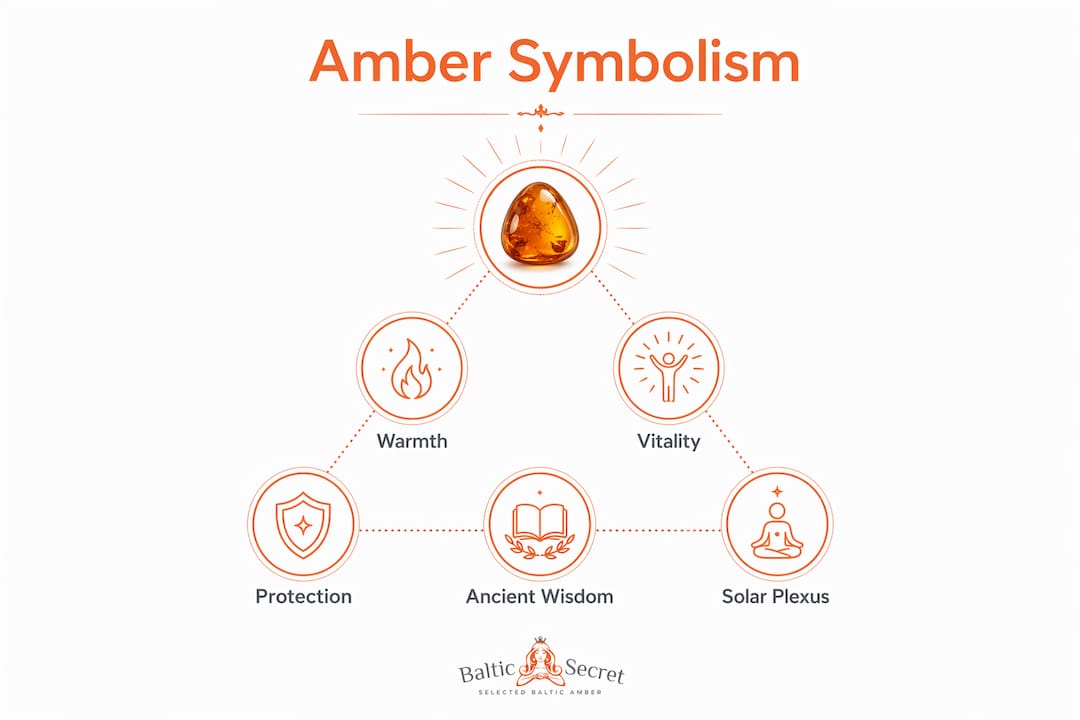
The core symbolic meanings attached to amber are warmth, vitality, protection, and ancient wisdom. These meanings are not arbitrary. They arise directly from amber’s physical qualities: its golden color echoes sunlight, its warm touch contrasts with cold mineral stones, and its inclusions literally preserve life from millions of years ago. When you hold a piece of amber, you are holding a record of a world that no longer exists.
Key physical properties at a glance
| Property | Amber |
|---|---|
| Hardness (Mohs scale) | 2 to 2.5 |
| Typical color range | Yellow, orange, cognac, green, white, blue |
| Weight | Lightweight, floats in saturated salt water |
| Inclusions | Insects, plant matter, air bubbles |
| Origin | Fossilized coniferous tree resin |
Amber’s Mohs hardness of 2 to 2.5 places it among the softest gemstones in common use. That softness means a fingernail can scratch it, which is why proper care matters more for amber than for harder stones like sapphire or garnet.
What are amber’s symbolic meanings and spiritual properties?
Amber carries the nickname “liquid sunshine” across multiple spiritual traditions, and the label is earned. Its golden hue and warm surface temperature make it a natural symbol of solar energy, life force, and renewal. Ancient Greek mythology called amber the tears of the Heliades, the daughters of the sun god Helios, wept into the sea after their brother Phaethon fell from the sky.
In chakra-based energy work, amber connects to the Solar Plexus Chakra, the energy center governing personal power, confidence, and emotional balance. Practitioners use it to clear stagnant energy, address emotional depletion, and counter seasonal depression. The logic is consistent with amber’s physical warmth: it is used to bring heat and light into areas of energetic coldness.
The protective dimension of amber’s symbolism is equally strong. Amber absorbs negative energies and is believed to act as a shield for the aura, a function that made it a popular talisman in ancient Rome, Egypt, and across the Baltic cultures. Sailors carried amber to protect against storms. Mothers placed it near infants to ward off illness. Warriors wore it as armor for the spirit.
Pro Tip: Pair amber with jet, a black organic gemstone formed from fossilized wood, for what practitioners call “witches’ amber.” Amber and jet together balance solar warmth with grounded protection, amplifying the protective effect beyond what either stone provides alone.
Amber also holds a specific role in meditation practice. Holding a warm piece of amber during breathwork is said to anchor the practitioner in the present while simultaneously connecting them to deep time through the stone’s ancient origins. That dual quality, present warmth and ancient memory, is rare among gemstones and explains amber’s enduring appeal in spiritual communities.
- Protection: Shields the aura from negative or draining energies
- Emotional healing: Stabilizes mood and supports recovery from grief or depletion
- Solar energy: Activates confidence, creativity, and personal will
- Ancient wisdom: Connects the wearer to prehistoric life and natural cycles
- Renewal: Supports transitions, new beginnings, and seasonal shifts
How to care for and maintain amber gemstones properly
Amber requires a different care approach than mineral gemstones, and most damage to amber pieces comes from treating them like harder stones. Because amber is organic and sensitive to chemicals and scratches, standard jewelry cleaning methods can destroy its surface within a single use.
Follow these steps to keep amber in good condition:
- Clean gently with lukewarm water. Use a soft cloth dampened with plain lukewarm water. Dry immediately and completely. Never soak amber in water, as prolonged immersion weakens the surface.
- Avoid all chemical exposure. Perfume, hairspray, sunscreen, and household cleaners all degrade amber’s surface. Apply cosmetics before putting on amber jewelry, not after.
- Store separately from harder stones. Any gemstone with a higher Mohs hardness, which includes almost every mineral crystal, will scratch amber on contact. Store amber pieces in a soft pouch or lined box, away from other jewelry.
- Limit direct sunlight. Prolonged sun exposure causes brittleness and loss of luster over time. Display amber away from windowsills and avoid leaving it in a hot car.
- Polish with mineral oil occasionally. A tiny drop of mineral oil on a soft cloth restores surface sheen without damaging the organic structure.
Pro Tip: Amber that looks dull or cloudy has usually been exposed to chemicals or stored incorrectly. Check the amber jewelry safety guide at Baltic Secret for specific cleaning protocols that preserve both the stone’s appearance and its energetic qualities.
One safety note deserves direct attention. Modern medical advice discourages amber teething necklaces for infants due to choking and strangulation risks. The traditional belief in amber’s soothing properties for teething babies is widespread, but pediatric safety organizations are clear that no necklace should be worn unsupervised by a child under three. Amber’s cultural history does not override current safety evidence.
What is the cultural and historical significance of amber?
Amber has been a traded luxury material since prehistoric times. Archaeological finds show amber beads in burial sites across northern Europe dating back more than 10,000 years. The Amber Road, an ancient trade network stretching from the Baltic coast to the Mediterranean, moved Baltic amber into the hands of Egyptian pharaohs, Roman senators, and Greek merchants who had never seen the forests where it formed.
Baltic amber’s trade history spans thousands of years and crosses nearly every major ancient civilization. Its use in jewelry, amulets, and burial rites reflects a consistent belief across cultures that amber carried protective and sacred power. The Romans called it electrum, a word that also gave us “electricity,” because amber generates a static charge when rubbed. Thales of Miletus observed this property around 600 BCE.
The word “amber” itself has a complicated etymology. It derives from the Arabic anbar, which originally referred to ambergris, a waxy substance from sperm whales used in perfume. The two materials became linguistically confused in medieval European trade, and the name stuck to the fossilized resin. That confusion is a reminder that amber has always been a commodity crossing cultural and linguistic borders.
| Culture | Amber’s role |
|---|---|
| Baltic peoples | Sacred material, trade currency, protective amulet |
| Ancient Romans | Luxury jewelry, believed to cure throat ailments |
| Ancient Greeks | Associated with the sun god Helios, called elektron |
| Medieval Europe | Used in rosaries, religious objects, and medicine |
| Modern artisans | Handcrafted jewelry, spiritual tools, collector pieces |
How does amber differ from other gemstones?
Amber’s organic origin separates it fundamentally from mineral gemstones, and that distinction shows up in every physical test you can apply. Quartz, sapphire, and topaz form through inorganic crystalline processes deep in the earth. Amber formed at the surface, in living trees, and carries the biological record of that origin inside it.
The most reliable way to identify genuine amber involves three tests. First, the float test: real amber floats in a saturated salt water solution (roughly one tablespoon of salt per cup of water), while glass and most plastics sink. Second, the warmth test: amber feels warm to the touch immediately, while glass feels cold. Third, the scent test: amber smells of pine resin when gently heated, a characteristic no synthetic imitation can replicate.
Amber belongs to a small group of organic gemstones that includes pearl, coral, jet, and ivory. These materials share the quality of coming from once-living organisms, which gives them a different energetic character in spiritual traditions and a different set of care requirements in practical use. Among this group, amber is unique for its inclusions. No other organic gemstone regularly contains preserved prehistoric life forms visible to the naked eye.
- Amber vs. copal: Copal is younger resin, typically under one million years old, and lacks amber’s hardness and succinic acid content. It is often sold as amber at lower price points.
- Amber vs. glass: Glass is cold, heavy, and sinks in salt water. Amber is warm, light, and floats.
- Amber vs. plastic: Plastic often shows mold lines and does not produce a pine scent when heated.
- Amber vs. quartz: Quartz scores 7 on the Mohs scale and is a mineral crystal. Amber scores 2 to 2.5 and is organic resin.
Key takeaways
Amber is an organic gemstone defined by its fossilized resin origin, solar symbolism, Solar Plexus Chakra connection, and care requirements that set it apart from every mineral crystal in the gemstone world.
| Point | Details |
|---|---|
| Organic origin | Amber is fossilized tree resin, not a mineral crystal, which shapes all its properties. |
| Solar symbolism | Amber represents warmth, vitality, and personal power across dozens of cultures. |
| Chakra connection | Amber activates the Solar Plexus Chakra, supporting confidence and emotional balance. |
| Gentle care required | Avoid chemicals, prolonged sunlight, and harder stones to preserve amber’s surface and luster. |
| Authenticity testing | Float test, warmth test, and pine scent when heated confirm genuine amber over imitations. |
Why amber’s warmth is something you feel before you understand it
I have handled a lot of gemstones over the years, and amber is the one that consistently surprises people the first time they pick it up. They expect something cold and heavy, the way most stones feel. Instead they get something that feels almost body-temperature, light as a dried leaf, and somehow alive. That physical quality is not a metaphor. It is the actual organic matter inside the stone responding to your hand.
What I find most underappreciated about amber’s spiritual properties is the Solar Plexus connection. Most people reach for amber because they like how it looks, then discover that wearing it daily shifts something in their confidence and emotional steadiness. That is not placebo territory in my experience. It is the result of wearing something that literally carries the warmth of ancient sunlight in its structure.
The care piece is where I see the most avoidable damage. People store amber with their other jewelry, spray perfume over it, and then wonder why it looks dull after six months. Amber is not a hard stone pretending to be delicate. It is genuinely soft, genuinely organic, and genuinely worth treating differently. A soft pouch and a bottle of mineral oil will keep a piece looking beautiful for decades.
The one area where I will not soften my position is infant teething necklaces. The cultural tradition is real and the belief is sincere, but the safety risk is also real. There are other ways to honor amber’s protective symbolism around children without placing a cord around a sleeping baby’s neck.
Amber connects you to something 50 million years old every time you wear it. That is worth understanding, worth caring for, and worth choosing well.
— Baltic Secret
Discover authentic Baltic amber jewelry at Baltic Secret

Baltic Secret sources its amber directly from Lithuania, the heart of the Baltic amber tradition, and every piece reflects that heritage. The collection includes polished amber necklaces and bracelets crafted from genuine Baltic amber with verified succinic acid content, available in cognac, honey, lemon, and cherry tones. Each piece is handcrafted to highlight the natural inclusions and warm translucence that make Baltic amber distinct from any imitation. Baltic Secret also offers natural amber tick collars for dogs, extending amber’s protective tradition to pets without synthetic chemicals. Whether you are drawn to amber for its symbolism, its history, or its beauty, Baltic Secret provides authentic pieces with the craftsmanship and sourcing transparency that genuine Baltic amber deserves.
FAQ
What does amber symbolize as a gemstone?
Amber symbolizes warmth, solar energy, protection, and ancient wisdom. Across cultures from ancient Greece to the Baltic region, it has represented the life force and served as a protective talisman.
Is amber a real gemstone or just resin?
Amber is classified as an organic gemstone, placing it in the same category as pearl and jet. It is fossilized tree resin rather than a mineral crystal, which gives it unique physical and energetic properties.
What chakra is amber associated with?
Amber connects primarily to the Solar Plexus Chakra, the energy center governing personal power, confidence, and emotional balance. Practitioners use it to clear stagnant energy and support emotional stability.
How can you tell real amber from a fake?
Genuine amber floats in saturated salt water, feels warm to the touch, and produces a pine-like scent when gently heated. Glass sinks, feels cold, and has no scent response to heat.
Is it safe to use amber for infant teething?
Current medical guidance advises against amber teething necklaces due to choking and strangulation hazards. Amber has deep cultural significance, but pediatric safety organizations recommend against unsupervised necklace use for children under three.