Color Amber: A Buyer's Guide for Parents & Pet Owners

“Color amber” refers to the natural color range of Baltic amber, the fossilized resin of ancient conifer trees that grew along the Baltic Sea roughly 44 million years ago. That range runs from pale beeswax and honey through cognac, butterscotch, deep brown, and into rare red and green tones. Each color carries real information about how the piece formed, whether it has been treated, and what it is worth.
- Common vs. rare: Honey, cognac, and butterscotch account for the majority of Baltic amber on the market. Naturally green pieces are rare, making up less than 2% of Baltic amber; most vivid green or bright red pieces you see have been heat-treated.
- Authenticity red flag: GIA cautions that unnaturally uniform or neon-bright colors often signal artificial modification. Real amber varies bead to bead.
- Safety first: Amber jewelry for babies, small children, and pets carries choking and strangulation risks. Always choose pieces with a screw or breakaway clasp, and never leave a child or pet unsupervised while wearing amber.
Table of Contents
- What gives Baltic amber its color?
- What are the natural colors of Baltic amber?
- How can you tell if amber color is natural or treated?
- Is amber jewelry safe for children and pets?
- How do you care for Baltic amber jewelry?
- What should you ask before buying Baltic amber?
- Why trust this guide?
- Key Takeaways
- What the color variation in Baltic amber actually tells you
- Baltic Secret amber for parents and pet owners
- Useful sources
What gives Baltic amber its color?
Color in Baltic amber comes from three overlapping sources: the original resin chemistry, the physical microstructure of the hardened material, and changes that happen during millions of years of burial.
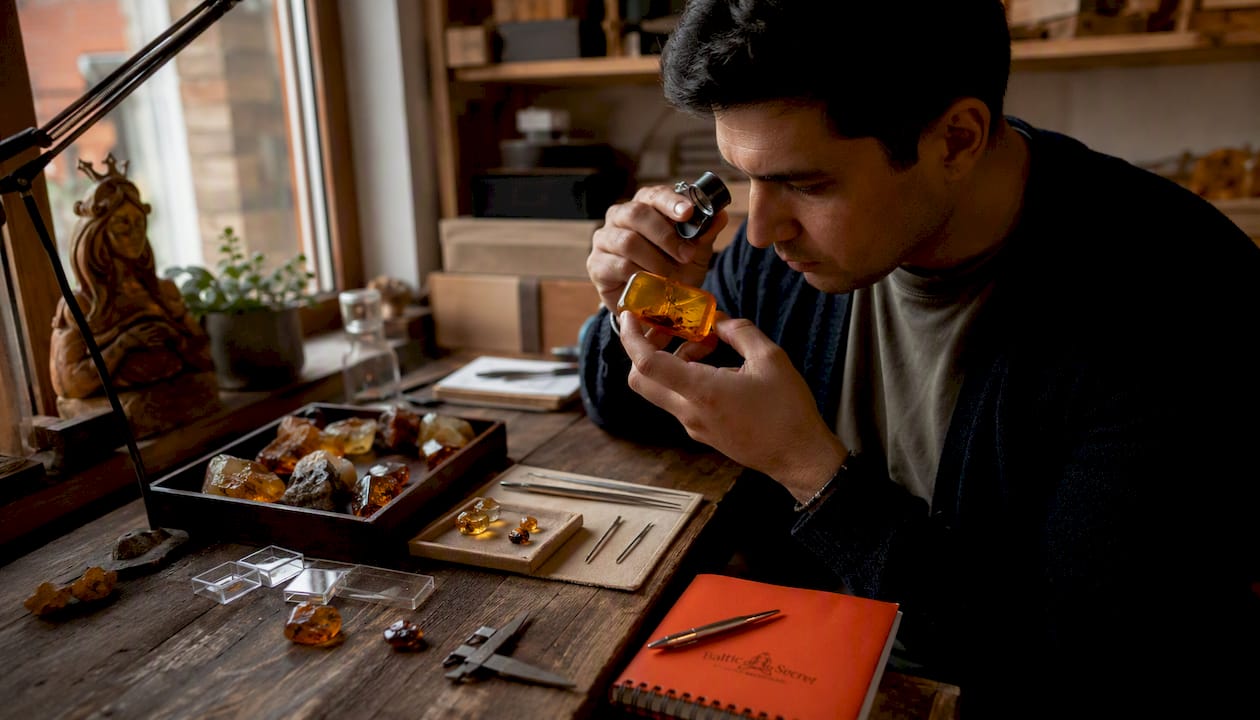
The most striking example is opaque “beeswax” amber. Research using scanning electron microscopy shows that this milky, yellowish-white appearance comes from dense populations of microscopic air bubbles trapped inside the resin as it hardened. Those bubbles scatter incoming light through Mie and Rayleigh scattering, the same physics that makes fog look white. Transparent amber, by contrast, has far fewer bubbles, so light passes straight through and the resin’s own warm yellow-orange chemistry dominates.
Oxidation adds another layer. Amber exposed to oxygen over geological time darkens progressively, which is why surface layers of a raw piece are often deeper brown or cognac while the interior stays lighter. Organic debris, trapped plant matter, and insect inclusions shift tone locally and can add greenish or brownish casts depending on what decayed inside the resin.
Heat and pressure, whether natural or applied in a lab, can dramatically alter all of the above. Autoclave clarification typically uses temperatures of 180–200°C and pressures up to 50 kg/cm², according to treatment documentation, dissolving bubbles to create clear amber or driving surface oxidation to produce darker or reddish tones. That process leaves diagnostic marks a trained eye can spot.
What are the natural colors of Baltic amber?
Baltic amber’s color palette is wider than most buyers expect. Here is what each hue signals.
- Pale yellow / lemon: Low oxidation, often younger-looking surface. Common and affordable; a good entry point for buyers new to amber.
- Honey: The classic warm gold most people picture. Moderate bubble density, moderate oxidation. The most widely available color.
- Cognac / deep amber: Richer, reddish-brown tone from heavier oxidation. Collector guidance places deep cognac and reddish tones above golden honey in market value.
- Butterscotch: Creamy, semi-opaque. Bubble density sits between beeswax and transparent. Popular in children’s and pet jewelry for its soft appearance.
- Beeswax / opaque white: Milky and dense. Prized in East Asian markets, where opaque material commands strong prices. Entirely natural; no treatment required to produce it.
- Dark brown / cherry: Heavy oxidation or organic inclusions. Genuine dark pieces are common; very uniform deep-red “cherry” pieces may be heat-darkened.
- Red: Naturally occurring red is rare and results from specific oxidation conditions. Vivid, uniform red is a treatment flag. Always ask for documentation.
- Green: The rarest natural color, making up less than 2% of Baltic amber. Most green pieces on the market are backed, burned, or heat-treated to create the illusion. Experts note that subtle, non-uniform color variation is a positive authenticity signal, not a flaw.
- Blue (rare): An optical effect caused by specific fluorescence conditions. Extremely uncommon in Baltic amber; more associated with Dominican amber.
Natural rarity generally raises value. Treated novelty colors may look striking but do not carry the same premium, and their color can fade under prolonged light exposure.
How can you tell if amber color is natural or treated?
No single DIY test is foolproof. The reliable approach combines physical checks, sensory observation, and seller documentation, with lab methods reserved for high-value pieces.
| Test | What it checks | Positive result | Reliability |
|---|---|---|---|
| UV fluorescence | Fluorescence color and intensity | Baltic amber glows pale yellow-white to blue-white; copal shows white; most plastics show nothing or an odd color | Good screen; not definitive |
| Salt-water float | Specific gravity — | Amber floats; glass and most plastics sink | Moderate; copal also floats |
| Acetone/alcohol tack | Distinguishes copal from fossilized amber | Fossilized amber resists solvent; copal becomes tacky | Good for copal vs. amber |
| Loupe/microscope | Internal features, inclusions, sun spangles | Authentic amber shows irregular inclusions, flow lines; heat-treated pieces show discoidal stress fractures | High when features present |
| Smell (warm pin) | Resin odor | Genuine amber smells piney/resinous; plastic smells acrid | Useful but subjective |
| FTIR/FT-Raman | Molecular fingerprint | Distinguishes treated from untreated succinite with high accuracy | Highest reliability |
Sun spangles, the disc-shaped stress fractures visible under magnification, are the clearest visual marker of heat treatment. Treated pieces also tend to show altered luminescence and reduced pine-resinous smell compared to untreated material.
Warning: Destructive tests (burning, deep scratching) permanently damage a piece. Use them only on a hidden spot, or skip them entirely and send the piece to a gem lab instead.
Pro Tip: Look for subtle imperfections under a loupe: slightly uneven color, tiny flow lines, or a small organic inclusion. Perfectly uniform, inclusion-free beads with no internal variation are more suspicious than ones with minor natural quirks.
Is amber jewelry safe for children and pets?
Amber beads are not risk-free for young children or animals. The primary hazards are choking on loose beads and strangulation from a cord that catches on something. Acknowledging that risk is the starting point for buying safely.
For children, the American Academy of Pediatrics advises against teething necklaces of any kind for unsupervised infants. If you choose to use amber jewelry, the minimum safety requirements are a screw clasp (not a simple lobster or spring clasp), individual bead knotting so a broken strand releases one bead rather than a cascade, and a fit loose enough to slip over the head but snug enough not to catch. Remove the piece during sleep and any unsupervised period.
For pets, the risks are similar, so owners should consult resources like Our Amazing Queens -Bellatrix Cattery to understand proper pet safety practices before choosing amber collars. A collar that is too tight restricts breathing; one that is too loose can catch on furniture or branches. The Baltic Secret pet collar guide recommends checking fit regularly and removing the collar when the animal is unsupervised or in an environment with snag hazards.
Key features to request from any seller:
- Screw clasp or safety screw clasp (not elastic or simple snap)
- Individually knotted beads between each bead
- Bead diameter appropriate for the wearer’s size
- Certified non-toxic surface finish
- Clear labeling of intended user (adult, child, or specific pet size)
Amber jewelry is not a substitute for medical care. Any claimed therapeutic benefit is separate from the safety question, and safety always comes first.
How do you care for Baltic amber jewelry?
Gentle care preserves amber’s natural color and surface finish. Harsh chemicals and high heat risk permanent damage.
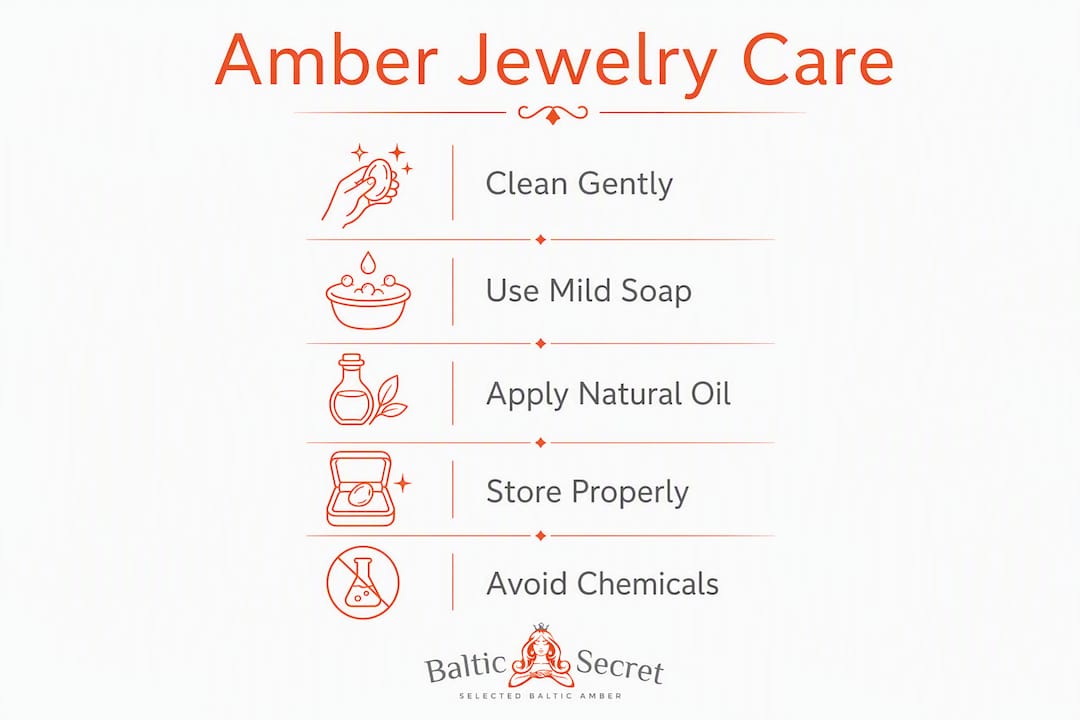
Clean amber with mild soap and lukewarm water, using a soft cloth or a very soft brush for textured surfaces. Rinse thoroughly and pat dry immediately. Do not soak pieces, and never leave them wet.
A very light application of natural olive or almond oil, buffed off with a clean cloth, can restore surface luster on pieces that have dulled. Use this sparingly, maybe once or twice a year, not as a routine step.
Store amber away from prolonged direct sunlight and heat sources. A padded pouch or a lined jewelry box works well. Amber is relatively soft (2–2.5 on the Mohs scale), so keep it away from harder stones that can scratch it.
Avoid acetone, alcohol, perfume, hairspray, and household cleaners on finished jewelry. Ultrasonic and steam cleaners are off the table entirely. Treated pieces are especially vulnerable: the color changes introduced by heat treatment can fade or shift further under sustained UV or heat exposure.
What should you ask before buying Baltic amber?
Color affects price, and provenance claims affect authenticity. Get clear answers before you pay.
- Where was this amber sourced? (Look for Lithuania or the broader Baltic region specifically.)
- Has this piece been heat-treated, clarified, or backed? Request written disclosure.
- What is the bead diameter and clasp type? (Critical for children’s and pet products.)
- Is an FTIR/FT-Raman lab certificate or gem lab report available for this piece?
- What is the return policy if authenticity cannot be verified?
On pricing: deep cognac, natural red, and inclusion-bearing pieces (especially those with insect inclusions) command the highest prices. Pale yellow and honey are the most affordable. Vivid green pieces at low prices are almost always treated; a genuinely natural green piece at a low price is a contradiction worth investigating. For high-value or unusual-color purchases, a GIA-style gem lab report or FTIR certificate is the strongest documentation you can hold.
Documentation worth requesting: an invoice stating Lithuanian origin, a treatment disclosure statement, and a lab certificate for any piece marketed as naturally green, red, or blue.
Why trust this guide?
Baltic Secret sources amber directly from Lithuania, the heart of the Baltic amber trade, and publishes detailed product pages listing bead diameter, clasp type, stringing method, and treatment status for each item.
The authenticity tests and safety guidance in this article draw on peer-reviewed research (PubMed), gemological authority (GIA, Gem-A), and lab-method studies (FTIR/FT-Raman feasibility research). For distinguishing authentic natural amber beads from treated or artificial pieces, the preference here is always for lab-grade methods over DIY screens alone.
For high-value purchases, request a lab report. For everyday pieces, the combination of UV fluorescence, loupe inspection, and seller documentation covers most scenarios.
Key Takeaways
Natural Baltic amber color is the single most reliable visual clue to a piece’s origin, treatment history, and value, and knowing what each hue signals protects buyers from paying a premium for treated material.
| Point | Details |
|---|---|
| Color signals origin and treatment | Honey and cognac are natural and common; vivid green or uniform red usually indicates heat treatment. |
| Two authenticity steps | Inspect under UV light and a loupe for sun spangles; request FTIR/FT-Raman lab documentation for high-value pieces. |
| Safety clasp is non-negotiable | Children’s and pet amber pieces must have a screw clasp and individually knotted beads; never leave unsupervised. |
| Natural rarity drives price | Inclusion-bearing, naturally red, and deep cognac pieces command higher prices than treated novelty colors. |
| Baltic Secret | Sources amber directly from Lithuania with safety features and treatment disclosure on every product page. |
What the color variation in Baltic amber actually tells you
Most buyers treat color as an aesthetic choice. That is understandable, but it undersells what color actually communicates. A piece of beeswax amber with its milky opacity is not just a style preference; it is a record of how many microscopic bubbles formed in that specific drop of resin, under those specific conditions, 44 million years ago. A cognac bead darkened by oxidation carries a different geological story than a pale lemon piece that stayed sealed from oxygen. Color is provenance made visible.
The part the market gets wrong is treating vivid, uniform color as a premium. It is often the opposite signal. The most valuable natural pieces tend to look slightly imperfect: uneven tone, a faint inclusion, a subtle flow line. That variation is exactly what authenticity looks like. A strand of perfectly matched, intensely colored beads with no internal variation is the one that deserves the most scrutiny, not the most admiration.
Baltic Secret amber for parents and pet owners
Baltic Secret offers handcrafted amber necklaces, bracelets, and collars sourced directly from Lithuania, with every product page listing bead diameter, clasp type, and treatment status. Children’s pieces feature screw clasps and individually knotted beads. Pet collars include a safety screw clasp sized to the animal. Adult artisanal pieces show the full natural color range, from pale honey to deep cognac.
For parents and pet owners who want the authenticity and safety details this guide describes, the product pages at Baltic Secret are the place to check bead sizing, clasp specifications, and provenance documentation before you buy. Browse the full range and review the safety details at balticsecret.com.
Useful sources
- Correlation Between Color and Bubble Microstructural Characteristics in Baltic Amber — PubMed study using SEM to explain how bubble density creates opaque beeswax coloration through light scattering.
- GIA Buyer’s Guide to Amber — Gemological Institute of America guidance on color, treatment flags, and what to look for when purchasing amber.
- Identification of Treated Baltic Amber by FTIR and FT-Raman — Feasibility study documenting spectral markers that distinguish treated from untreated succinite.
- An Update on Identification Features of Treated Baltic Amber — Gem-A summary of surface and internal diagnostic features including sun spangles and luminescence changes.
Recommended
- Pet Amber Accessory Handcrafted Meaning: 2026 Guide – Baltic Secret
- Teething Amber Beads: A Safety-First Guide for Parents – Baltic Secret
- Monitoring Pet Amber Collar Wear: A Pet Owner’s Guide – Baltic Secret
- Buying an Amber Collar for Dogs — What to Look For and Is It Safe? | Balticsecret – Baltic Secret