Your Authentic Amber Pet Collar Checklist Before You Buy

Treat an amber pet collar as an accessory, not a pest-control solution, and run these checks before you hand over your credit card.
Before buying any amber collar, confirm all five of these:
- Documented Baltic origin (Lithuania or neighboring region, not just “natural amber”)
- Certificate of Authenticity or FTIR lab reference available on request
- Close-up product photos showing bead texture, drill holes, and stringing
- Breakaway or quick-release clasp appropriate for your pet’s size
- Clear return policy and an authenticity guarantee in writing
If a listing is missing even two of these, walk away. No provenance, no return policy, or a suspiciously cheap price with no lab documentation are the clearest signs of a fake or misrepresented product.
Key Takeaways
Amber collars are worth buying only when you can verify Baltic origin, confirm safety features, and pair them with vet-approved pest prevention.
| Point | Details |
|---|---|
| Amber is not proven pest control | No controlled studies confirm amber collars reliably repel fleas or ticks; use vet-approved treatments for prevention. |
| Baltic origin requires documentation | “Natural amber” is not enough; ask for an FTIR report or COA naming Lithuania, Latvia, or Estonia specifically. |
| Safety design is non-negotiable | Confirm a breakaway clasp, individually knotted beads, and correct sizing (two-finger rule) before your pet wears the collar. |
| Seller signals matter | Macro photos, explicit provenance, a stated return policy, and willingness to share lab documentation separate credible sellers from risky ones. |
| Baltic Secret as a benchmark | Baltic Secret sources from Lithuania, provides COA/FTIR on request, and publishes detailed product pages with sizing and safety guidance. |
Table of Contents
- What Baltic amber actually is — and what it isn’t
- What the science and vets actually say about amber collars
- Your step-by-step authentic amber pet collar checklist
- Safety and sizing checks every pet owner should run
- How to vet sellers and read reviews without getting fooled
- Evidence-based alternatives when pest prevention is the actual goal
- What a trustworthy vendor page looks like — Baltic Secret as a benchmark
- Our perspective on what this checklist is really protecting
- Baltic Secret’s amber collars meet the checklist
- Sources
What Baltic amber actually is — and what it isn’t
Baltic amber is fossilized tree resin, formed roughly 44 million years ago from trees in the region now covered by the Baltic Sea. It is not a crystal, not a modern plastic, and not the same as copal, which is a much younger, semi-fossilized resin that looks almost identical to the untrained eye.
What you are most likely to encounter as a fake:
- Plastic imitations: Uniform color, no internal inclusions, slightly flexible under pressure, and often lighter than real amber.
- Copal: Younger resin that softens with acetone or alcohol; amber does not.
- Dyed glass: Heavy, cold to the touch, and perfectly transparent with no cloudiness or inclusions.
- Pressed amber: Made from genuine amber dust fused under heat; technically amber, but not a single natural piece and often misrepresented as such.
Two quick physical signals worth knowing: real amber feels warm in your hand almost immediately (plastic stays neutral longer), and when you look closely, you will see irregular internal features — tiny bubbles, plant fragments, or cloudiness — that no factory can replicate consistently. A raw vs. polished amber comparison shows these differences clearly across bead types.
What the science and vets actually say about amber collars
The direct answer: there is no robust scientific evidence that amber collars reliably repel fleas or ticks. Veterinary and scientific analysis consistently flags this, and most positive owner reports are anecdotal rather than controlled.
Two mechanisms are commonly proposed. First, succinic acid or terpenes released from the resin may theoretically deter insects. Second, the friction of amber beads against fur is said to generate a static charge that makes it harder for ticks to grip. Neither mechanism has been validated at the scale needed to prevent real infestations under field conditions.
| Claim | Evidence type | Verdict |
|---|---|---|
| Amber repels fleas via succinic acid | Anecdotal / theoretical | Not confirmed in controlled studies |
| Static charge deters ticks | Hypothesized mechanism | No peer-reviewed validation |
| Amber is safe as a complementary accessory | General consensus | Reasonable with safety precautions |
| Proven collars provide documented protection | Clinically validated | Confirmed (e.g., documented 8-month protection durations for some products) |
The practical takeaway: consult your vet before relying on any collar for pest control. An amber collar worn alongside a vet-approved treatment is a very different proposition from using it as a standalone solution.
Your step-by-step authentic amber pet collar checklist
Pre-purchase checks (online, before ordering)
-
Verify Baltic origin specifically. “Natural amber” is not the same as “Baltic amber.” Look for explicit mention of Lithuania, Latvia, or Estonia as the source region, not just a vague “sourced from Europe.”
-
Ask for or confirm a COA or FTIR reference. A Certificate of Authenticity (COA) or FTIR spectroscopy result is the gold standard for confirming Baltic provenance. Reputable sellers either publish this or provide it on request. If a seller cannot name the test or refuses to share documentation, that is a red flag.
-
Examine product photos critically. Genuine amber beads are irregular. Look for variation in bead shape, color depth, and surface texture across the strand. Identical, perfectly round, uniformly colored beads almost always indicate plastic or pressed material.
-
Check the return policy before checkout. A seller confident in their product’s authenticity will offer a clear return window and an authenticity guarantee. No return policy on a natural-material product is unusual.
In-hand checks (once the collar arrives)
-
Salt-water float test (non-destructive observation). Museum-documented guidance recommends placing a bead in a saturated salt-water solution (roughly 2.5 tablespoons of salt per cup of water). Real amber floats; most plastics and glass sink. Copal also floats, so combine this with other checks.
-
UV/blacklight fluorescence. Under a UV lamp, genuine Baltic amber typically fluoresces blue-white or greenish-blue. Plastic tends to show little to no fluorescence or a different color entirely. This is one of the fastest non-destructive checks you can do at home.
-
Magnification of internal structure. Use a loupe or your phone’s macro camera. Real amber shows irregular inclusions, flow lines, or tiny bubbles. Perfectly clear, inclusion-free beads with no internal variation are almost certainly not natural amber.
-
Weight and warmth. Hold a bead in your closed palm for 10 seconds. Amber warms quickly and feels lighter than glass of the same size. If it stays cold or feels dense, suspect glass or ceramic.
Red flags that mean walk away
- Beads that are perfectly identical in size, shape, and color across the entire strand
- Glue residue visible around drill holes (sign of mass-produced fakes with plugged holes)
- Seller describes origin only as “natural” or “organic” with no geographic specificity
- Price dramatically below comparable products with no explanation
- No macro photography anywhere in the listing
Pro Tip: When requesting an FTIR or COA, ask the seller specifically for the succinic acid percentage and the source region noted in the report. Authentic Baltic amber typically shows succinic acid content in the report. A seller who cannot explain what FTIR measures is unlikely to have run the test.
Safety and sizing checks every pet owner should run
Getting the fit right matters as much as getting the material right. A collar that is too tight restricts breathing; one that is too loose can snag on branches, furniture, or another animal’s jaw.
- Two-finger rule: Slide two fingers between the collar and your pet’s neck. If you cannot fit two fingers, it is too tight. If you can fit three or more, it is too loose and a snagging hazard.
- Bead size relative to pet size: Small dogs and cats need smaller beads (roughly 5–7mm) to avoid the collar sitting awkwardly or the beads becoming a choking hazard if the strand breaks. Larger dogs can wear 8–11mm beads comfortably.
- Breakaway or quick-release clasp: For cats especially, a breakaway clasp is not optional. It releases under pressure, which prevents strangulation if the collar catches on something. Check that the clasp mechanism actually releases under moderate force before putting it on your pet.
- Inspect the stringing: Beads should be individually knotted or separated so that if the cord breaks, beads do not scatter. A single continuous thread with no knots between beads means one break sends every bead across the floor — and potentially into your pet’s mouth.
- No unsupervised wear near water: Prolonged water exposure weakens cord and can cause amber to crack. Remove the collar before baths and swimming.
Baltic Secret’s collar wear guide recommends checking the cord and clasp weekly for fraying, discoloration, or loosening knots. A frayed cord is a choking hazard waiting to happen.
Pro Tip: Run your thumbnail along the cord between beads every week. Any roughness, stiffness, or visible fiber separation means it is time to replace the collar, regardless of how good the amber looks.

How to vet sellers and read reviews without getting fooled
The listing tells you almost as much as the product itself. Start with these checks before you read a single review.
- Documented provenance: Does the listing name the country of origin? Does it mention Lithuania, Latvia, or Estonia by name? “Handcrafted” and “natural” are marketing words; geographic specificity is a factual claim that can be verified.
- Macro photography: A trustworthy seller photographs the beads up close. You should be able to see surface texture, color variation, and the drill holes. Stock-photo-style images with no close-ups are a warning sign.
- COA/FTIR statement: Even a line saying “FTIR documentation available on request” signals that the seller knows what authentication looks like. Silence on this point is not neutral.
- Return and authenticity guarantee: Spelled out clearly, not buried in a general FAQ.
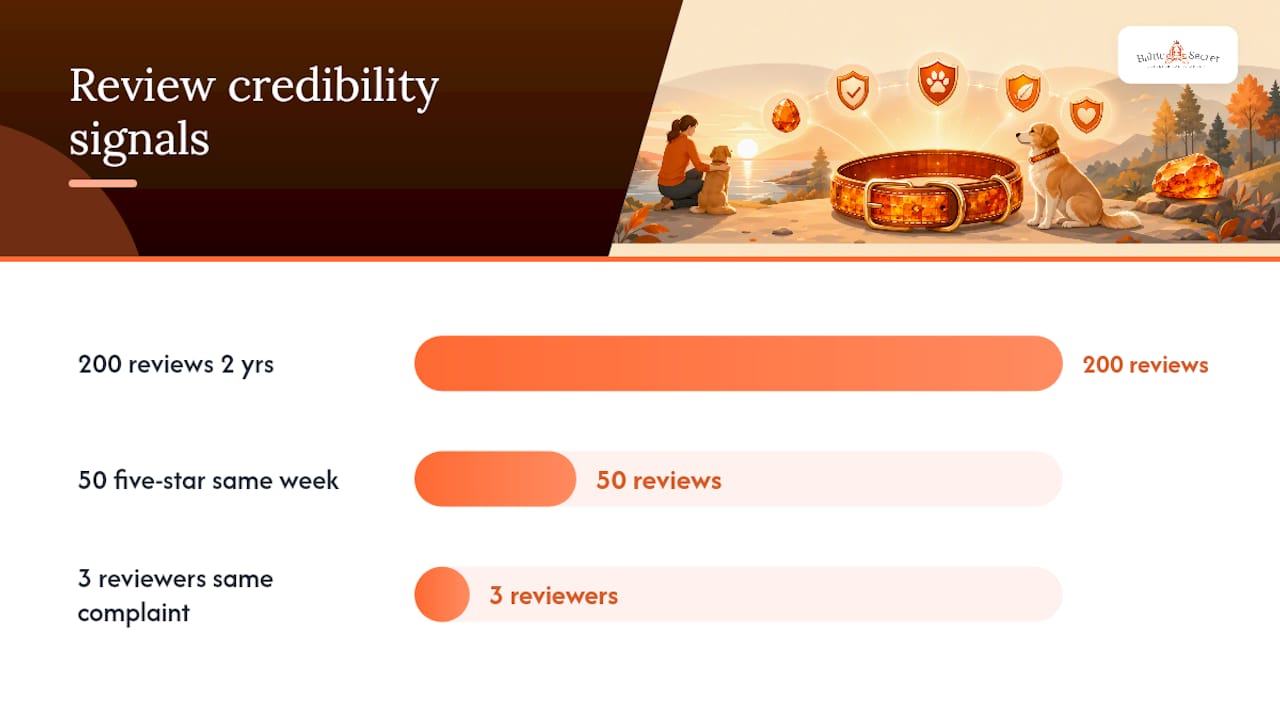
When reading reviews, look for age and diversity. A product with 200 reviews posted across two years, including photos uploaded by buyers, is far more credible than 50 five-star reviews posted in the same week. Look for repeat complaint themes too — if three separate reviewers mention beads that smell like plastic or a clasp that broke immediately, that pattern matters more than the star average.
The question to ask any seller before buying: “Can you provide the country of origin for this specific batch, and do you have FTIR documentation or a COA I can review?” A seller with genuine Baltic amber will answer this without hesitation. One who deflects, offers a generic “authenticity guarantee” without specifics, or goes silent is telling you something important.
Community threads on Reddit and pet owner forums carry a lot of noise, but timestamped photos from multiple independent reviewers corroborating the same product details are worth paying attention to. A single glowing post with no photos proves nothing. Manufacturers of clinically validated pet collars invest in anti-counterfeit documentation and authorized retailer lists — the same standard of transparency is reasonable to expect from any seller claiming Baltic provenance.
Craftsmanship signals matter too. On a quality amber collar, hardware should feel solid and heavy, not hollow or lightweight. Clasps should open and close cleanly without wobbling. Thin, plated-looking hardware on a “premium” product is a sign of cost-cutting that usually extends to the amber itself.
Evidence-based alternatives when pest prevention is the actual goal
If your primary goal is keeping fleas and ticks off your pet, amber is not the right tool. The evidence is clear on this.
The one-sentence answer: For pest control, rely on products with peer-reviewed evidence and veterinary approval — topical treatments, oral chewables, or clinically validated collars — and treat amber as a cosmetic accessory only.
Evidence-backed options your vet can help you choose from:
- Monthly topical treatments: Applied to the skin at the back of the neck; effective against both fleas and ticks with documented kill rates. Dosing is weight-based, so confirm the right product for your pet’s size.
- Oral chewables: Prescription or over-the-counter options that work systemically; some cover fleas only, others cover ticks as well. Check species compatibility — some products safe for dogs are toxic to cats.
- Clinically validated collars: Some collar products carry documented protection durations backed by controlled studies. These are not the same as amber collars; they use active chemical compounds with regulatory approval.
A vet consultation matters here for two specific reasons: drug interactions (especially in older pets on other medications) and lifecycle control (treating the environment, not just the animal). An infestation that is already established needs a different protocol than prevention.
Once your vet-approved treatment is in place, wearing an amber collar alongside it as a natural accessory is a reasonable choice — provided the collar passes the authenticity and safety checks above. The two are not mutually exclusive; the problem is only when amber is used instead of proven prevention.
What a trustworthy vendor page looks like — Baltic Secret as a benchmark
A reputable seller’s product page should answer your checklist questions before you have to ask. Here is what that looks like in practice.
A credible listing for a Baltic amber pet collar should include:
- Explicit origin statement: “Sourced from Lithuania” or equivalent, not just “Baltic amber.”
- COA or FTIR reference: Either published on the page or noted as available on request, with a contact method.
- Multiple macro photographs: Close-ups of individual beads showing surface texture, color variation, and the stringing method. At least one photo of the clasp mechanism.
- Bead description: Raw vs. polished, approximate bead size in millimeters, and the stringing or knotting method used.
- Safety information: Sizing guidance, clasp type (breakaway or standard), and care instructions.
- Return and authenticity policy: Stated clearly, not implied.
| Document or feature | What to accept | What requires more verification |
|---|---|---|
| Origin statement | Named Baltic country (Lithuania, Latvia, Estonia) | “Natural amber,” “European amber,” no country named |
| Lab documentation | FTIR report or COA with succinic acid reference | “Authenticity guaranteed” with no test named |
| Product photography | Macro close-ups of beads and clasp | Stock images or single lifestyle photo only |
| Return policy | Explicit window and process stated | “All sales final” or no policy mentioned |
| Bead description | Size in mm, raw vs. polished, stringing method | “Handcrafted” with no further detail |
Baltic Secret’s amber tick collar for dogs is sourced from Lithuania and includes product detail pages with bead descriptions, sizing guidance, and care instructions. If a seller you are evaluating cannot match this level of documentation, ask why before purchasing.
If a seller claims “Baltic” origin but provides no lab documentation, ask directly: “Can you provide an FTIR report or a dated invoice from your Baltic supplier?” The response tells you everything. A supplier with genuine provenance has these documents. One who cannot produce either is relying on your trust rather than earning it.
Our perspective on what this checklist is really protecting
The checklist above is not about being difficult with sellers. It is about the fact that the amber collar market has a real counterfeiting problem, and the consequences of getting it wrong fall on your pet, not the seller.
Amber collars worn as accessories on healthy pets with proper vet-approved pest prevention in place are a reasonable choice. The amber is real, the craftsmanship is genuine, and the collar is safe. That combination is achievable. What it requires is exactly the kind of verification this checklist covers: provenance you can trace, documentation you can read, and safety features you can physically confirm.
Baltic Secret prioritizes pet safety and does not recommend amber as a standalone pest-control method. If you have questions about a specific product’s COA or FTIR documentation, or want to send macro photos for a quick authenticity check, Baltic Secret’s customer support team can help you evaluate what you have or what you are considering.
Baltic Secret’s amber collars meet the checklist
Baltic Secret sources its amber directly from Lithuania and publishes detailed product pages that align with the checklist criteria above. Every collar listing includes bead type (raw or polished), sizing guidance, clasp description, and care instructions. COA and FTIR documentation are available on request.
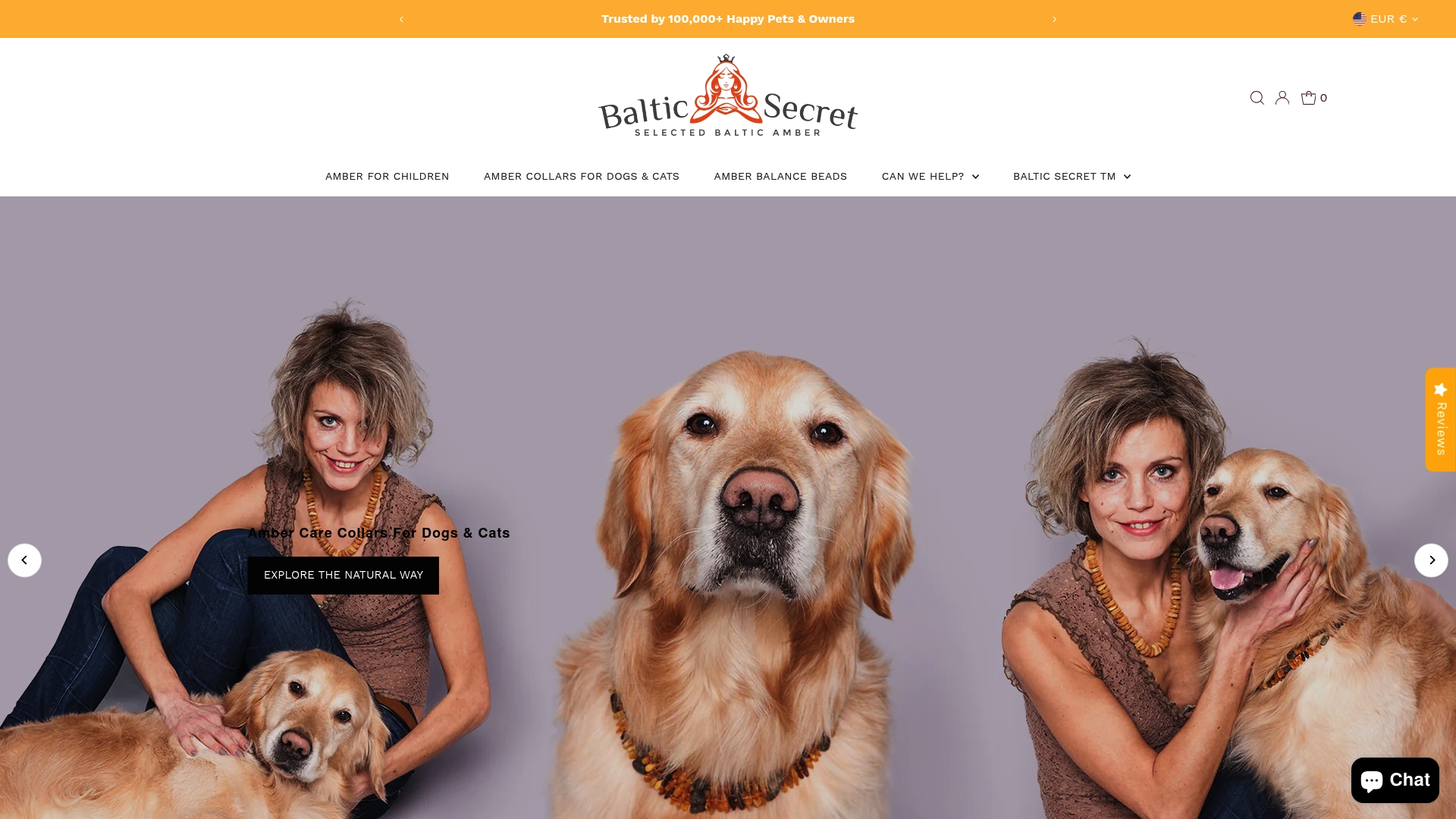
The Baltic Secret amber collar for dogs and cats comes with macro product photography, explicit Baltic sourcing, and a transparent returns and authenticity guarantee. Browse the full U.S. product range at Baltic Secret to compare bead types, sizes, and collar options for your pet. Every purchase is backed by a clear return policy — no ambiguity, no fine print.
Sources
These are the primary sources used in this article, organized by the type of information they provide.
On COA and FTIR requests: When you receive documentation, look for explicit mention of succinic acid content and the geographic origin of the resin. If the document names only “amber” without specifying Baltic provenance or succinic acid markers, ask the seller for a more detailed report or a supplier invoice. Any reputable Baltic amber seller can provide one.
This article is general information, not a substitute for advice from a qualified doctor. Consult a qualified healthcare professional about your own circumstances before acting on anything here.