Baltic Amber Certifications for Children's Products: U.S. Guide

Before you buy any Baltic amber item for your child, demand three documents from the seller: a Certificate of Authenticity declaring Baltic origin with a batch or lot number, an FTIR lab report from an ISO/IEC 17025–accredited lab confirming amber identity, and CPSIA-referenced third-party safety test results covering lead, phthalates, and mechanical safety. Without all three, you cannot verify what you are actually buying.
The three documents every U.S. parent should request before purchasing Baltic amber products for children:
- Certificate of Authenticity with declared Baltic origin, supplier name, and batch/lot number
- FTIR lab report from a named, ISO/IEC 17025–accredited laboratory
- CPSIA or third-party safety test results (lead, phthalates, mechanical/clasp release)
- Product page safety notes: individually knotted beads, breakaway clasp, age grading, and supervision warnings
The International Amber Association, the U.S. Consumer Product Safety Commission (CPSC), and accredited testing labs like SGS or Intertek are the names you should expect to see referenced across these documents. A seller who cannot produce all three is not a seller you should trust with your child’s safety.
Table of Contents
- Which certificates, lab tests, and standards actually prove Baltic amber identity and child safety
- How to read and verify a COA and lab reports before you buy
- How to spot common amber imitations and why FTIR is the only reliable test
- Design features, safety testing, and usage rules parents should expect on children’s amber items
- Exactly which documents to request before you buy
- Red flags to avoid and direct seller questions that reveal credibility
- How Baltic Secret documents authenticity and child safety
- Key Takeaways
- The verification habit that actually protects your child
- Baltic Secret’s children’s amber products: verified, traceable, and ready to review
- Authoritative resources for verifying certificates and lab accreditation
Which certificates, lab tests, and standards actually prove Baltic amber identity and child safety
Not all certification language means the same thing. Here is what each document actually verifies and why you need it.
Certificate of Authenticity (COA)
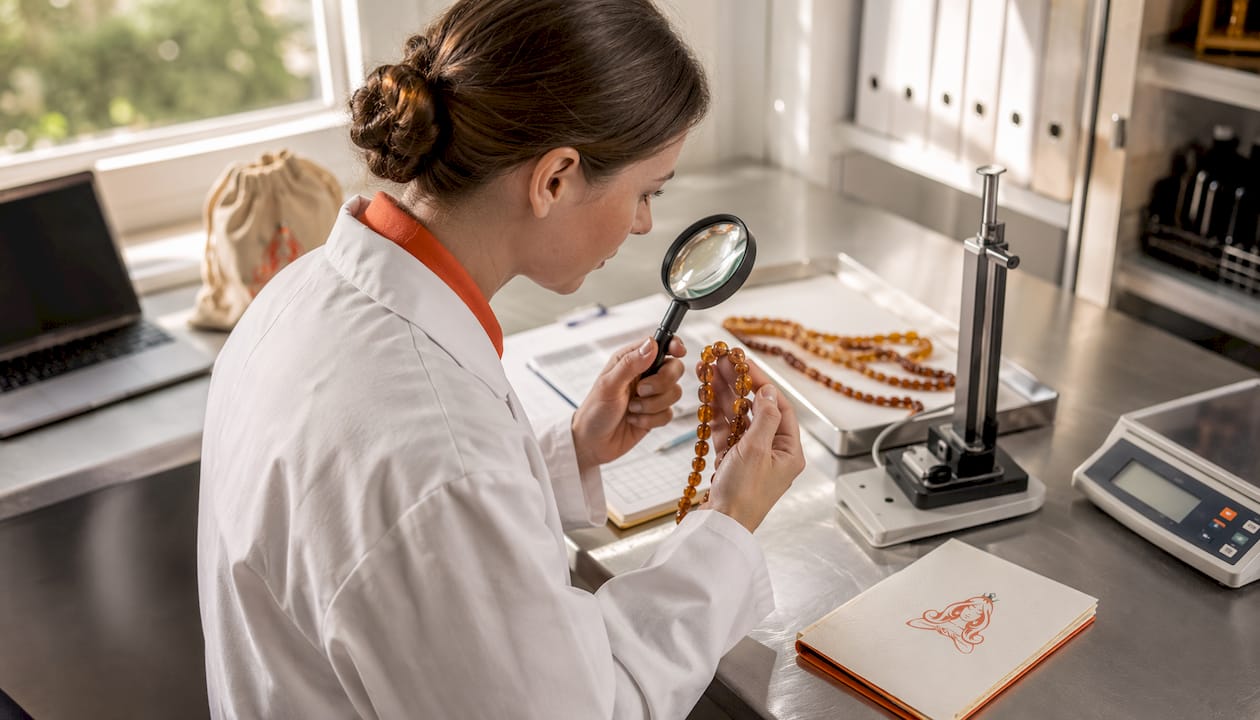
A legitimate COA for Baltic amber products for children should include the declared Baltic origin, the supplier’s name and contact, a batch or lot number (or serial code), bead count or weight, and the date of issue. The batch number is the most underrated field on the document. It is what lets you trace a specific product back to a specific production run and request verification from the issuing lab or assay office.
A COA signed only by the seller, with no lab name and no traceable batch identifier, is essentially a self-declaration. It proves nothing about the amber’s identity.
FTIR spectral analysis
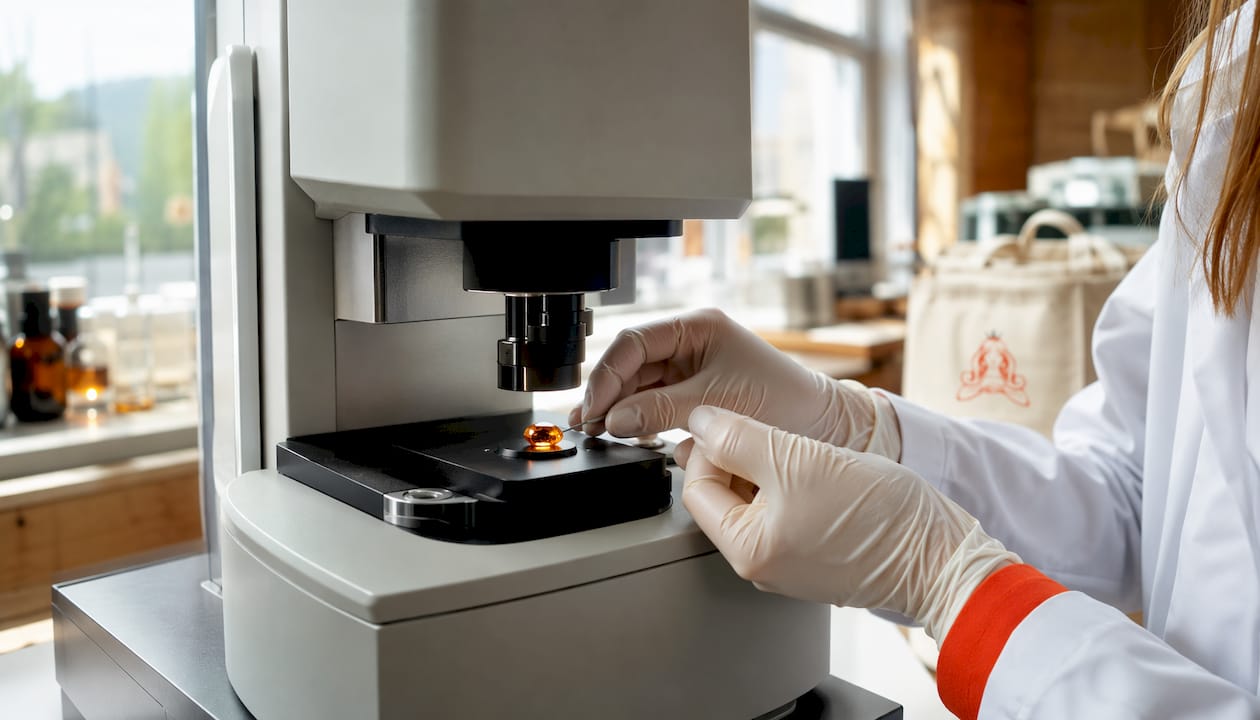
FTIR testing (Fourier-transform infrared spectroscopy) is the accepted laboratory method for identifying Baltic amber. The test detects the characteristic succinic-acid peaks in the infrared spectrum that distinguish genuine Baltic amber from copal, plastic beads, and heat-treated synthetic resins. No home test replicates this. The lab report should name the instrument used, the method, and the accrediting body.
ISO/IEC 17025 lab accreditation
ISO/IEC 17025 is the international standard for testing laboratory competence. When a lab holds this accreditation, it means an independent body has verified that the lab’s methods, equipment, and staff meet a defined quality standard. For FTIR reports, ISO/IEC 17025 accreditation is the baseline you should insist on. A report from an unaccredited lab carries no verifiable weight.
Children’s safety testing under CPSIA
For amber products for children sold in the U.S., CPSIA compliance is not optional. The Consumer Product Safety Improvement Act requires children’s products to be tested by a CPSC-accepted third-party lab for lead content, phthalates, and in many cases mechanical safety. Certified amber teething necklaces should also show mechanical test results, typically conducted to EN71-1 or an equivalent standard, covering tensile strength, small-parts assessment, and clasp release force. These tests address child safety independently of whether the amber is genuine.
Quick reference: what each document covers
| Document | What it proves | Issuing authority |
|---|---|---|
| Certificate of Authenticity | Baltic origin, batch traceability | Seller + recognized assay lab |
| FTIR lab report | Amber identity vs. copal/plastic | ISO/IEC 17025–accredited lab |
| CPSIA/third-party safety test | Lead, phthalates, mechanical safety | CPSC-accepted lab (e.g., SGS, Intertek) |
| EN71-1 mechanical test | Clasp release, tensile strength, small parts | Accredited test lab |
Recognized industry bodies
The International Amber Association sets industry guidance on amber classification and recommends buying from retailers that follow recognized certification systems. The Lithuanian Assay Office and similar national gem-testing labs are frequently cited on legitimate COAs as the issuing authority for Baltic amber identity. When you see either name on a certificate, it signals the seller sourced documentation from an established institution rather than printing their own.
Pro Tip: Ask the seller specifically which lab performed the FTIR test and whether that lab is ISO/IEC 17025–accredited. If they cannot name the lab, the report is not independently verifiable.
How to read and verify a COA and lab reports before you buy
Receiving a document is not the same as verifying it. Here is a practical sequence you can follow before any purchase.
- Confirm the lab name is present. The FTIR report must name the laboratory, not just the seller. A report on seller letterhead with no external lab name is a self-issued document.
- Check ISO/IEC 17025 accreditation. The report should reference the lab’s accreditation number or body. You can cross-check accreditation status through national accreditation bodies such as A2LA (American Association for Laboratory Accreditation) or ILAC-member bodies. Look for a report ID, a clear date, the method used (FTIR), and a signature.
- Verify the FTIR result matches Baltic amber spectra. A legitimate report will reference the characteristic succinic-acid absorption peaks. If the report only says “amber confirmed” with no spectral data or method reference, push back.
- Match the batch or lot number. The number on the FTIR report and COA should match the number printed on the product tag or packaging. Certificates sometimes contain lot numbers and presentation leaflets that make this cross-check straightforward.
- Confirm the date. A report dated years before the product was manufactured raises questions about whether it covers the specific batch you are buying.
- Contact the lab if unsure. A legitimate ISO/IEC 17025–accredited lab will have a public contact and can confirm whether a report with a given ID was issued by them.
Red flags that invalidate a certificate or report:
- COA with no lab name, no batch identifier, or no date
- FTIR report missing instrument name, method reference, or accreditation info
- Generic “certificate of authenticity” with no traceable lab or assay office
- Photos of certificates instead of downloadable PDF files
- Batch number on the document that does not match the product tag
- Seller who cannot name the testing lab when asked directly
How to spot common amber imitations and why FTIR is the only reliable test
The most common materials sold as Baltic amber are copal (young tree resin, sometimes millions of years younger than true amber), plastic or acrylic beads, heat-treated non-Baltic resins, and dyed stones. Visually, copal can look nearly identical to amber. Plastic beads often feel lighter and warmer to the touch, but that is not a reliable diagnostic.
Safe at-home checks (and their limits):
- Saltwater float test: Genuine Baltic amber floats in a saturated saltwater solution (roughly 2.5 tablespoons of salt per cup of water). Copal also floats. Plastic usually sinks. This test rules out some plastics but cannot distinguish amber from copal.
- Visual inspection: Look for natural inclusions, slight surface irregularities, and color variation. Perfectly uniform beads with no inclusions are suspicious, though some processed amber is uniform.
- Touch test: Amber feels slightly warm and light. Glass beads feel cold and heavy. Again, not definitive.
Do not do these:
- Hot needle test: damages the bead, voids authenticity claims, and may void the seller’s return policy
- Chemical solvent tests: destructive and dangerous around children
- Burning: destructive and produces toxic fumes
Labs like SGS and Intertek perform FTIR testing as part of broader materials analysis services. An FTIR report from a named, accredited lab is the only document that definitively separates Baltic amber from its imitators.
Design features, safety testing, and usage rules parents should expect on children’s amber items
Authenticity and safety are separate questions. A product can be genuine Baltic amber and still be unsafe for a child if it is poorly constructed.
Design features to look for:
- Individually knotted beads: Each bead should be knotted on both sides so that if the strand breaks, only one bead is released rather than the entire necklace scattering. Safety-conscious designs incorporate this as standard.
- Breakaway or screw clasp: The clasp should release under a defined pressure (typically tested to EN71-1 mechanical standards) to prevent strangulation risk. Screw clasps add a secondary security layer.
- Age grading: Products should specify whether they are appropriate for infants (0+) or older children (3+), with corresponding bead size and small-parts compliance.
- Bead size: Beads small enough to be a choking hazard for the intended age group should not pass a small-parts test.
Testing anchors for U.S. buyers:
CPSIA-referenced testing covers lead content and phthalates. Mechanical safety tests, typically conducted to EN71-1 or equivalent, assess tensile strength (how hard the strand must be pulled before breaking), clasp release force, and small-parts compliance. Both sets of tests should appear in the seller’s documentation.
Usage rules that should appear on product pages and care labels:
- Remove the necklace during naps and sleep, always
- Adult supervision required at all times while wearing
- Do not submerge in water or expose to detergents
- Wipe clean with a dry or slightly damp cloth
- Store separately to avoid scratching
Exactly which documents to request before you buy
Save every document the seller provides. Here is the complete list of what to request, and a message you can copy and send directly.
Document checklist:
- Downloadable FTIR report (PDF) with lab name, accreditation reference, method, date, and report ID
- Original COA showing declared Baltic origin, supplier name, and batch/lot number
- CPSIA or third-party safety test results for lead, phthalates, and mechanical safety
- EN71-1 or equivalent mechanical test report (tensile strength, clasp release, small parts)
- Product photos showing the clasp type and individual bead knotting
- Packaging or product tag showing the lot or batch number that matches the COA
Sample message to send a seller (copy and paste):
What counts as an acceptable response:
- A downloadable PDF with a visible lab name, accreditation number, and report date
- A COA with a batch number that matches the product tag
- A safety test report referencing a CPSC-accepted lab
- Lab contact information you can independently verify
Certificates that include lot numbers and presentation leaflets make this cross-check straightforward. If a seller provides only photos of documents or refuses to share PDFs, that is a problem.
Red flags to avoid and direct seller questions that reveal credibility
Red flags:
- Vague “certified” claims with no lab name, no report number, and no accreditation reference
- Only photos of certificates, no downloadable PDFs
- Inconsistent or absent batch numbering across COA, product tag, and safety reports
- Refusal to supply the FTIR report file when asked directly
- No photos of clasp type or bead knotting on the product page
- Unusually low prices with no testing documentation at all
- COA signed only by the seller with no external lab or assay office named
Direct questions to ask, in order:
- Which lab performed the FTIR test?
- Can I receive the FTIR report as a PDF?
- Is that lab ISO/IEC 17025–accredited, and can you share the accreditation certificate?
- What is the batch or lot number for this specific product?
- Do you have CPSIA or third-party safety test results for this batch?
What trustworthy vs. untrustworthy answers look like:
A trustworthy seller names the lab immediately, sends a PDF within one business day, and the batch number on the report matches the product tag. An untrustworthy seller responds with “our products are certified” without naming a lab, offers only a photo of a certificate, or says the FTIR report is “available on request” but never delivers it.
The International Amber Association stresses that the biggest consumer risk is false classification and imitation. Sellers who follow recognized certification systems reduce that risk measurably. A seller who cannot answer question one clearly has not followed those systems.
How Baltic Secret documents authenticity and child safety
Baltic Secret sources directly from Lithuania and provides product documentation that parents can use as a benchmark when evaluating other sellers.
Trust signals Baltic Secret supplies:
- COA declaring Baltic origin with supplier information and batch traceability
- FTIR lab summaries referencing the testing lab and identity confirmation
- Product pages with visible safety details: individual bead knotting, clasp type, and age grading
- Care and safety instructions on product pages covering sleep removal, supervision, and water avoidance
- Detailed product descriptions for children’s amber necklaces that include construction specifics
What a complete Baltic Secret product packet looks like:
The COA fields cover declared Baltic origin, the supplier (Baltic Secret, sourced from Lithuania), and a batch identifier tied to the product. The FTIR note references the testing method and lab. The product page includes a CPSIA or third-party testing statement alongside photos of the clasp and knotted construction. Safety instructions appear on the product page and packaging.
This documentation structure maps directly onto the checklist in the previous section. If you request the FTIR PDF and COA from Baltic Secret and the batch number on the report matches your product tag, you have completed the verification loop.
Key Takeaways
Genuine Baltic amber certifications for children’s products require three independent documents: a traceable COA, an FTIR report from an ISO/IEC 17025–accredited lab, and CPSIA-referenced safety test results covering lead, phthalates, and mechanical safety.
| Point | Details |
|---|---|
| COA with batch traceability | Demand a COA that names the supplier, declares Baltic origin, and includes a batch or lot number. |
| FTIR from an accredited lab | The FTIR report must name an ISO/IEC 17025–accredited lab and reference the succinic-acid spectral method. |
| CPSIA safety tests | U.S. children’s products require third-party testing for lead, phthalates, and mechanical safety under CPSIA. |
| Child-safe design features | Individually knotted beads and a tested breakaway clasp are non-negotiable construction requirements. |
| Baltic Secret as a benchmark | Baltic Secret provides COA, FTIR summaries, and CPSIA-referenced safety details on its children’s product pages. |
The verification habit that actually protects your child
Most parents focus on whether amber is “real.” That is the right instinct, but it is only half the question. The other half is whether the product was built safely for a child’s body and tested to prove it.
What changed my own buying decisions was treating the FTIR report and the CPSIA safety test as non-negotiable, not nice-to-haves. When a seller could not name the lab that performed the FTIR, I moved on, regardless of how good the product photos looked. When a seller sent a PDF within hours with a matching batch number, I had something I could actually verify. Save every seller reply and every PDF. Match the batch number on the report to the number on the product tag when it arrives. If they do not match, contact the seller before your child wears it.
The certification process is not bureaucratic theater. It is the only mechanism that puts a seller’s authenticity claims on the record.
Baltic Secret’s children’s amber products: verified, traceable, and ready to review
Parents who have worked through this checklist know exactly what documentation to expect. Baltic Secret’s children’s amber jewelry is sourced directly from Lithuania, with product pages that include COA information, FTIR lab summaries, safety construction details, and care instructions built into every listing.
Before you buy, visit the Baltic Secret US store and review the product documentation on any children’s necklace or bracelet listing. If the FTIR report PDF or COA is not immediately visible on the page, contact Baltic Secret directly to request both documents along with the batch number before your order ships. That one step closes the verification loop this guide has walked you through.
Authoritative resources for verifying certificates and lab accreditation
Use these organizations to cross-check the documents a seller provides.
- International Amber Association / Amber Standard (amberstandard.com): Sets industry guidance on amber classification and identifies certified retail sources. Use it to understand what recognized certification looks like and which sellers follow established standards.
- Lithuanian Assay Office and recognized gem-testing labs: Frequently cited on legitimate COAs as the issuing authority for Baltic amber identity. If a COA names this office, you can contact it directly to verify the certificate.
- ISO/IEC 17025 accreditation lookup: Check lab accreditation status through A2LA (American Association for Laboratory Accreditation) or the ILAC directory of member accreditation bodies. Search by lab name to confirm current accreditation status.
- U.S. Consumer Product Safety Commission (CPSC) / CPSIA guidance: The CPSC publishes guidance on children’s product testing requirements, including which labs are accepted for CPSIA compliance testing. Visit cpsc.gov for current requirements and accepted lab lists.
- SGS and Intertek: Examples of large, internationally accredited testing organizations that perform both FTIR materials analysis and CPSIA-required children’s product safety testing. A report from either, with a visible accreditation reference, carries strong independent weight.
This article is general information for parents researching Baltic amber products and does not constitute legal, medical, or regulatory advice. Confirm current CPSIA requirements and lab accreditation status directly with the CPSC and your chosen accreditation body before making purchasing decisions.