Amber Jewelry Symbolism Explained: Meaning and History

Amber jewelry carries one of the oldest symbolic vocabularies in human history: protection, warmth, vitality, and a direct connection to the sun and the divine. Long before gemologists classified it, ancient peoples wore amber as a talisman, buried it with their dead, and traded it across continents for its perceived power. The symbolism is not arbitrary. It grew from amber’s physical strangeness, its golden warmth, its ability to hold electric charge, and its uncanny habit of trapping living things inside it for millions of years.
- Protection: Worn as an amulet against evil, illness, and misfortune across nearly every ancient culture.
- Warmth and vitality: Its solar color and warm feel linked it to life force and the sun’s energy.
- Preservation: Inclusions of insects and plants made it a symbol of life captured and held forever.
- Spiritual connection: Used in funerary rites, ritual offerings, and by healers and magicians.
- Status: Ownership of amber signaled wealth and prestige, especially in cultures far from Baltic sources.
Baltic amber, sourced from the shores of the Baltic Sea, sits at the center of this story. It is the most historically significant and symbolically rich variety of amber in the world.
Table of Contents
- What amber actually is, and why its nature drives its symbolism
- Amber jewelry symbolism explained through mythology and spiritual belief
- How amber shaped art, craft, and social identity across history
- What amber represents in contemporary culture and personal jewelry
- Baltic Secret’s expertise on authentic Baltic amber
- How amber’s symbolism differs across Slavic and Nordic cultures
- Amber jewelry symbolism in religion and sacred practice
- Baltic Secret: authentic amber jewelry rooted in centuries of tradition
- Key Takeaways
What amber actually is, and why its nature drives its symbolism
Amber is fossilized tree resin, not a mineral, which sets it apart from every other gemstone in the jewelry world. It formed over millions of years as resin from ancient trees hardened, trapping air, insects, plant matter, and even feathers inside. That preserved life is part of what made ancient peoples treat it as something sacred rather than merely decorative.
“Amber is nature’s time capsule. This fossilized tree resin contains remnants of life on earth millions of years ago.” — GIA (Gemological Institute of America)
Its softness, rated 2–2.5 on the Mohs scale, means it warms quickly against skin, which ancient wearers interpreted as evidence of living energy. Rub it against wool and it generates a static charge. The Greeks named it elektron, meaning “made by the sun,” and that word eventually gave us electricity. Colors range from pale honey yellow to deep cognac, rare white, and even red. Each shade carries its own symbolic weight, with white amber valued like ivory and red varieties prized for their intensity and rarity.
Amber jewelry symbolism explained through mythology and spiritual belief
The mythological meanings of amber are strikingly consistent across cultures that had no contact with each other, which tells you something about how powerfully its physical qualities shaped human imagination.
- Greek myth: The Greeks believed amber was the crystallized tears of the Heliades, sisters of Phaethon, who wept after their brother fell from the sun chariot. The historian Nicias described it as congealed droplets of the sun sinking beneath the ocean at dusk.
- Norse and Viking tradition: Vikings carved amber into animal shapes, believing the carving captured the animal’s strength. A bear-shaped amber piece was not decorative; it was a transfer of power.
- Chinese belief: Early Chinese tradition held that the souls of tigers transformed into amber upon death, making the stone a vessel for fierce, protective energy.
- Mother Goddess worship: Classical worshippers believed amber held Akasha, the animating fifth element that bound earth, air, fire, and water together. Amber was, in this view, literally alive.
- Funerary use: Stone Age gravesites dating to 8,000 BCE have yielded amber amulets with spiral patterns placed deliberately with the dead, suggesting a belief in amber’s power to guard the soul.
- Magic and healing: Magic workers wore amber necklaces as a sign of power and charged energy. In Homer’s Odyssey, an amber necklace is among the most impressive gifts a suitor could offer Penelope.
How amber shaped art, craft, and social identity across history
Amber’s role in human culture went well beyond personal belief. It shaped entire economies, artistic traditions, and social hierarchies.
- The Amber Road: The Amber Road was a trade network stretching from the Baltic coast to the Mediterranean, moving raw and carved amber across thousands of miles. Ownership of amber so far from its source became a marker of royal power, particularly in the Near East.
- Prehistoric ritual objects: Ancient artisans carved amber into pendants, beads, and figurines that served ritual functions. These were not hobbyist crafts. Specialized amber workers held significant social roles, sitting somewhere between jeweler, healer, and priest.
- Etruscan and Roman workshops: Central Italy, particularly Aquileia, became a major amber production center between the 1st and 3rd centuries CE. Roman women wore amber jewelry widely, and gladiators attached amber pieces to their fighting nets for protection.
- Medieval Armenian trade: After Rome’s decline, Armenian craftsmen kept amber manufacture alive, ensuring its trade continued into the modern era.
- Neolithic ornamental use: Amber has been used as jewelry since the Stone Age, from roughly 13,000 years ago, making it one of the earliest materials humans chose for personal adornment.
- Dual role as art and amulet: The J. Paul Getty Museum’s collection of pre-Roman carved ambers illustrates how the same object could function simultaneously as fine art and a charged ritual artifact, with the maker’s skill considered part of the object’s magical potency.
- Social signaling: Amber jewelry communicated age, sex, status, and group identity in ways that words could not. Permanent ornaments outlasted their wearers and connected descendants to ancestors.
What amber represents in contemporary culture and personal jewelry
The ancient meanings have not disappeared. They have adapted. Today, people wear amber for emotional balance, as a personal talisman, and as a connection to natural wellness traditions that feel increasingly relevant against a backdrop of synthetic everything.
- Amber remains a go-to choice for people drawn to warmth, protection, and vitality as personal values, not just aesthetic ones.
- Wellness communities use amber jewelry as part of broader practices around natural healing, drawing on traditions that go back to Roman physicians who prescribed powdered amber mixed with honey for infections.
- Its modern use continues symbolic themes of health and emotional grounding, with wearers treating it as a talisman of personal power.
- Astrologically, amber is associated with a zodiac sign reflecting its warm, solar, nurturing qualities.
- Baltic amber specifically carries a prestige that mass-produced or synthetic alternatives cannot replicate, because its provenance is traceable and its history is documented.
The personal dimension matters here. When you understand what a piece of amber has meant to people across six millennia, wearing it becomes a different experience than wearing a piece of colored glass.
Baltic Secret’s expertise on authentic Baltic amber
Baltic amber is not just geographically specific. It is chemically distinct. It contains succinic acid, a compound with antioxidant properties that gives traditional healing claims a grounding in actual chemistry. Ancient physicians who prescribed amber were not entirely wrong, even if they did not know why it worked.
Baltic Secret sources directly from Lithuania, where Baltic amber has been harvested and crafted for thousands of years. That direct provenance matters because the amber market has a counterfeiting problem: copal (young resin), glass, and plastic are routinely sold as genuine amber. Knowing your source is the first line of defense.
Pro Tip: To test amber at home, dissolve a small amount of salt in water until the solution is saturated. Genuine Baltic amber floats in saturated saltwater; plastic and glass sink. Copal may float too, but it will feel sticky and soften with acetone, while real amber will not.
Baltic Secret’s handcrafted pieces carry transparent provenance and detailed care guidance, connecting the wearer to a tradition that stretches from Neolithic Baltic shores to the present.
How amber’s symbolism differs across Slavic and Nordic cultures
Slavic and Nordic peoples lived closest to the primary amber sources, and their relationships with the stone are the most layered.
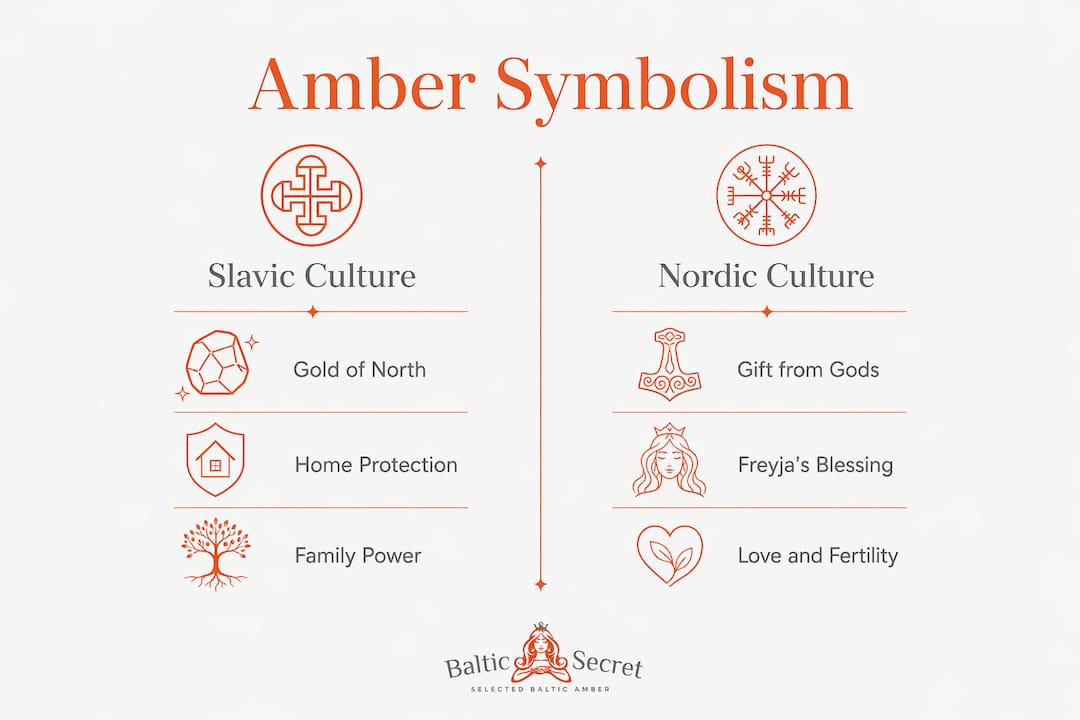
In Slavic tradition, amber was called “the gold of the north” and carried protective power for the home and family. It was placed in cradles to guard newborns, worn by women during pregnancy, and used in folk medicine to treat throat and respiratory ailments. The Slavic sun goddess Solntse was associated with amber’s golden color, and offerings of amber were made at seasonal festivals tied to the agricultural calendar.
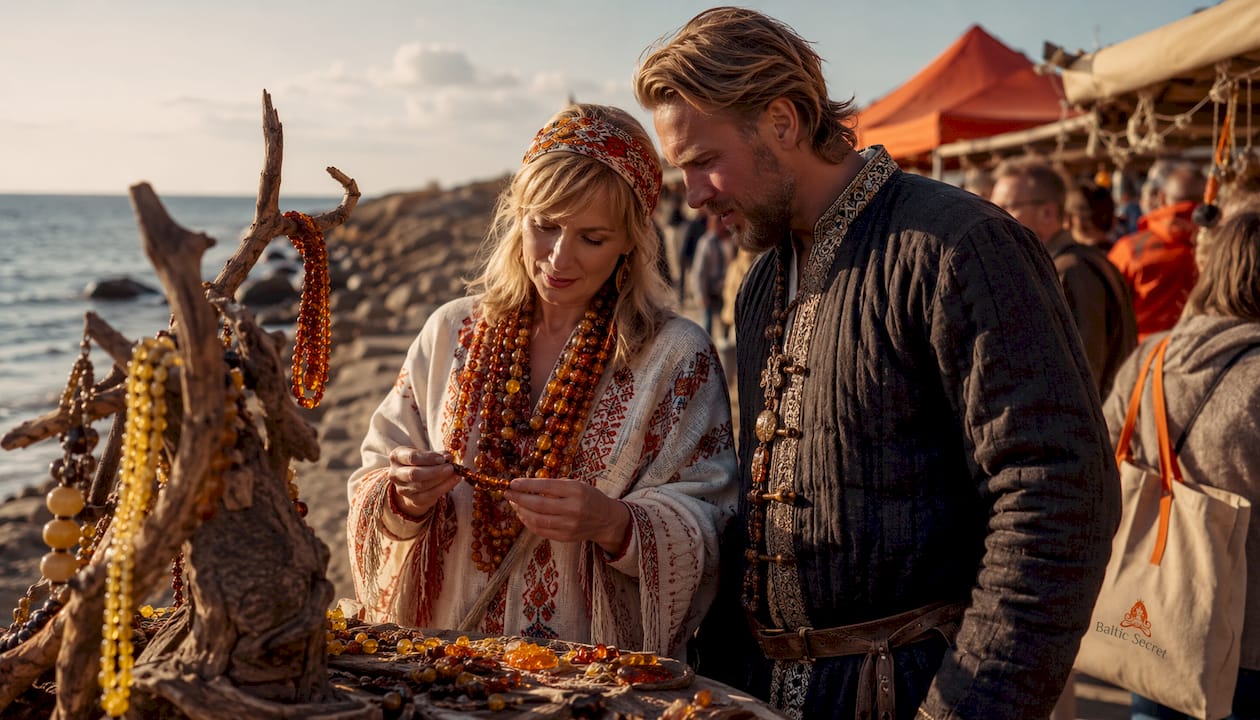
Nordic cultures treated amber as a gift from the gods, specifically from Freyja, the Norse goddess of love, fertility, and magic. According to Norse myth, Freyja wept tears of gold and amber when separated from her husband. Viking craftsmen carved amber into Thor’s hammer pendants and animal totems, believing the material amplified the protective power of the symbol. The amber’s electrical charge, visible when rubbed, reinforced the idea that it held divine energy.
Amber jewelry symbolism in religion and sacred practice
Religious traditions across the world incorporated amber in ways that reveal how universally it was seen as a bridge between the physical and spiritual.
In ancient Egypt, amber appeared in tomb offerings, placed with the dead to ease their passage to the afterlife. Egyptian amulet traditions treated amber as a material that could “guard” and provide “well-being,” two of the four core functions of Egyptian amulets. In ancient Greece and Rome, amber was dedicated to gods at sanctuaries, placed on cult statues as part of their sacred adornment.
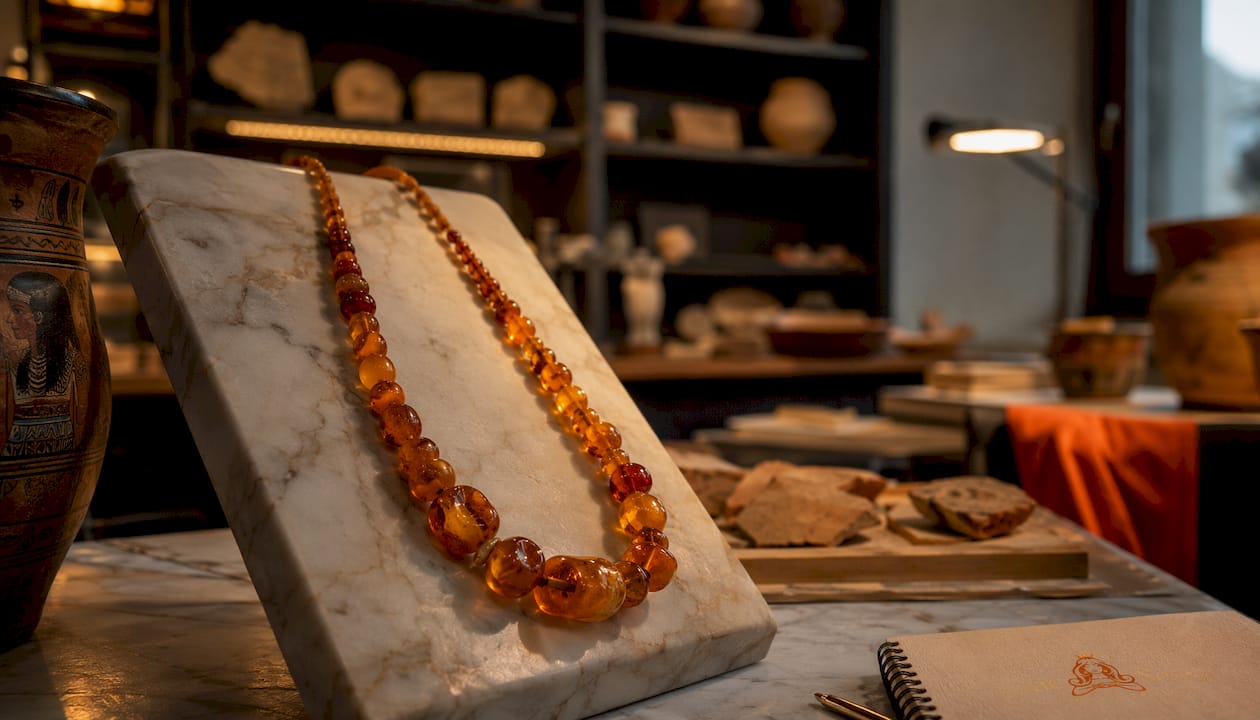
The biblical reference to “amber” in some translations of the Hebrew scriptures is actually a mistranslation. The original Hebrew word chashmal referred to an unknown glowing substance, not fossilized resin. This distinction matters because it shows how amber’s luminous quality was so distinctive that translators reached for it to describe divine radiance even when the original text meant something else entirely.
In Islamic tradition, amber beads were used in prayer strings, valued for their warmth and natural origin. In Christian medieval Europe, amber rosaries were prized objects, and Baltic amber guilds in cities like Gdańsk held significant economic and social power tied to the Church’s demand for devotional objects.
Baltic Secret: authentic amber jewelry rooted in centuries of tradition
If you have read this far, you already understand that amber is not a generic gemstone. Its meaning is specific, its history is documented, and its symbolism is earned through thousands of years of human experience. The piece you wear matters, and so does where it comes from.
Baltic Secret offers authentic Baltic amber jewelry sourced directly from Lithuania, handcrafted for adults, children, and pets. Every piece carries the provenance and quality that makes the symbolism real rather than decorative. Whether you are drawn to amber for its protective tradition, its solar warmth, or its connection to Baltic heritage, Baltic Secret’s collection gives you a genuine entry point into that history. Browse the full range of artisanal amber necklaces and find the piece that fits your intention.
Key Takeaways
Amber jewelry’s symbolism is inseparable from its physical nature as fossilized resin: its warmth, its inclusions, and its electrical charge all drove ancient peoples to treat it as a living, protective material.
| Point | Details |
|---|---|
| Core symbolic meaning | Amber represents protection, warmth, vitality, and spiritual connection across virtually every culture that encountered it. |
| Physical origin drives meaning | As fossilized tree resin rated 2–2.5 on the Mohs scale, amber’s warmth, electrical charge, and preserved inclusions made it feel alive to ancient wearers. |
| Mythological roots | Greek, Norse, Baltic, and Chinese traditions all independently associated amber with solar energy, divine tears, and the transfer of animal or spiritual power. |
| Color and origin matter | White amber was valued like ivory; red amber carried intensity and rarity; Baltic amber specifically contains succinic acid, grounding its healing traditions in chemistry. |
| Baltic Secret | Baltic Secret sources authentic Lithuanian amber directly, offering handcrafted jewelry for adults, children, and pets with transparent provenance. |