Baltic Amber versus Dominican Amber: Key Differences

Baltic amber and Dominican amber are two distinct fossil resins that differ in origin, chemical composition, color range, and market value. Baltic amber forms from ancient conifer trees in the Baltic Sea region, primarily Lithuania, Latvia, and Estonia, and dates back roughly 44 million years. Dominican amber originates from the extinct Hymenaea protera tree in the Caribbean and is approximately 15 to 40 million years old. For anyone comparing baltic vs dominican amber differences to choose jewelry or a natural wellness product, these distinctions go far beyond geography and directly affect what you buy, what you pay, and what you get.
How do Baltic and Dominican amber differ in color and appearance?
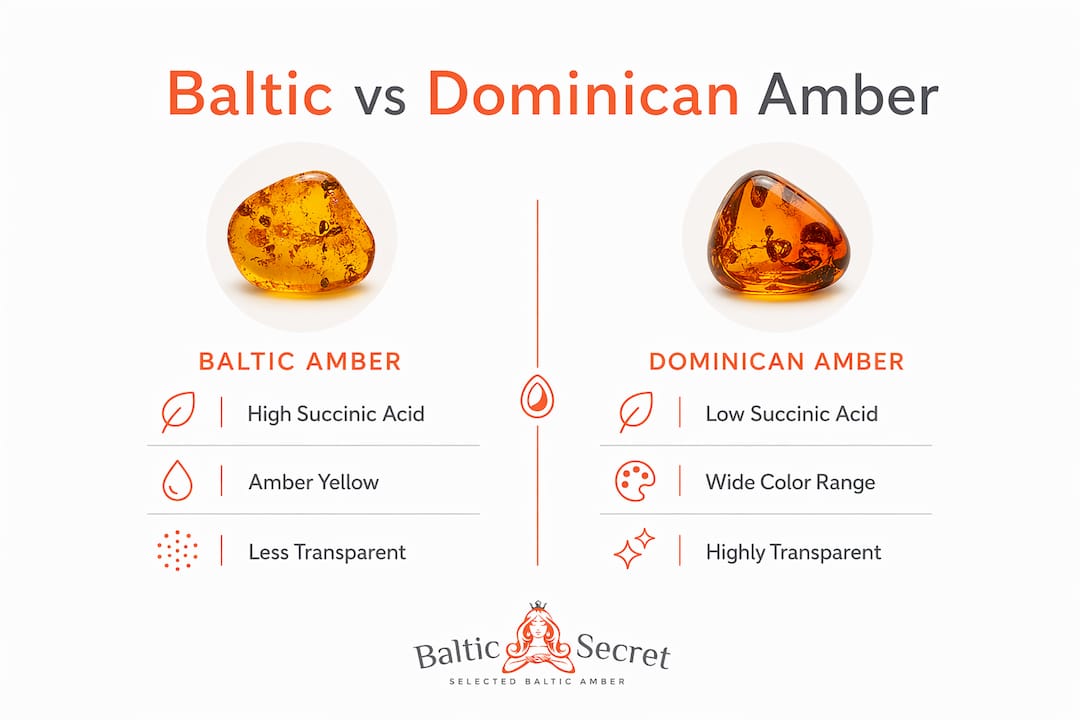
Color is the first thing most buyers notice, and the two ambers tell very different visual stories. Baltic amber typically ranges from pale yellow and honey orange to deep cognac and brown, with many pieces showing a cloudy or semi-opaque quality caused by microscopic air bubbles trapped in the resin. Dominican amber, by contrast, tends toward greater clarity and transparency, appearing almost glass-like in many specimens.
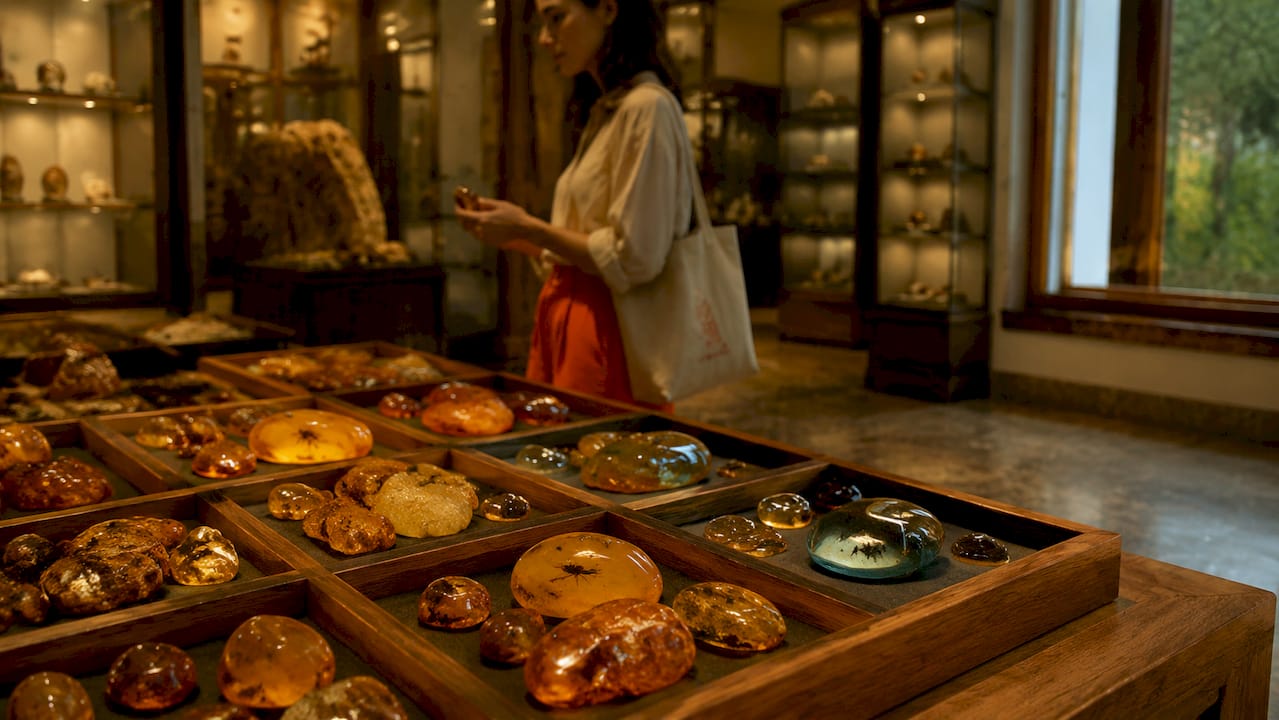
The most striking difference in the amber differences comparison is color range. Blue and green hues exist in Dominican amber but are entirely absent from natural Baltic amber. These rare colors come from fluorescent polycyclic aromatic hydrocarbons embedded in the resin. Under UV light, blue Dominican amber produces an intense electric blue glow that has no equivalent in Baltic material.
Here is a quick breakdown of typical visual traits:
- Baltic amber: Yellow, orange, cognac, brown, and occasionally green (treated); often cloudy or semi-opaque; matte surface common in raw form
- Dominican amber: Colorless, yellow, orange, red, and uniquely blue or green; nearly always transparent; high natural luster
Pro Tip: Never rely on color alone to confirm amber origin. Modern treatments can alter color and clarity in both types, so color is only an initial clue and chemical analysis is needed for conclusive identification.
Dominican amber’s transparency also makes it easier to spot internal features, which brings us to one of its most celebrated qualities.
What fossil inclusions are found in each amber, and why does it matter?
Inclusions are organisms or materials trapped inside amber as the resin hardened millions of years ago. They are one of the most important factors in amber’s scientific value and collector appeal, and the two types differ significantly here.
Dominican amber is nearly always transparent and contains a higher number of exquisitely preserved fossil insect inclusions than Baltic amber. The clarity of Dominican material allows researchers and collectors to examine delicate structures like antennae, wing venation, and leg hairs in extraordinary detail. These specimens have enabled scientists to reconstruct tropical ecosystems from tens of millions of years ago.
Baltic amber inclusions are also scientifically significant, but the profile differs. Baltic amber inclusions frequently include plant debris, air bubbles, and marine microfossils, alongside insects. The organisms captured in Baltic amber reflect a temperate forest environment rather than a tropical one, so the species found in each type rarely overlap.
What this means for buyers:
- Dominican amber with a well-preserved insect inclusion commands a significant price premium over plain Dominican pieces
- Baltic amber inclusions are common but often less visually dramatic due to the resin’s opacity
- Dominican amber’s superior inclusion preservation gives it both aesthetic and scientific value, making it highly prized among collectors
Pro Tip: Fake inclusions are a real problem in the amber market. Insects inserted into reconstituted or synthetic amber often look too perfect, with no distortion around the body. Genuine inclusions typically show slight compression or resin flow marks around the organism.
For jewelry buyers focused on wellness rather than collecting, inclusions matter less than chemical composition, which is where the real functional differences lie.
How do the chemical properties distinguish Baltic from Dominican amber?
Chemistry is where Baltic versus Dominican amber diverge most definitively, and it is the only reliable way to confirm which type you actually have.
Baltic amber contains high concentrations of succinic acid, a compound that gives it the alternative name succinite. This acid is responsible for the amber healing properties and skin-contact benefits that Baltic amber is traditionally associated with. Dominican amber contains weak or negligible succinic acid compared to Baltic material, which is a critical distinction for anyone buying amber specifically for wellness purposes.
The scientific tool used to measure this difference is Fourier Transform Infrared Spectroscopy, known as FTIR. It produces a chemical fingerprint of the resin.
| Property | Baltic amber | Dominican amber |
|---|---|---|
| Succinic acid (FTIR ~1240 cm⁻¹) | Strong, defining band | Weak or absent |
| Fluorescence under UV | Pale blue or green glow | Intense electric blue (blue variety) |
| Transparency | Often cloudy to semi-opaque | Nearly always transparent |
| Prominent FTIR bands | ~1240 cm⁻¹ succinite shoulder | ~890 cm⁻¹, ~1640 cm⁻¹, ~3080 cm⁻¹ |
| Age | ~44 million years | ~15 to 40 million years |
The FTIR difference at the ~1240 cm⁻¹ band is the single most reliable chemical marker for distinguishing Baltic amber from Dominican amber. No home test replicates this.
Common home tests like the saltwater float test have real limitations. Both Baltic and Dominican amber float in saturated saltwater, so this test cannot tell them apart. It also cannot exclude all fakes, since some counterfeit plastics are manufactured to match amber’s specific gravity. The touch test, which checks whether amber feels warm rather than cold like glass, is similarly unreliable for origin identification. These tests are useful for spotting obvious fakes but are not substitutes for laboratory analysis.
What are the differences in hardness, durability, and price?
Both amber types are soft gemstones, but their practical durability and cost profiles differ in ways that matter for everyday wear.
Both ambers score between Mohs 2 and 2.5 on the hardness scale, placing them among the softest materials used in jewelry. For context, a fingernail scores about 2.5, so both types scratch easily. Baltic amber tends to be slightly more brittle due to its greater age, while Dominican amber may feel marginally tougher, though neither type is suitable for rough daily wear without protective settings.
Care guidelines that apply to both:
- Store separately from harder gemstones to prevent surface scratching
- Avoid prolonged exposure to direct sunlight, which can cause color fading and surface cracking
- Clean with a soft, damp cloth only. Never use ultrasonic cleaners, steam, or chemical solvents
- Remove amber jewelry before swimming, bathing, or applying perfume or hairspray
Pricing tells a very different story between the two types. Baltic amber is generally more affordable and abundant, making it the accessible choice for everyday jewelry, children’s accessories, and pet products. Dominican amber commands higher prices overall, and blue Dominican amber sits at the premium end of the market due to its rarity and the intense demand from collectors and gemstone enthusiasts. A simple Baltic amber bead necklace may cost a fraction of what a comparable piece in blue Dominican amber would fetch, even when the craftsmanship is equivalent.
For buyers focused on amber jewelry safety and daily wearability, Baltic amber’s combination of affordability, succinic acid content, and wide availability makes it the practical choice. Dominican amber appeals most strongly to collectors, gemstone investors, and buyers drawn to its unique visual properties.
How can buyers verify authenticity and choose confidently?
Buying authentic amber requires more than trusting a seller’s word, particularly as the market contains significant quantities of reconstituted amber, copal (young resin that is not fully fossilized), and synthetic imitations.
Follow these steps to protect your purchase:
- Request FTIR documentation. For Baltic amber, ask for a report confirming the succinic acid marker band at approximately 1240 cm⁻¹. This is the most reliable verification method available.
- Buy from certified sources. Sellers who source directly from Lithuania or the Dominican Republic and provide certificates of authenticity are far less likely to sell fakes. Balticsecret, for example, sources directly from Lithuania and guarantees authenticity.
- Examine inclusions critically. Genuine inclusions show natural distortion and resin flow. Suspiciously perfect insects centered in clear resin are a warning sign.
- Understand the limits of home tests. The saltwater float test and touch test can rule out obvious plastic fakes but cannot reliably differentiate origins or exclude all counterfeits.
- Ask about treatments. Modern treatments to enhance color or clarity are common. Gemmological techniques like FTIR and GC-MS are necessary for confident origin verification when treatments are suspected.
Pro Tip: Copal is the most common fake sold as amber. It is young resin, sometimes only thousands of years old, and it lacks the chemical stability of true amber. A drop of acetone on an inconspicuous spot will dissolve copal’s surface but leave genuine amber unaffected.
The most common misidentification in the market is copal sold as Dominican amber. Because copal can also be transparent and contain insect inclusions, it visually mimics Dominican amber convincingly. Only chemical testing draws a clear line.
Key takeaways
Baltic amber and Dominican amber serve different buyers: Baltic amber delivers succinic acid content and affordability for wellness and everyday jewelry, while Dominican amber offers unmatched visual rarity and inclusion quality for collectors and premium buyers.
| Point | Details |
|---|---|
| Chemical identity | Baltic amber contains high succinic acid; Dominican amber has weak or no succinic acid content. |
| Color and clarity | Dominican amber includes unique blue and green hues; Baltic amber ranges from yellow to brown and is often cloudy. |
| Inclusion quality | Dominican amber preserves tropical insect inclusions in exceptional detail; Baltic amber inclusions include plant debris and air bubbles. |
| Price and availability | Baltic amber is affordable and widely available; blue Dominican amber commands premium prices due to rarity. |
| Verification method | FTIR spectroscopy targeting the ~1240 cm⁻¹ succinic acid band is the only reliable way to confirm Baltic amber origin. |
Why I always recommend starting with Baltic amber
After years of working closely with amber products and the buyers who love them, I have a clear opinion: for most people entering the amber market, Baltic amber is the smarter starting point. The succinic acid content is real, the price is accessible, and the supply chain from Lithuania is well-established and traceable. When a buyer at Balticsecret asks me which type to choose for a teething necklace, a pet collar, or a first piece of amber jewelry, Baltic amber wins on every practical measure.
Dominican amber is genuinely extraordinary, particularly the blue variety. But the premium price, the flood of copal imitations in the market, and the difficulty of verification without lab equipment make it a riskier purchase for anyone who is not already an experienced collector. I have seen buyers pay collector prices for what turned out to be copal with a trapped insect. That experience is avoidable with the right knowledge.
My honest recommendation: if you want amber for its Baltic amber properties and therapeutic tradition, buy Baltic and buy from a certified source. If you want Dominican amber for its visual drama and rarity, invest in FTIR documentation before you spend serious money. Both ambers are worth appreciating. Neither one forgives a careless purchase.
— Baltic Secret
Explore authentic Baltic amber from Baltic Ssecret
Baltic Secret sources every piece of amber directly from Lithuania, with authenticity guaranteed and no middlemen. The collection covers Baltic amber jewelry for children, adults, and pets, from polished bead necklaces and bracelets to natural amber collars for dogs and cats. Every product is crafted from genuine Baltic amber with the succinic acid content that makes it the trusted choice for wellness-focused buyers. If you are comparing amber types and want the confidence of a certified source with transparent provenance, Baltic Secret is the place to start. Browse the full range and find pieces designed for daily wear, safety, and lasting quality.
You can also explore a beautifully crafted Baltic Sea amber necklace paired with sunstone and moonstone from Mindful Botany Market for a gemstone combination that highlights amber’s natural warmth alongside complementary stones.
FAQ
What is the main difference between Baltic and Dominican amber?
Baltic amber contains high concentrations of succinic acid, confirmed by a strong FTIR band at approximately 1240 cm⁻¹, while Dominican amber has weak or negligible succinic acid. Dominican amber is also nearly always transparent and can display unique blue and green colors not found in Baltic material.
Which amber is better for wellness and healing properties?
Baltic amber is the preferred choice for amber healing properties because of its high succinic acid content, which is the compound associated with its traditional therapeutic use. Dominican amber lacks this chemical marker, making it less relevant for wellness applications.
How can I tell if my amber is real?
The saltwater float test and touch test can identify obvious plastic fakes but cannot confirm origin or rule out copal imitations. The most reliable method is requesting an FTIR spectroscopy report, which identifies the chemical fingerprint specific to Baltic or Dominican amber.
Is Dominican blue amber natural?
Yes. Blue Dominican amber gets its color from fluorescent polycyclic aromatic hydrocarbons naturally present in the resin. It produces an intense electric blue glow under UV light. No treatment creates this effect, which is why genuine blue Dominican amber commands such high prices.
Which amber type is more affordable for jewelry buyers?
Baltic amber is generally more affordable and widely available, making it the practical choice for everyday jewelry, children’s accessories, and pet products. Dominican amber, especially blue varieties, sits at the premium end of the market due to scarcity and collector demand.