Amber Bracelet vs Necklace for Toddlers: Safety Guide

Amber bracelets are safer than necklaces for toddlers, but neither is proven effective for teething relief, and both carry real physical hazards. The American Academy of Pediatrics (AAP) recommends against any jewelry worn around an infant’s neck, and the U.S. Food and Drug Administration (FDA) issued a formal warning after an 18-month-old was strangled to death by an amber necklace during a nap. No clinical study has demonstrated that amber jewelry reduces teething pain.
Here is how the two forms compare at a glance:
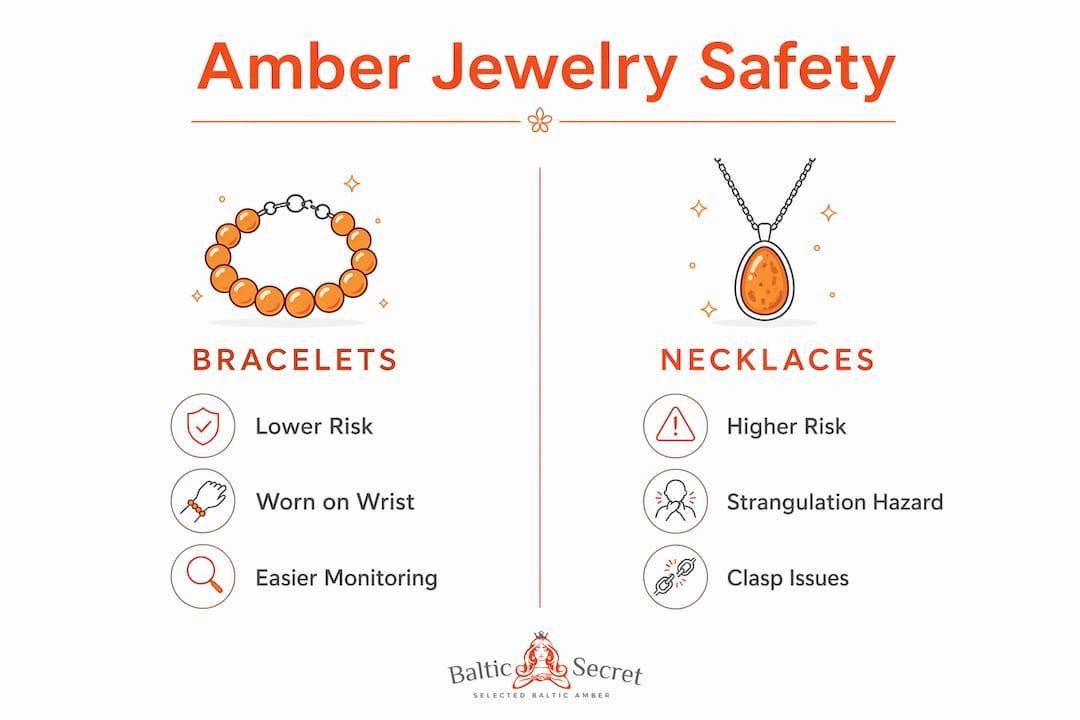
- Strangulation risk: Necklaces sit directly at the throat, where a loop can tighten in seconds. Bracelets worn on the wrist or ankle remove that specific danger, though they introduce tourniquet risk if sized too snugly.
- Choking risk: Both forms share it equally. A bead that breaks free is a choking hazard regardless of where the jewelry was worn.
- Supervision requirement: The AAP advises removing amber jewelry during every nap and overnight sleep, and never leaving a child unattended while wearing it, whether bracelet or necklace.
- Effectiveness: No scientific evidence supports the claim that amber relieves teething pain in either form.
Pro Tip: If you choose to let your toddler wear amber jewelry at all, place a bracelet on the ankle rather than the wrist. An ankle bracelet is harder for the child to pull off and chew on, and it keeps the beads farther from the airway.
What actually works for toddler teething relief
The safest teething remedies are the ones pediatricians have recommended for decades, and they cost far less than amber jewelry. Cold is the most effective tool you have. A chilled (not frozen) silicone teething ring numbs inflamed gum tissue directly, with zero choking risk when sized correctly for the child’s age. Frozen items are too hard and can bruise tender gums, so keep the ring in the refrigerator rather than the freezer.

Gentle gum massage with a clean finger is another option that works well for younger toddlers. The counter-pressure on erupting teeth provides the same kind of relief that chewing does, without introducing any object that could break apart. The AAP recommends cold teething rings and gum massage as first-line approaches before any pharmacological option.
When discomfort is severe, age-appropriate doses of acetaminophen (Tylenol) or ibuprofen (for children over six months) are clinically validated options. Texas Children’s Hospital lists these alongside chew toys and gum massage as the four remedies the AAP endorses. Topical benzocaine gels marketed for teething, such as Orajel Baby, carry their own FDA warnings for children under two and should be avoided.
Wet, chilled washcloths are a practical middle ground many parents overlook. A clean cloth dampened with cold water and tied loosely at one end gives a toddler something to chew on that is soft, cold, and poses no bead-scatter risk. It also costs nothing.
What the safety data actually says about amber jewelry for toddlers
The risks tied to amber jewelry for toddlers are not theoretical. Documented adverse events include strangulation, choking on detached beads, and contact dermatitis. A survey of Canadian pediatricians identified 10 adverse events related to teething necklaces and bracelets in a single 12-month period, including strangulation, choking, and swallowing a clasp magnet, with several cases resulting in hospitalization.
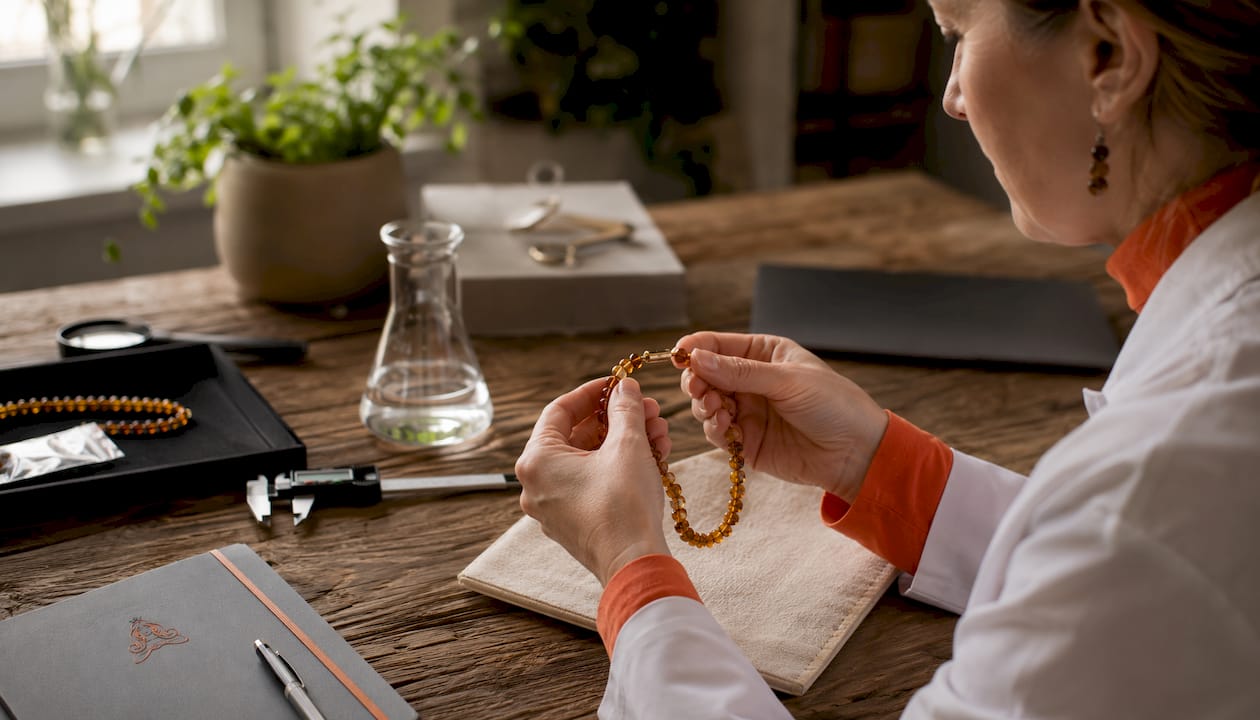
The clasp mechanics are a specific problem. Research testing amber necklaces against the American Society for Testing and Materials (ASTM) Standard Specification for Consumer Product Safety for Children’s Jewelry found that 8 out of 10 necklaces required a mean force of 1.6 pounds to open the clasp, and 8 out of 15 required more than 15 pounds of force. A small child cannot generate that release force, which means a tightening necklace will not break free before it restricts the airway.
Suffocation is a leading cause of death for young children, including infants and toddlers, according to the AAP. Amber necklaces sit in exactly the category of objects that drive that statistic.
The FDA reinforced this in its December 2018 warning, citing the death of an 18-month-old from strangulation and reports of choking on detached beads. The agency’s position has not changed since.
The succinic acid claim does not hold up
The core marketing argument for amber teething jewelry is that body heat causes the beads to release succinic acid, which is then absorbed through the skin and acts as a natural analgesic. Every part of that chain fails under scrutiny.
Succinic acid release from Baltic amber requires heating the resin to approximately 392°F (200°C), far beyond what human skin ever reaches. Researchers who submerged intact amber beads in solutions mimicking skin conditions for 24 weeks detected no measurable succinic acid release. The only beads that released any succinic acid were light-colored ones that physically fragmented during the experiment, which introduces a choking hazard rather than a benefit.
Even if succinic acid were somehow absorbed, the same research found it produced no consistent reduction in inflammatory markers in human macrophage cells. At high concentrations, it actually increased one inflammatory cytokine (IL-1β) rather than suppressing it. The therapeutic claim has no scientific foundation in either direction.
| Risk factor | Amber necklace | Amber bracelet |
|---|---|---|
| Strangulation | High (worn at throat) | Low (worn at wrist or ankle) |
| Choking on beads | Present if beads detach | Present if beads detach |
| Tourniquet effect | Low | Possible if too tight |
| Clasp release failure | Documented in ASTM testing | Less critical but still relevant |
| Proven teething benefit | None | None |
| AAP/FDA recommendation | Strongly against | Against; bracelet preferred if worn |
What 91% of pediatricians already know
In the Canadian pediatrician survey cited above, 91% of pediatricians aware of teething necklaces also recognized the associated choking and strangulation risks. Yet only a minority of pediatricians had been approached by families with questions about these products, suggesting most parents are making decisions without a conversation with their child’s doctor. If you are weighing amber jewelry for your toddler, that conversation is worth having before you buy.
How sizing and construction affect your toddler’s safety
Fit is the single most controllable safety variable in amber jewelry. A necklace that is too long can loop around a limb or catch on a crib rail; one that is too short creates constant pressure on the throat. A bracelet that is too tight restricts circulation; one that is too loose slides off easily and becomes a loose bead hazard on the floor.
For toddlers, a bracelet worn on the wrist should allow two fingers to slide underneath it comfortably. On the ankle, the same two-finger rule applies. Necklaces, if worn at all, should fit close to the base of the neck without slack, and should be removed before any sleep period, supervised or not.
What to look for in amber jewelry construction
The construction of the strand matters as much as the size. Individually knotted beads reduce scatter if the strand breaks, because each bead is contained between two knots rather than all beads flying loose at once. That said, individually knotted construction does not eliminate strangulation risk for necklaces.
- Individual knots between every bead: Limits scatter to one or two beads if the strand snaps, rather than a full necklace worth of loose pieces.
- Safety release clasp: Designed to open under pressure, though ASTM testing has shown many clasps on the market do not release at safe force levels. Verify the clasp opens easily with your own hands before putting it on a child.
- Genuine Baltic amber certification: Synthetic beads or resin imitations may trigger allergic reactions and offer none of the claimed properties even in theory. Look for certification from the supplier.
- Smooth, polished beads: Raw or rough-cut beads can irritate sensitive toddler skin, especially at the neck or wrist where friction occurs during movement.
- Appropriate bead size: Beads small enough to pass through a standard choke-tube test (a cylinder with a 1.25-inch diameter) are classified as a choking hazard under U.S. Consumer Product Safety Commission guidelines for children under three.
- No metal components near skin: Metal clasps or spacers can cause contact dermatitis in children with nickel sensitivity.
Baltic Secret’s extra-safe amber jewelry for children uses individually knotted genuine Baltic amber beads with a safety release clasp, sourced directly from Lithuania. If you decide amber jewelry is right for your family, construction details like these are the minimum standard to look for.
Bracelets vs necklaces: practical wearability
Bracelets and anklets are easier to monitor visually than necklaces. You can see a bracelet at a glance during play; a necklace can shift under clothing or twist without you noticing. Toddlers also tend to pull at necklaces more than bracelets, which increases both the strangulation risk and the chance of snapping the strand.
Comfort differences are real too. A necklace rests against the chest and neck during crawling, rolling, and active play, creating friction points. A wrist bracelet moves with the arm and tends to bother children less during physical activity. An ankle bracelet is often the least intrusive option of all, since toddlers pay less attention to their feet than their hands.
Key Takeaways
Amber bracelets carry lower strangulation risk than necklaces, but no form of amber jewelry has proven teething benefits, and both the AAP and FDA advise against their use for toddlers.
| Point | Details |
|---|---|
| Bracelets are safer than necklaces | Bracelets worn on the wrist or ankle avoid the throat, reducing strangulation risk significantly. |
| No proven teething benefit | Succinic acid cannot be released from intact amber beads at body temperature, making analgesic claims unsupported. |
| Documented adverse events | Pediatricians identified 10 adverse events in one year, including strangulation and choking requiring hospitalization. |
| AAP and FDA both advise against use | Both organizations warn that suffocation is a leading cause of death in children under four, and amber jewelry contributes to that risk. |
| Construction details matter | Individually knotted beads and a tested safety release clasp are the minimum features to require if amber jewelry is worn. |
Baltic Secret crafts every piece of children’s amber jewelry from certified genuine Baltic amber sourced directly from Lithuania, with individually knotted beads and safety release clasps built to the highest construction standards available. If you have decided amber jewelry fits your family’s approach, browse the full children’s amber collection and choose with confidence that the craftsmanship behind each piece reflects real care for your child’s safety.
Recommended
- Choosing Amber Bracelet Toddler Size: A Parent’s Guide – Baltic Secret
- Infant Bracelet Size Guide: Measurements, Safety & Fit – Baltic Secret
- Teething Necklace Size Guide for Babies: Stay Safe – Baltic Secret
- Best Amber Teething Necklace for Babies — What Parents Need to Know | Balticsecret – Baltic Secret